Expert Guide to Choosing a Large Black Bead Necklace: Materials & Fit
Discover the technical details behind a large black bead necklace. Compare onyx, obsidian, and spinel, plus stringing mechanics and weight distribution.

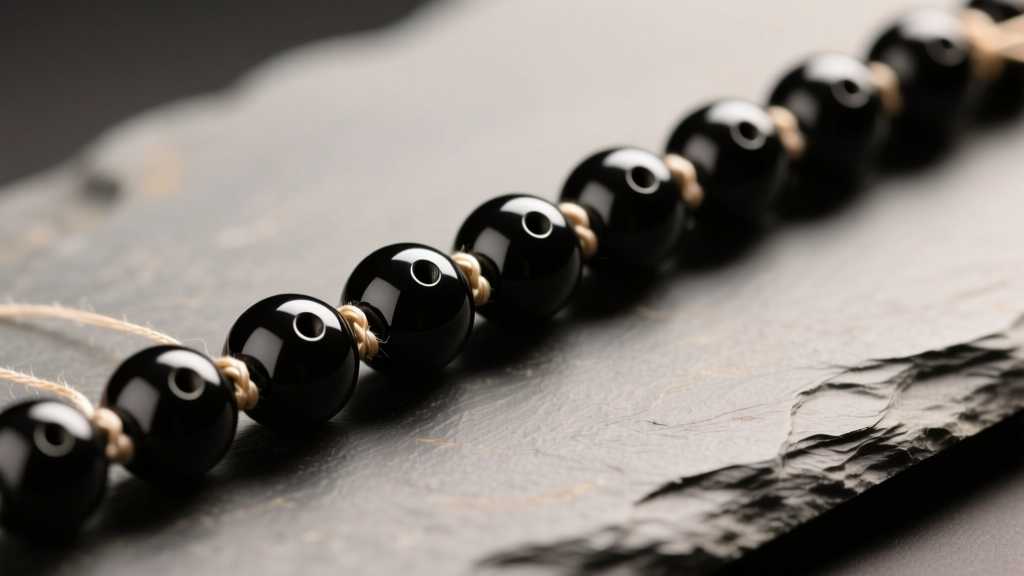
The Physics and Aesthetics of Large-Format Black Beads
When designing or purchasing a large black bead necklace, the conversation often stops at aesthetics. However, for beads exceeding 12mm in diameter—particularly in the 16mm to 20mm range—structural engineering and material science become paramount. A 16-inch necklace composed of 18mm solid stone beads can easily exceed 180 grams, introducing significant dynamic load, tensile stress on the stringing medium, and ergonomic challenges regarding the necklace's center of gravity.
This expert deep dive bypasses generic styling advice to examine the metallurgical, gemological, and mechanical realities of large-format black bead necklaces. Whether you are sourcing natural schorl, dyed chalcedony, or synthetic alternatives, understanding these technical parameters is the difference between a lifelong heirloom and a catastrophic stringing failure.
Material Science: Natural vs. Treated Black Gemstones
The market for black beads is flooded with misidentified materials. True, naturally occurring black gemstones possess distinct crystalline structures that dictate their durability, specifically their cleavage planes and fracture mechanics. According to the Gemological Institute of America (GIA), identifying the exact mineral species is critical for predicting how the bead will withstand daily wear and tear.
Black Onyx (Chalcedony) vs. Obsidian
Black onyx is a banded chalcedony (quartz family) with a Mohs hardness of 6.5 to 7.0. It lacks true cleavage, meaning it resists splitting along internal planes. However, 95% of commercial 'black onyx' is actually gray agate treated with a sugar-acid carbonization process to achieve a uniform black hue. This treatment does not compromise structural integrity but makes the material highly stable for large drill holes.
Obsidian, conversely, is a naturally occurring volcanic glass with a Mohs hardness of only 5.0 to 5.5. Its primary failure mode is conchoidal fracture. When subjected to point-load stress (such as a bead striking a hard surface), obsidian chips in smooth, curved shell-like patterns. In a large black bead necklace, the drill holes are the most vulnerable points. Poorly reamed obsidian beads will develop micro-fractures around the stringing channel, eventually leading to catastrophic bead splitting.
Black Tourmaline (Schorl) and Melanite Garnet
Schorl is heavily striated and often riddled with internal inclusions and micro-fissures. While it boasts a Mohs hardness of 7.0 to 7.5, its specific gravity (3.05) makes it significantly heavier than quartz. A large black bead necklace made of 16mm schorl will feel noticeably heavier than one made of onyx, requiring upgraded stringing hardware. Melanite (black andradite garnet) offers exceptional brilliance and a hardness of 6.5 to 7.5, but large, flawless melanite beads are exceptionally rare and command premium pricing.
| Material | Mohs Hardness | Specific Gravity | Avg. Price (16" Strand) | Drill-Hole Chipping Risk |
|---|---|---|---|---|
| Black Onyx (Treated Agate) | 6.5 - 7.0 | 2.60 | $45 - $85 | Low |
| Volcanic Obsidian | 5.0 - 5.5 | 2.40 | $25 - $50 | High (Conchoidal) |
| Black Tourmaline (Schorl) | 7.0 - 7.5 | 3.05 | $90 - $160 | Medium (Inclusions) |
| Dyed Howlite | 3.5 | 2.55 | $15 - $25 | Medium (Softness) |
Structural Integrity: Stringing Mechanics for Heavy Loads
The most common failure point in a large black bead necklace is not the clasp, but the interaction between the stringing medium and the interior of the bead's drill hole. Large beads possess higher mass; when the necklace swings, the kinetic energy generates severe sheer stress against the stringing wire or cord at the exact point where it enters the stone.
Wire vs. Cord: Tensile and Abrasion Resistance
For beads 14mm and larger, standard nylon beading thread is entirely insufficient. You must choose between multi-strand stainless steel beading wire or high-denier synthetic cords. According to Fire Mountain Gems' stringing material guidelines, a 49-strand micro-wire with a diameter of 0.024 inches offers a tensile strength of up to 40 pounds. However, steel wire is vulnerable to 'kinking' and metal fatigue if bent sharply.
If utilizing steel wire, the drill holes of the black beads must be laser-drilled or mechanically reamed to a perfectly smooth, cylindrical finish. Cheap, mass-produced beads feature conical, jagged drill holes that act like microscopic saws against steel wire, severing it within months. Alternatively, Size G (0.8mm) braided silk or synthetic S-lon cord provides excellent drape and knotability, but requires French wire (gimp) at the clasp connection to prevent friction wear.
The Necessity of Micro-Spacers
When large stone beads rest directly against one another, the friction caused by normal body movement acts as a lapidary grinding wheel. Over time, this kinetic wear will flatten the sides of the beads, ruining their polish and geometry. Integrating 1mm to 2mm TPU (thermoplastic polyurethane) or vulcanized rubber micro-spacers between each large black bead absorbs this lateral friction, preserving the stone and adding a subtle, modern textural contrast to the necklace.
Weight Distribution and Ergonomic Drape
A uniform strand of 18mm beads suffers from a severe ergonomic flaw: the fulcrum effect. Because the beads at the back of the neck are the same mass as those at the front, the necklace tends to ride up the cervical spine, choking the wearer and causing the heavy center drape to pull awkwardly against the sternum.
The Graduated Solution
To solve this, expert jewelers utilize a graduated bead profile. By placing the largest beads (e.g., 18mm-20mm) at the center front and systematically tapering down to 10mm or 12mm beads near the clasp, you manipulate the center of gravity. This ensures the necklace anchors comfortably on the collarbone, preventing the back clasp from sliding forward and reducing neck strain by up to 30%.

Hardware and Clasp Failure Modes
Magnetic clasps and standard spring-ring clasps are structural liabilities for large black bead necklaces. Magnetic clasps frequently fail under dynamic load—a sudden jerk or swing will overcome the magnetic flux, dropping the necklace. Spring rings lack the internal spring tension to securely hold the thick jump rings required for heavy wire.
Recommended Hardware:
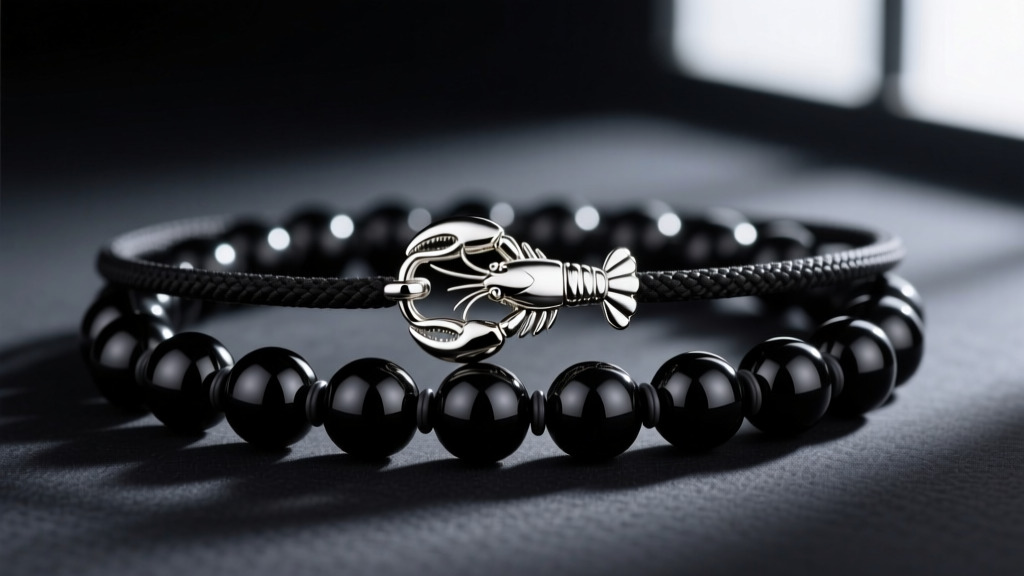
- Heavy-Duty Lobster Claws: Minimum 15mm length, cast in solid sterling silver or stainless steel (avoid plated base metals which will snap at the lever joint).
- Box Clasps with Safety Figures-Eight: Ideal for multi-strand large bead designs, providing a mechanical locking mechanism that supplements the primary friction fit.
- Oversized Soldered Jump Rings: Any jump ring connecting the clasp to the wire must be soldered closed or utilize a heavy-gauge split ring. A standard open jump ring will pull apart under the sheer weight of 18mm stone beads.
Maintenance and Troubleshooting
Even the highest quality large black bead necklace requires specific maintenance. Black onyx and treated agates are porous to certain chemicals; exposure to chlorinated pool water or harsh ultrasonic cleaners can cause the black dye to leach, resulting in a mottled, grayish appearance. Always clean large black stone beads with a damp microfiber cloth and a mild, pH-neutral soap.
Inspect the stringing medium every six months. Gently flex the necklace and examine the wire or cord where it exits the drill holes of the three center-front beads. If you observe fraying on silk, or micro-kinks on steel wire, immediate restringing is mandatory to prevent catastrophic loss of the gemstones.