Large Cross Pendant Necklace: A Technical Guide to Bails and Chains
Master the mechanics of a large cross pendant necklace. Explore bail sizing, chain tensile strength, metal grades, and center-of-gravity styling.


The Physics of Proportion: Weight and Center of Gravity
When designing or purchasing a large cross pendant necklace, aesthetics are only half the equation; the other half is structural engineering. A standard jewelry pendant typically weighs between 3 and 6 grams. However, a truly 'large' cross pendant—often measuring over 50mm in height and 35mm in width—can easily weigh between 20 and 45 grams, depending on the metal density and whether it is cast solid or hollow-formed.
This massive weight discrepancy introduces a significant center-of-gravity challenge. A 30-gram pendant acts as a pendulum, creating a fulcrum effect at the nape of the neck. If the chain is too light or the clasp is weak, the pendant will constantly pull the chain forward, causing the clasp to migrate to the front of the collarbone and the chain links to stretch under the dynamic load. Understanding the tensile limits of your materials is not just pedantic; it is essential for the longevity of the piece.
Bail Engineering: The Critical Connection Point
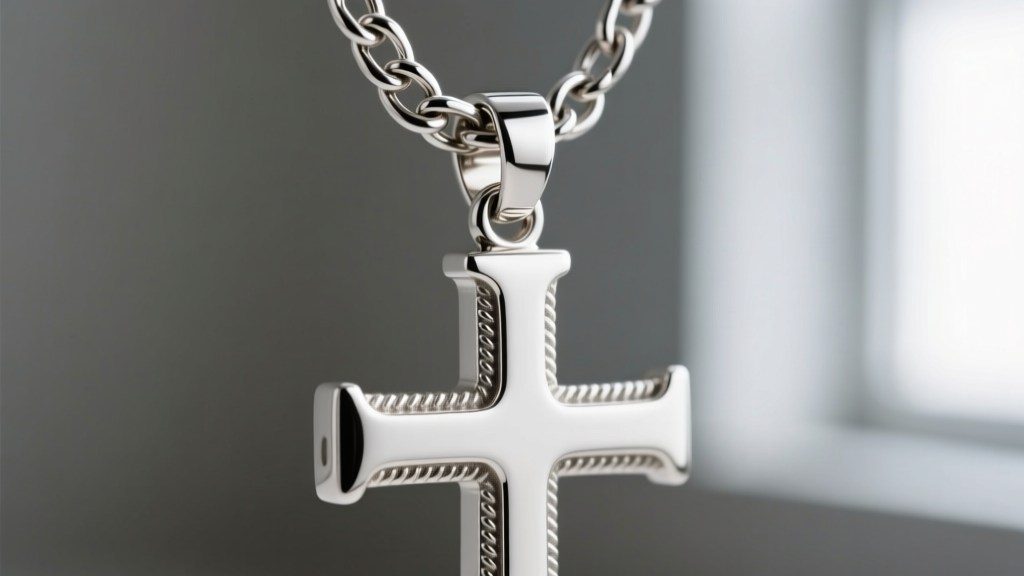
The bail—the loop that connects the pendant to the chain—is the single most common point of catastrophic failure in heavy jewelry. According to manufacturing standards outlined by suppliers like Rio Grande, the inner diameter (ID) of the bail must be precisely calibrated to the outer width of the chain.
If you force a 5mm chain through a bail with a 5.5mm ID, the lack of articulation will cause severe friction. Every time the wearer moves, the chain links will grind against the interior of the bail, eventually acting like a jeweler's saw and cutting through the metal. For a heavy large cross pendant necklace, you must maintain a minimum clearance of 1.5mm to 2mm between the chain width and the bail ID.
Standard Bail Dimensions for Heavy Pendants
Hidden bails (which slide into a hollow tube at the top of the cross) are aesthetically pleasing but structurally risky for pendants exceeding 25 grams. The adhesive or friction-fit pins used in hidden bails frequently fail under dynamic torque. Instead, opt for a soldered, heavy-duty V-bail or a reinforced double-loop bail. These distribute the kinetic energy across a wider surface area of the pendant's top arm.
| Chain Width | Recommended Bail ID | Maximum Pendant Weight | Ideal Bail Type |
|---|---|---|---|
| 3.0 mm | 4.5 mm - 5.0 mm | Up to 15g | Standard Soldered Loop |
| 4.0 mm | 5.5 mm - 6.5 mm | Up to 25g | Heavy V-Bail |
| 5.5 mm | 7.0 mm - 8.5 mm | Up to 40g | Reinforced Double-Loop |
| 7.0 mm+ | 9.0 mm+ | 45g+ | Custom Cast Integral Bail |
Metallurgy and Material Grades for Oversized Crosses
The choice of metal dictates not only the visual warmth of the large cross pendant necklace but also its structural integrity and overall weight. The Gemological Institute of America (GIA) and global metallurgical standards provide clear guidelines on alloy hardness, measured in Vickers Hardness (HV).
- 18k Yellow Gold (75% Au): With a Vickers hardness of roughly 120 HV, 18k gold is dense and heavy, giving the cross a premium, substantial drape. However, its relative softness means that thin bail loops will slowly stretch and deform under the weight of a 30g+ pendant over several years of daily wear.
- 14k Yellow or White Gold (58.5% Au): Alloyed with higher proportions of copper, zinc, or nickel, 14k gold achieves a hardness of approximately 135-145 HV. This is the optimal precious metal for heavy pendants, offering a superior strength-to-weight ratio and high resistance to bail deformation.
- 316L Stainless Steel: Boasting a massive 220+ HV rating, 316L steel is virtually impervious to bending or scratching. The trade-off is density; a solid steel cross will be significantly heavier than its gold counterpart, requiring an industrial-grade chain to support the load without causing cervical fatigue.
- Argentium Sterling Silver (93.5% Ag): Traditional 925 sterling silver is notoriously soft and prone to work-hardening and snapping. Argentium, which replaces some copper with germanium, offers higher tarnish resistance and slightly better structural memory, though it still requires a thick gauge (minimum 1.2mm wire thickness) for heavy pendants.
Chain Selection: Tensile Strength and Link Architecture
Pairing a massive cross pendant with a delicate cable chain is a recipe for immediate failure. Cable chains consist of uniform oval links that pull in a single linear direction. When subjected to the multi-directional torque of a swinging heavy pendant, the weak points at the soldered seams of the oval links will quickly pull apart.
Link Styles That Prevent Torque and Snapping
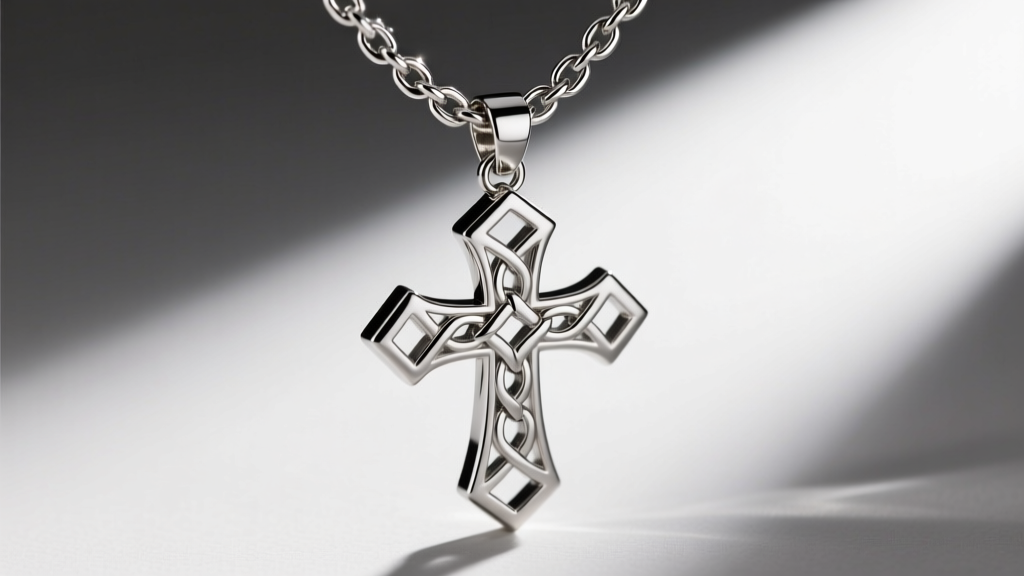
To properly support a large cross pendant necklace, you must select chains with interlocking or multi-axis link architectures. These designs distribute kinetic stress across multiple planes.
- Curb Chains: The flattened, interlocking links of a curb chain lay flush against the skin and offer exceptional tensile strength. A 4mm solid curb chain can easily support a 35-gram pendant without stretching.
- Rope Chains: Constructed from twisted, helical links, rope chains are incredibly resilient to snapping because the twisting motion absorbs shock. However, ensure the rope chain is 'solid' and not 'hollow-core,' as hollow-core ropes will crush and kink under heavy pendant weight.
- Figaro Chains: Featuring a pattern of three short links and one long link, the Figaro chain provides excellent structural redundancy. If one small link experiences stress, the adjacent long link helps distribute the load.
Troubleshooting Common Failure Modes
Even with the correct chain and metal, the hardware connecting the system can compromise the entire piece. Pay close attention to the clasp and the jump rings.
Expert Warning: Never use a standard spring-ring clasp for a pendant exceeding 15 grams. The internal tension spring in a spring-ring is rated for light loads; the persistent downward pull of a heavy cross will eventually fatigue the spring, causing the clasp to pop open unexpectedly. Always upgrade to a heavy-duty lobster clasp with a reinforced trigger mechanism.
Furthermore, the jump ring connecting the pendant bail to the chain (if applicable) must be soldered closed. An open, unsoldered jump ring will slowly twist apart under the pendulum motion of a large cross. If your pendant features a split jump ring, take it to a professional jeweler to have it laser-welded or soldered shut before wearing it.
Final Considerations on Length and Drape
The length of the chain fundamentally alters how the weight of the pendant is perceived and supported. A 16-inch choker length places the cross high on the sternum, minimizing the pendulum swing but increasing the localized pressure on the back of the neck. A 24-inch to 30-inch chain allows the heavy cross to rest lower on the torso, utilizing the chest wall to bear the weight and reducing cervical strain. For optimal comfort with a large cross pendant necklace over 30 grams, a 22-inch or 24-inch heavy curb or rope chain provides the best balance of structural support, visual proportion, and ergonomic weight distribution.


