The Anatomy of a Large Shell Pendant Necklace: Expert Guide
Master the technical specs of a large shell pendant necklace. We analyze shell density, bail mechanics, chain gauges, and structural failure points.

Material Science: Decoding Shell Varieties
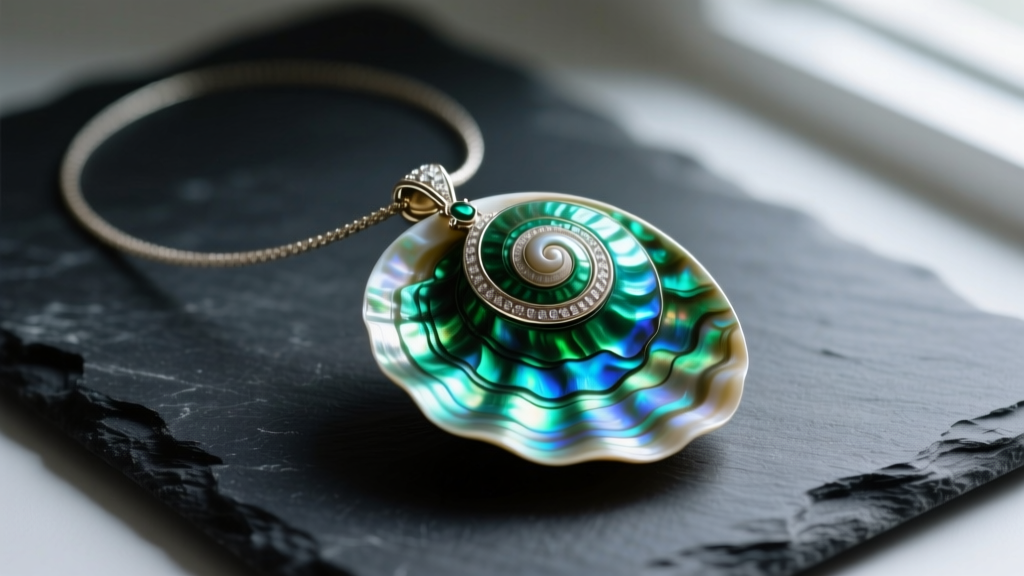
When evaluating a large shell pendant necklace, the lapidary foundation dictates both the aesthetic longevity and the structural integrity of the piece. Shells are biomineralized composites primarily consisting of calcium carbonate (in the form of aragonite or calcite) and an organic protein matrix called conchiolin. According to the GIA's organic gem materials database, the specific arrangement of these microscopic layers creates the iridescence known as orient, but it also introduces distinct cleavage planes that make large slices highly susceptible to delamination under physical stress.
Not all shells are created equal. The market is dominated by three primary variants, each requiring different handling techniques during the cutting and polishing phases. Pinctada maxima (South Sea Pearl oyster) yields thick, relatively flat sheets of white or gold mother-of-pearl. Haliotis (Abalone or Paua) provides intense, undulating iridescence but is notoriously brittle due to its highly irregular growth rings. Strombus gigas (Queen Conch) offers a unique cross-lamellar structure that manifests as a fiery pink porcelain-like finish, lacking nacre but boasting superior impact resistance.
Technical Comparison of Shell Materials
| Shell Variety | Mohs Hardness | Specific Gravity | Structural Vulnerability | Avg. Price (50mm Blank) |
|---|---|---|---|---|
| Pinctada Maxima | 2.5 - 3.0 | 2.70 | Edge chipping, acid etching | $15 - $35 |
| Haliotis (Paua) | 3.0 - 3.5 | 2.65 | Delamination, thermal shock | $25 - $60 |
| Strombus Gigas | 3.5 - 4.0 | 2.85 | UV fading, blunt force fracture | $40 - $90 |
Structural Engineering: Bails and Mountings
The most frequent point of catastrophic failure in a large shell pendant necklace is the bail connection. Because a 50mm to 70mm shell slice can weigh anywhere from 18 to 45 grams, the mounting hardware must withstand significant kinetic shear. Mass-produced pendants often rely on glue-on bails affixed with standard cyanoacrylate (super glue). This is a critical engineering flaw. Cyanoacrylate becomes brittle upon curing and lacks the flexibility to absorb the micro-vibrations and thermal expansion differentials between the metal bail and the organic shell. Over time, the adhesive bond shears, resulting in a lost pendant.
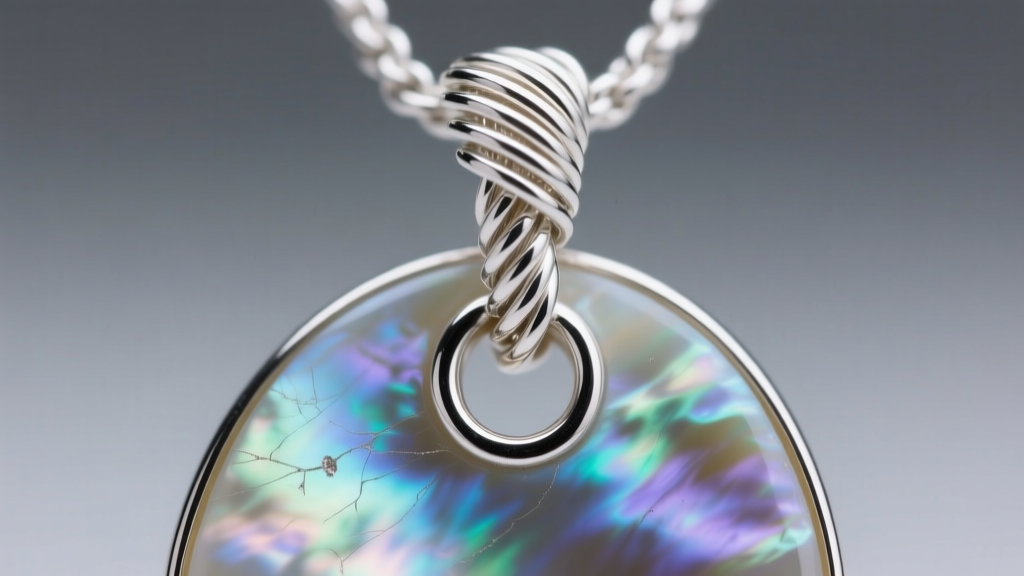
For high-end structural integrity, jewelers employ either mechanical wire-wrapping or precision-drilled holes with reinforced jump rings. When drilling, a diamond-core micro-bit must be used with continuous water lubrication to prevent thermal fracturing of the aragonite crystals. The hole should be positioned at least 4mm from the edge of the shell to prevent blowout. Wire wrapping, utilizing 20-gauge or 18-gauge dead-soft argentium silver, provides a custom-tensioned basket that distributes the pendant's weight across a broader surface area, entirely eliminating the need for chemical adhesives.
Expert Insight: If a large shell pendant features a glue-on bail, inspect the adhesive line. A yellowing or crystalline edge indicates cheap cyanoacrylate. A dark, slightly flexible seam suggests the use of a two-part jeweler's epoxy, which offers vastly superior shear strength and longevity.
Chain Mechanics: Weight Ratios and Gauge Sizing
A large shell pendant necklace is only as secure as its weakest link—literally. Pairing a 40-gram Paua shell with a standard 0.9mm cable chain is a recipe for immediate tensile failure. The chain must be rated to withstand at least four times the static weight of the pendant to account for the kinetic force generated when the wearer turns their head or the pendant swings.
For pendants weighing between 20 and 50 grams, a minimum chain gauge of 2.0mm is required. Wheat chains and rope chains are highly recommended due to their interlocking link structures, which distribute tension multidirectionally rather than relying on single-axis solder points. Furthermore, the clasp must be proportionate. A standard 5mm spring ring is insufficient; opt for a 12mm to 15mm solid-cast lobster clasp with a heavy-duty steel internal spring mechanism to prevent accidental unspooling.
Galvanic Corrosion Risks
When pairing chains and bails, material compatibility is paramount. If a sterling silver bail is connected to a base-metal alloy chain via a copper jump ring, exposure to ambient humidity and skin oils creates a galvanic cell. This electrochemical reaction accelerates oxidation, resulting in severe localized corrosion that can snap the jump ring within months. Always ensure the bail, jump rings, and chain share the same metallurgical baseline—preferably surgical-grade stainless steel, solid 14k gold, or argentium silver.
Chemical Vulnerabilities and Preservation
As noted in Encyclopedia Britannica's guide on mother-of-pearl, the calcium carbonate matrix is highly reactive to acidic environments. The modern wearer's daily routine presents a minefield of chemical hazards. Lactic acid from human sweat, citric acid in perfumes, and the alkaline compounds in hairsprays can slowly etch the polished surface of the shell, destroying the nacreous luster and leaving a chalky, opaque residue.
To preserve a large shell pendant necklace in 2026 and beyond, a strict operational protocol must be followed. The pendant must be the last item put on and the first item taken off. Ultrasonic cleaners are strictly forbidden; the high-frequency cavitation bubbles will aggressively strip the conchiolin layers, causing irreversible micro-fractures. Cleaning should be limited to a damp, lint-free microfiber cloth with a mild, pH-neutral soap solution, followed by immediate drying and storage in a humidity-controlled environment away from direct UV exposure, which degrades the organic protein matrix.
Expert Buying Framework
When procuring or commissioning a large shell pendant necklace, use this technical checklist to ensure you are acquiring a structurally sound piece:
- Thickness Verification: Ensure the shell slice is at least 3mm to 5mm thick at the bail point. Anything thinner risks snapping under the torque of a heavy chain.
- Epoxy Backing: High-quality large pendants often feature a thin layer of black or white epoxy resin on the back. This is not a defect; it is a stabilizing technique that prevents light leakage and adds crucial impact resistance to the brittle aragonite.
- Bail Clearance: The inner diameter of the bail must be at least 4mm to accommodate a 2.0mm+ chain without creating friction points that wear down the metal.
- Edge Finishing: Run a gloved finger along the perimeter. The edges should be smoothly beveled and sanded to at least 1200-grit to prevent micro-abrasions against the wearer's skin and clothing.
Understanding the intersection of marine biology and metallurgical engineering transforms the way we appreciate organic jewelry. A well-constructed large shell pendant necklace is not merely a bohemian accessory; it is a triumph of material science, capable of surviving decades of wear when the technical specifications are respected.


