The Anatomy of a Lariat Cross Necklace: Metals, Gauges & Fit
Master the technical details of the lariat cross necklace. Explore chain gauges, sliding hardware mechanics, and metal durability for optimal wear.


The lariat cross necklace—often referred to in manufacturing circles as a Y-drop or kinetic pendant—represents a unique intersection of symbolic adornment and mechanical jewelry design. Unlike fixed-pendant necklaces where the focal point is soldered or permanently attached to a stationary bail, a true lariat relies on gravity, friction, and kinetic movement to achieve its signature drape. This dynamic structure introduces specific engineering challenges that mass-market jewelry brands frequently overlook, resulting in premature chain kinking, bail wear, and structural failure.
As an expert in jewelry metallurgy and structural design, I approach the lariat cross necklace not merely as a fashion accessory, but as a micro-mechanical system. To select, design, or maintain a piece that will last decades rather than months, one must understand the precise interplay between chain gauge, tensile strength, sliding hardware geometry, and metal hardness. This deep dive strips away the marketing fluff to examine the exact technical specifications that define a master-crafted lariat cross necklace.
The Engineering of the Y-Drop: Chain Gauges and Tensile Strength
The foundation of any lariat is its chain, and the choice of chain style and gauge dictates the piece's structural integrity. A common failure mode in poorly engineered lariats is the use of box chains. While visually appealing, the sharp interior corners of box links act as micro-abrasives against the sliding bail. Over months of kinetic friction, this shaves away metal dust, eventually compromising the chain's structural links and causing the drop to snap.
Expert jewelers universally recommend a 1.0mm to 1.2mm cable or rolo chain for lariat designs. These rounded link profiles allow the sliding hardware to glide smoothly without catching or generating excessive friction. However, gauge thickness must be calibrated to the metal's specific tensile strength. According to manufacturing standards documented by the Ganoksin Project, a 1.0mm 14k gold cable chain possesses a tensile strength of roughly 12 to 15 pounds. This is more than sufficient to support a solid cross pendant weighing up to 5 grams without risking plastic deformation (permanent stretching) of the links.
For sterling silver, which has a significantly lower yield strength than 14k gold, the gauge must be increased. A 0.8mm sterling silver chain is entirely inappropriate for a lariat drop; the constant downward pull of the cross pendant will cause micro-stretching within weeks. For silver lariats, the master gauge is 1.2mm to 1.4mm to compensate for the metal's inherent softness.
Sliding vs. Fixed Drops: Hardware Mechanics and Friction Wear
It is vital to distinguish between a true lariat cross necklace and a fixed Y-necklace. In a fixed Y-necklace, the chain is soldered directly to a jump ring attached to the top of the cross pendant. While this eliminates sliding friction, it completely removes the adjustable, kinetic drape that defines the lariat style. A true lariat utilizes a sliding mechanism, which introduces complex wear mechanics.
The O-Ring Slide Mechanism
The most durable sliding hardware is the solid O-ring (or donut bail). For a lariat to function smoothly, the interior diameter of the O-ring must be mathematically calibrated to the chain. The optimal formula is an interior diameter at least 0.6mm larger than the chain's outer width. If the tolerance is too tight, the chain binds and kinks; if it is too loose, the O-ring sits at an awkward angle, causing asymmetric wear on the inner curve of the bail.
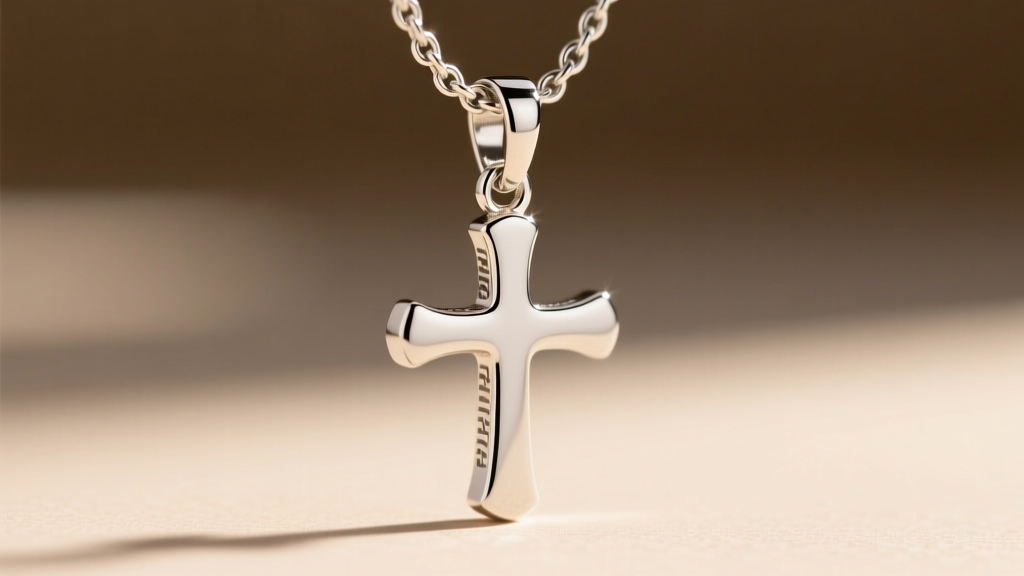
The Thread-Through (Station) Lariat
An alternative design is the thread-through lariat, where the chain passes directly through a hollow tube integrated into the top of the cross. While this offers a sleek, minimalist aesthetic, it is highly susceptible to friction wear. The interior of the tube must be lined with a hardened metal insert or polished to a mirror finish to prevent the tube edges from acting like a file against the chain links. Unlined brass or low-grade silver tubes will literally saw through a delicate 1.0mm chain over a period of 12 to 18 months of daily wear.
Metallurgy and Cross Proportions: Balancing Weight and Drape
The cross pendant in a lariat design functions as a plumb bob. Its weight dictates how the chain drapes across the clavicle and sternum. If the cross is disproportionately heavy for the chain gauge, it will pull the neckline chain taut, causing discomfort and accelerating link fatigue at the clasp. Conversely, a cross that is too light will fail to pull the Y-drop down, causing the lariat to bunch up awkwardly.
The Gemological Institute of America (GIA) provides extensive data on metal properties, which is crucial when calculating the volume and weight of the cross pendant. Below is a technical comparison of common lariat metals, factoring in their Vickers Hardness (HV) and the recommended maximum weight for the cross drop when paired with a standard 1.2mm cable chain.
| Metal Composition | Vickers Hardness (HV) | Max Recommended Cross Weight | Est. Price Range (20" + 2" Drop) |
|---|---|---|---|
| 925 Sterling Silver | 60 - 75 HV | 3.5 grams | $85 - $160 |
| 14k Yellow Gold | 130 - 150 HV | 5.5 grams | $450 - $850 |
| 14k White Gold (Rhodium Plated) | 135 - 155 HV | 5.5 grams | $500 - $900 |
| Platinum (950/50) | 110 - 130 HV (High Density) | 7.0 grams | $1,200 - $2,500+ |
Note that while Platinum is softer than 14k gold on the Vickers scale, its high density and superior resistance to metal loss (it displaces rather than abrades) allow it to support a heavier cross pendant without structural failure.
Sizing the Drop: Geometry for Different Necklines
The functional elegance of a lariat cross necklace lies in its adjustable drop, but the geometry of that drop must be matched to the wearer's wardrobe and anatomy. The standard factory drop length is 2.0 inches. However, a true custom or expertly tailored lariat should feature a 2.5 to 3.0-inch drop.
Expert Sizing Framework: To determine your ideal lariat drop length, measure from the base of your throat (the suprasternal notch) down to the desired resting point of the cross. For deep V-necks and wrap dresses, a 3.0-inch drop provides optimal visual elongation. For crew necks and higher collars, a 1.5-inch to 2.0-inch drop prevents the pendant from looking lost in the fabric folds.
Furthermore, the placement of the sliding mechanism on the main necklace loop affects the geometry. If the O-ring slide is positioned too close to the clasp, the lariat will sit asymmetrically, pulling the cross off-center. Master jewelers calculate the slide placement based on the exact circumference of the main chain, ensuring the Y-junction rests precisely at the center of gravity.

Maintenance: Preventing Chain Kinking and Bail Wear
Because the lariat cross necklace is a kinetic piece of jewelry, its maintenance protocol differs significantly from standard pendants. The primary enemy of the lariat is chain kinking, which occurs when the delicate cable links are twisted beyond their rotational threshold. When a kinked chain is forced through the sliding O-ring, it can permanently deform the link or jam the hardware.
To prevent this, never store a lariat necklace in a tangled pile. It must be hung vertically from a jewelry stand or laid perfectly flat in a lined drawer. When putting the necklace on, always thread the drop through the slide slowly, ensuring the chain links are lying flat against one another.
Regarding the sliding hardware, friction inevitably generates microscopic metal dust that accumulates inside the bail or tube. Every six months, the slide mechanism should be flushed with a few drops of high-purity isopropyl alcohol and gently brushed with a soft-bristled toothbrush to remove this abrasive debris. Avoid using ultrasonic cleaners on lariat necklaces with rhodium-plated white gold slides, as the high-frequency vibrations can cause micro-fractures in the plating where it rubs against the chain. By adhering to these strict metallurgical and mechanical guidelines, a lariat cross necklace transforms from a fragile fashion trend into a resilient, lifelong heirloom.


