Anatomy of a Lariat Turquoise Necklace: Expert Guide
Explore the technical anatomy of a lariat turquoise necklace. Expert insights on chain gauges, stabilization grades, and structural durability.

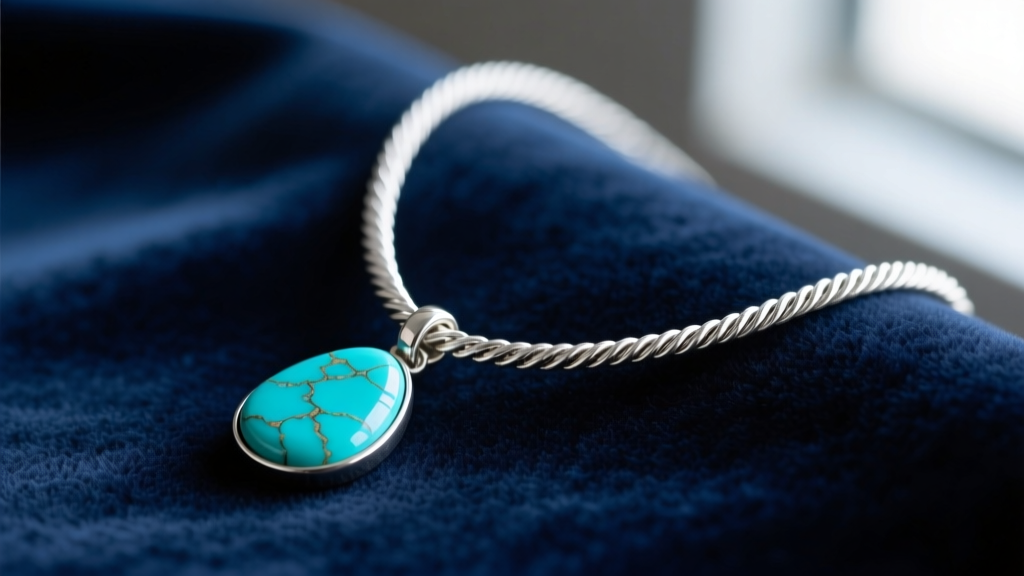
The lariat turquoise necklace represents a fascinating intersection of fluid mechanical design and ancient mineralogy. Unlike traditional clasp-secured necklaces, the lariat relies on a dynamic Y-drop structure, utilizing gravity and friction to maintain its silhouette. When this kinetic design is paired with turquoise—a notoriously porous and relatively soft hydrous phosphate mineral—the engineering tolerances become critical. In this expert deep dive, we deconstruct the anatomy of the lariat turquoise necklace, examining the precise chain gauges, stabilization protocols, and structural failure points that separate heirloom-quality jewelry from disposable fashion accessories.
The Mechanics of the Lariat Design: Chain Gauge and Friction
The defining feature of any lariat necklace is the 'slide' or 'drop'—the component that the chain threads through or wraps around. In a lariat turquoise necklace, this slide is typically a drilled turquoise bead, a cabochon set in a bezel with a soldered bail, or a carved turquoise totem. The interaction between the metal chain and this stone slide dictates the necklace's longevity and drape.
Chain Selection and Tensile Strength
A common failure mode in poorly engineered lariats is chain snapping at the friction point. When the wearer moves, the heavy turquoise drop acts as a pendulum, placing immense torque on the chain links passing through the slide. Snake chains and herringbone chains (often under 1.0mm) are highly susceptible to kinking and metal fatigue under this specific kinetic stress. For a turquoise slide weighing between 15 and 40 carats, expert jewelers mandate a 1.2mm to 1.8mm box chain or rope chain. Box chains offer superior tensile strength and a geometric surface that glides through a smooth bezel bail without catching, while rope chains provide a higher-friction surface that helps lighter slides maintain their position on the chest.
The Friction Fit Tolerance
The inner diameter of the slide's bail or drill hole must be precisely calibrated to the chain's outer diameter. An optimal tolerance leaves a 0.3mm to 0.5mm clearance. If the clearance is too tight, the chain will bind, causing abrasive wear on the silver or gold links. If the clearance exceeds 1.0mm, the turquoise drop will slip uncontrollably, requiring constant readjustment and increasing the risk of the chain whipping out of the slide entirely.
Turquoise Metallurgy and Stabilization Protocols
Turquoise is a hydrous phosphate of copper and aluminum, with the chemical formula CuAl6(PO4)4(OH)8·4H2O. According to mineralogical data from Mindat.org, its Mohs hardness ranges from 5 to 6, making it significantly softer than quartz or sapphire. This inherent softness and high porosity present severe challenges for a lariat slide, which is subjected to constant friction against metal chains and exposure to the wearer's sebum and perspiration.
Untreated, natural turquoise is generally unsuitable for lariat slides unless it is of the highest 'hard' grade (rare and prohibitively expensive). Therefore, stabilization is not merely a market enhancement; it is a structural necessity. The Gemological Institute of America (GIA) notes that stabilization involves infusing the porous stone with a hardening agent. However, not all stabilization methods are equal for kinetic jewelry:
- Epoxy Resin Impregnation: The most common method. The stone is submerged in a liquid epoxy under a vacuum. While it increases durability, cheap epoxies can yellow over time when exposed to UV light and skin oils, altering the turquoise's color profile.
- The Zachery Method: A proprietary, non-polymer chemical bath that enhances the stone's natural luster and increases its Mohs hardness to roughly 6.5 without introducing plastics. This is the gold standard for high-end lariat turquoise slides, as it preserves the stone's natural thermal properties and matrix integrity.
- Backed Turquoise: Often, thin slices of high-grade turquoise are epoxied to a black onyx or steel backing to provide the structural depth required for a lariat drop, preventing the stone from snapping under its own weight.
Matrix Variations and Structural Integrity
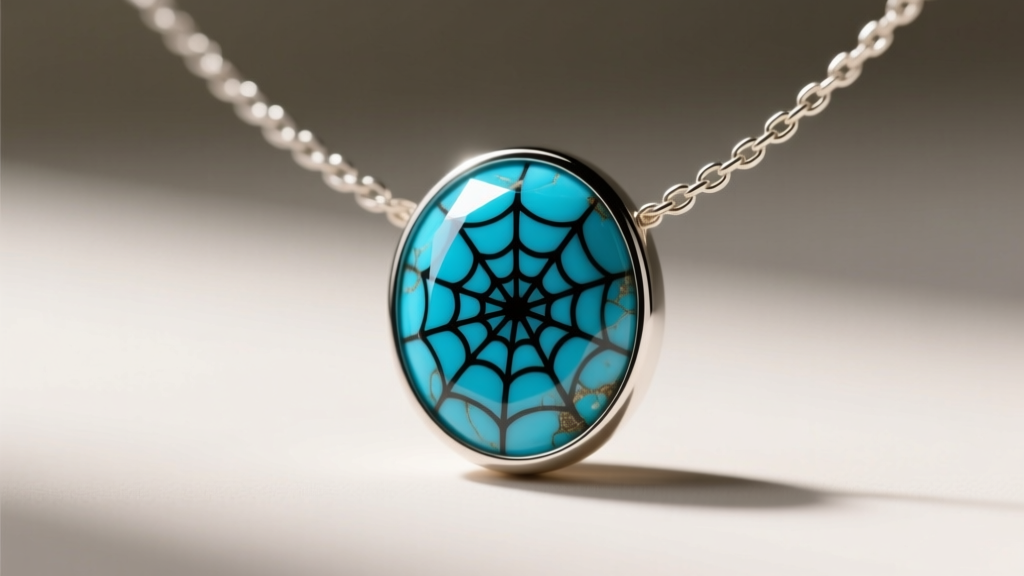
The 'matrix'—the host rock visible within the turquoise—plays a vital role in the stone's structural integrity. A 'spiderweb' matrix composed of iron pyrite or sandstone can actually act as a natural reinforcement grid, holding the turquoise together under stress. However, if the matrix contains soft chalky inclusions or large pockets of limonite, the friction from the chain rubbing against the slide can eventually excavate these softer pockets, leading to localized pitting and eventual fracture of the cabochon.
Proportion Framework: Sizing the Drop and Chain
Achieving the correct visual and physical balance in a lariat turquoise necklace requires adhering to strict proportion frameworks. The weight of the turquoise drop must be counterbalanced by the length and gauge of the chain to ensure the necklace lays flat against the sternum rather than pulling uncomfortably on the cervical spine.
| Chain Length | Drop Length | Cabochon Weight | Recommended Chain Gauge | Ideal Neckline |
|---|---|---|---|---|
| 24 inches | 4 - 6 inches | 15 - 25 carats | 1.2mm Box Chain | Deep V-Neck / Scoop |
| 30 inches | 6 - 8 inches | 25 - 45 carats | 1.5mm Rope Chain | High Collar / Crew |
| 36 inches | 8 - 12 inches | 45 - 80 carats | 2.0mm Box/Rope | Open Button-Down |
When designing or purchasing a lariat, always verify that the terminal end of the drop (the piece that hangs below the slide) features a counterweight. This is often a smaller turquoise bead or a sterling silver tassel. Without this terminal counterweight, the slide will continually migrate upward toward the neck, defeating the purpose of the elongated Y-silhouette.
Failure Modes and Preventative Maintenance
Even expertly crafted lariat turquoise necklaces are subject to unique wear patterns due to their mechanical design. Understanding these failure modes allows collectors and daily wearers to implement targeted maintenance routines.
The Choke Point Abrasion
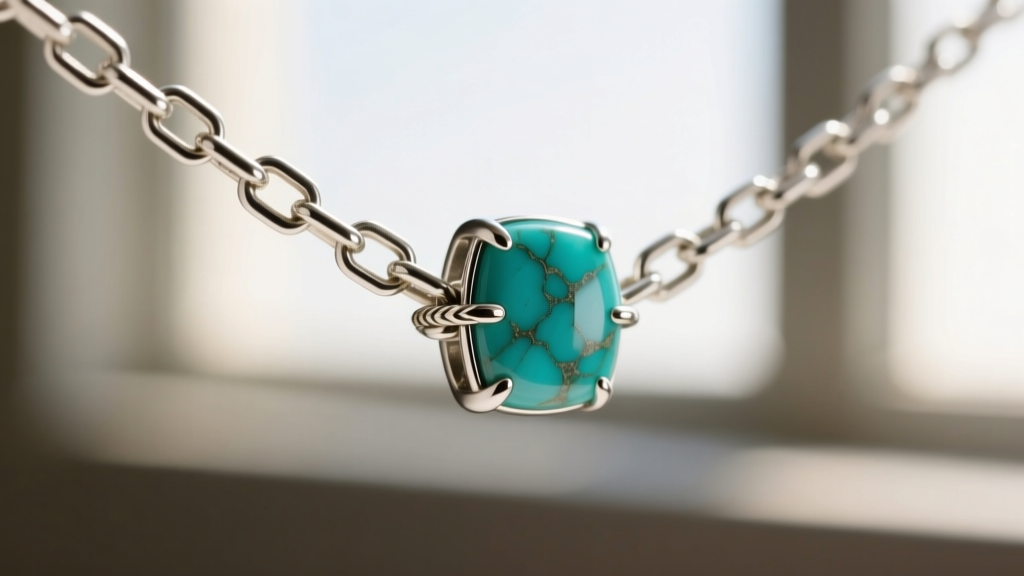
The 'choke point' is the exact millimeter of chain that rests inside the slide's bail when the necklace is stationary. Over time, the microscopic abrasion between the metal chain and the inner wall of the bail can wear through a silver or gold link. To prevent this, high-end jewelers line the interior of the turquoise bezel bail with a hardened steel or platinum sleeve, creating a sacrificial wear layer that protects the precious metal chain.
Chemical Degradation from Cosmetics
Because the lariat drop rests directly on the skin and clothing, it is highly exposed to aerosolized cosmetics, perfumes, and lotions. Turquoise is highly reactive to acids and harsh chemicals. Exposure to alcohol-based perfumes can break down inferior epoxy stabilizations, causing the stone to become chalky and brittle. Always apply cosmetics and allow them to dry completely before donning a lariat turquoise necklace.
Expert Archival Tip: Never store a lariat turquoise necklace hanging on a standard jewelry tree. The constant gravitational pull on the chain, combined with the weight of the turquoise slide, will cause the metal links to permanently stretch and deform over time. Always store the necklace coiled loosely in a tarnish-resistant flannel pouch, ensuring the turquoise slide is not resting on top of the metal chain to prevent micro-scratching.
Ultimately, the lariat turquoise necklace is a triumph of kinetic jewelry design. By respecting the metallurgical limits of the chain, the chemical realities of the turquoise, and the physics of the friction fit, wearers can enjoy a piece that is not only visually striking but mechanically enduring.


