Lotus Pendant Necklace Guide: Metallurgy, Casting & Chain Pairing
Master the technical details of a lotus pendant necklace. Learn about metal grades, casting methods, chain gauges, and pricing in our expert guide.

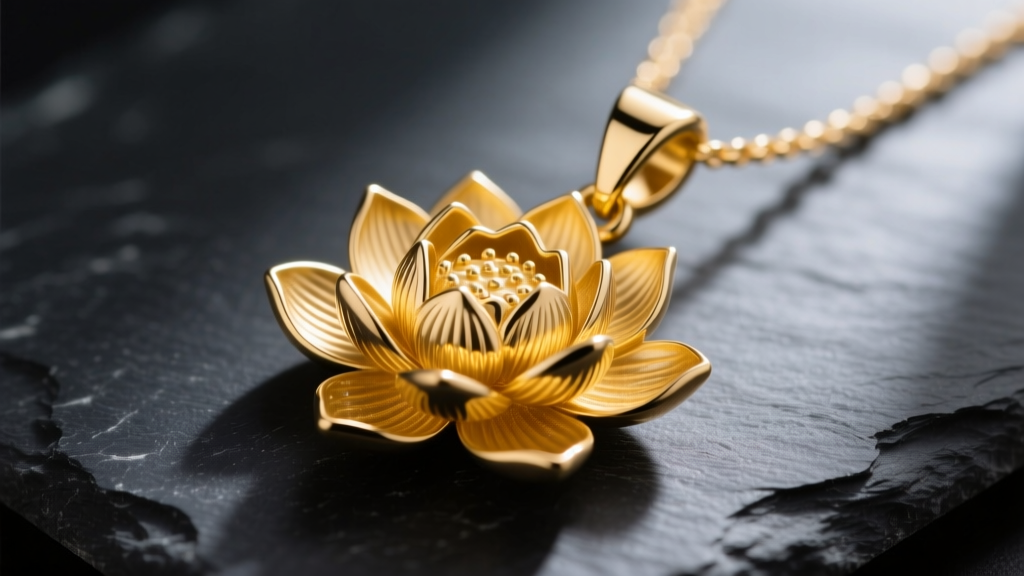
The lotus flower is a masterclass in natural geometry, making it one of the most enduring motifs in fine jewelry. However, translating the delicate, overlapping petals and complex seed pod of a lotus into a wearable piece of metal presents unique engineering challenges. For the discerning collector or bench jeweler, evaluating a lotus pendant necklace goes far beyond superficial aesthetics. It requires a deep understanding of metallurgical hardness, casting porosity, bail pivot mechanics, and chain tensile strength.
In this expert deep dive, we deconstruct the anatomy of the lotus pendant, providing you with the technical frameworks needed to identify superior craftsmanship, avoid structural failure points, and perfectly pair your pendant with a chain that guarantees both longevity and optimal drape.
The Metallurgy of the Lotus: Selecting the Right Alloy
When evaluating a lotus pendant necklace, the untrained eye looks at color, but the expert looks at Vickers hardness (HV). The lotus design inherently features thin, tapering petal edges and deep, recessed crevices. If the metal alloy is too soft, the petal tips will warp during routine wear or polishing. If it is too brittle, the intricate detailing can crack under stress.
According to the GIA Gem Encyclopedia, understanding the alloy composition is critical for predicting how a piece will hold up to the rigors of daily wear. Pure 24k gold and 999 fine silver are entirely unsuitable for 3D lotus pendants due to their low hardness. Instead, master jewelers rely on specific alloy mixes to maintain the crispness of the petal edges.
| Metal Alloy | Vickers Hardness (HV) | Petal Edge Durability | Best Application |
|---|---|---|---|
| 925 Sterling Silver | 60 - 75 HV | Moderate (Prone to bending) | Flat, die-struck 2D lotus silhouettes |
| 14k Yellow Gold (58.5% Au) | 130 - 150 HV | High (Excellent edge retention) | Complex 3D overlapping petal designs |
| 18k Yellow Gold (75% Au) | 90 - 115 HV | Moderate-High (Softer edges) | Heirloom pieces with minimal impact risk |
| 950 Platinum | 110 - 130 HV | Exceptional (Dense and malleable) | High-end, diamond-set lotus pendants |
For a highly detailed, three-dimensional lotus pendant, 14k gold is often the superior technical choice over 18k gold. The higher percentage of alloying metals (like copper and zinc) in 14k gold provides the necessary structural rigidity to prevent the thinnest petal tips from catching on fabrics and bending out of shape.
Casting Techniques: Lost-Wax vs. Die Striking
The manufacturing method dictates the topographical depth of your lotus pendant necklace. There are two primary methods used in modern jewelry manufacturing, and knowing the difference is key to spotting quality.
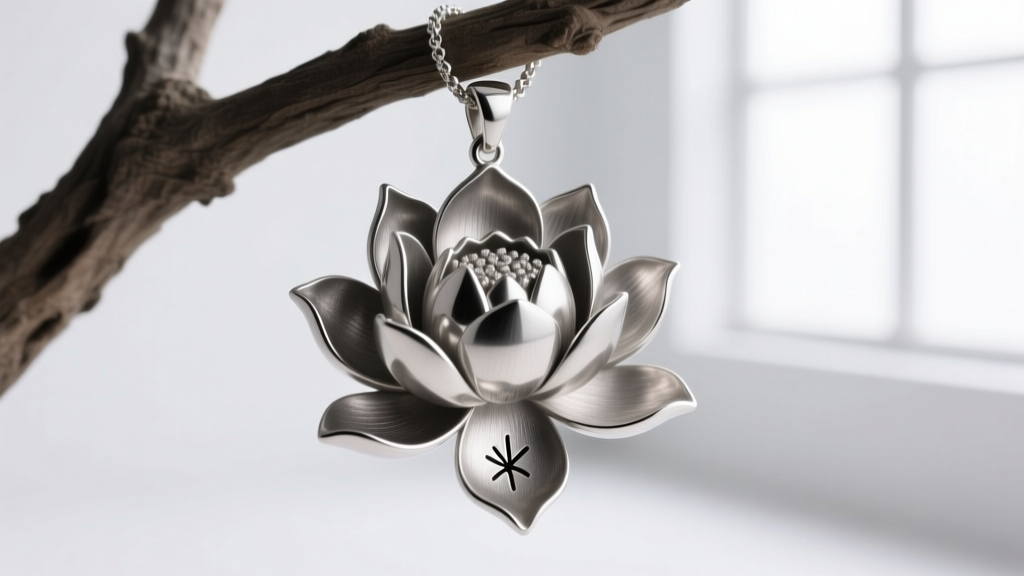
Investment (Lost-Wax) Casting
For 3D lotus pendants where petals overlap and the central seed pod is fully sculpted, investment casting is mandatory. A wax model is encased in a plaster-like investment material, burned out in a kiln, and replaced with molten metal. The primary risk with this method is casting porosity—tiny gas bubbles trapped in the metal as it cools. In a lotus design, porosity often hides in the deep recesses between the petals or inside the seed pod holes. Always inspect these recessed areas with a 10x jeweler's loupe; pitting in these areas indicates poor temperature control during the casting process.
Die Striking
If you are looking at a flat, 2D lotus silhouette, it should be die-struck. This process uses immense hydraulic pressure to stamp a sheet of metal between two hardened steel dies. Die-struck lotus pendants have a compressed grain structure, making them significantly denser and more resistant to scratching than cast equivalents. However, they lack the undercuts and overlapping depth of a cast piece.
Anatomical Scaling: Pendant Dimensions and Bail Engineering
The bail—the loop that connects the pendant to the chain—is the most critical mechanical joint on any lotus pendant necklace. Because the lotus is a wide, horizontally oriented flower, improper bail engineering will cause the pendant to constantly flip upside down or sit crookedly on the chest.
- Standard Loop Bail: A simple ring soldered to the top petal. This is the cheapest method but offers poor pivot control, often resulting in the lotus tilting sideways.
- Tapered V-Bail: Soldered directly into the top cleft of the lotus petals, this bail lowers the center of gravity and forces the flower to lay flat against the sternum.
- Hidden Bail: Attached to the back of the pendant, allowing the chain to pass through unseen. This is the premium choice for a seamless, floating lotus effect, though it requires a thicker chain gauge to slide smoothly through the rigid back-tube.
For a standard 20mm wide lotus pendant, the bail's internal diameter must be at least 3.5mm to accommodate a properly proportioned chain without causing excessive friction wear on the chain links.
Chain Pairing: Gauge, Weight, and Clasp Mechanics
A common failure point in jewelry is pairing a heavy, solid-cast pendant with an under-gauged chain. A solid 14k gold 3D lotus pendant typically weighs between 6 and 12 grams. The chain must possess adequate tensile strength to support this static load, as well as the dynamic shock load of the pendant bouncing during movement.
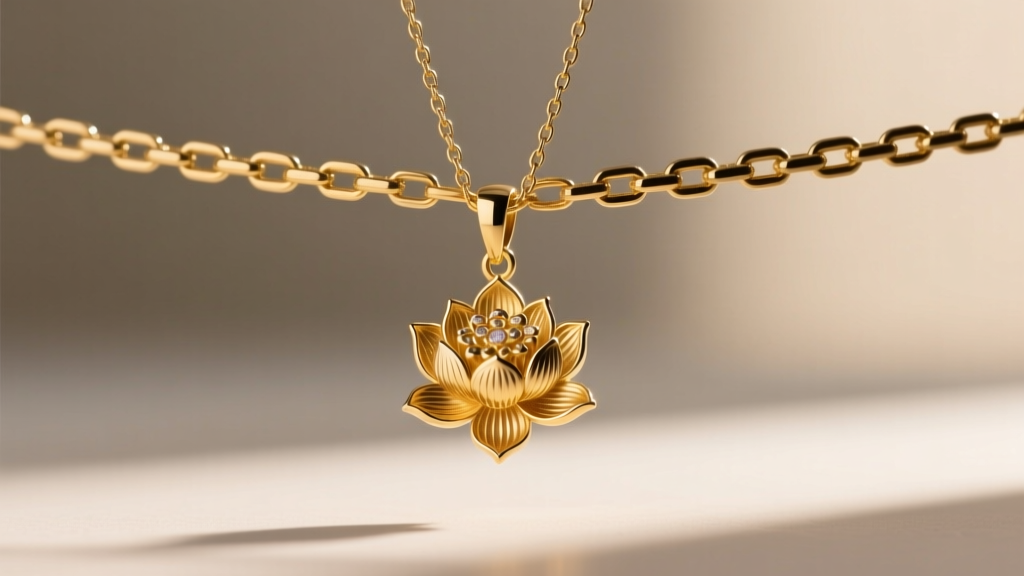
The Jewelers of America frequently highlights the importance of matching chain clasps and gauges to the weight of the pendant to prevent catastrophic loss. Here is the technical framework for pairing chains with lotus pendants:
- 0.8mm - 1.0mm Cable Chain: Strictly for lightweight (under 4g), hollow, or die-struck 2D lotus pendants. Will snap if used with a solid 3D casting.
- 1.2mm - 1.5mm Box Chain: The ideal pairing for medium-weight (5g - 10g) lotus pendants. The square links distribute weight evenly and resist kinking, which is vital for maintaining the drape of the wide lotus flower.
- 1.5mm - 2.0mm Rope Chain: Required for heavy, oversized (12g+) lotus pendants, especially those featuring pavé diamond accents in the seed pod. The twisted links offer superior tensile strength.
Always ensure the clasp is a lobster claw or a locking box clasp. Spring ring clasps lack the internal spring tension to securely hold the D-ring of a heavy lotus pendant bail.
Pricing Tiers and Authenticity Markers
Understanding the manufacturing and material costs protects you from inflated retail pricing. Below is a benchmark guide for what you should expect to pay for a genuine, high-quality lotus pendant necklace in the current market.
"A genuine hallmark should be laser-engraved or stamped in a legible, standardized font. Cast-in hallmarks that appear blurry or shallow are a red flag for unverified metal purity."
- Entry-Level ($40 - $90): 925 Sterling Silver, die-struck or simple hollow cast. Often features oxidized recesses to highlight the petal details.
- Mid-Tier ($350 - $800): Solid 14k Gold (approx. 4g - 7g), lost-wax cast with hand-finished petal edges and a soldered tapered bail.
- High-End ($1,500 - $4,000+): Solid 18k Gold or Platinum, featuring intricate milgrain detailing, pavé-set diamonds in the central pod, and a custom-engineered hidden bail.
Care and Patina Management for Recessed Petals
The intricate topography of a lotus pendant makes it a magnet for skin oils, lotions, and environmental dust, which accumulate in the deep crevices between the overlapping petals and the holes of the seed pod.
While ultrasonic cleaners are standard for diamond jewelry, they can be risky for lotus pendants that feature mixed media (like enamel accents in the petals) or porous gemstones (like opals or pearls) set in the center. Furthermore, if the pendant has deep, enclosed recesses, ultrasonic cavitation can trap moisture inside, leading to slow oxidation in silver pieces.
The Expert Cleaning Protocol:
Use a soft-bristled detailing brush (such as a baby toothbrush) dipped in a mild solution of warm water and ammonia-free dish soap. Gently agitate the bristles into the petal crevices. Rinse with distilled water to prevent hard water spotting, and immediately dry with compressed air or a microfiber cloth wrapped around a wooden skewer to reach the deepest parts of the seed pod. This mechanical action removes buildup without risking the structural integrity of the delicate metal edges.


