How Material Weight Dictates Your Ideal Necklace Inch Length
Discover how metal density and specific gravity dictate your ideal necklace inch length for perfect drape, comfort, and clasp durability.

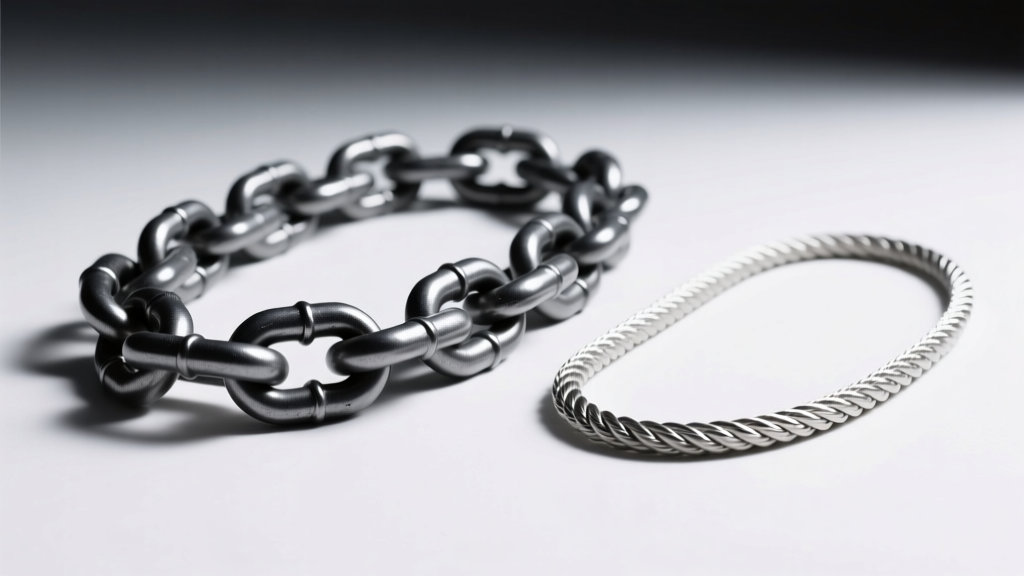
When shopping for a new chain, most style guides focus exclusively on where the metal rests on the chest—categorizing pieces as chokers, princess, or matinee lengths. However, this traditional approach ignores a fundamental law of physics: gravity. The ideal necklace inch length you choose should not be based solely on your neckline or outfit, but heavily dictated by the specific gravity and density of the metal itself. A 24-inch chain in lightweight titanium will drape elegantly, while that exact same 24-inch length in solid platinum or thick tungsten will pull uncomfortably on the nape of your neck, distort your collarbone, and eventually snap its clasp.
In this comprehensive material comparison, we break down the biomechanics of jewelry drape, exploring how metal density impacts your ideal necklace inch length for maximum comfort, structural integrity, and aesthetic flow.
The Physics of Drape: Why Material Density Matters
To understand how a chain behaves, we must look at Specific Gravity (SG), a measure of density relative to water. The higher the SG, the heavier the metal per cubic millimeter. According to metallurgical data referenced by the Gemological Institute of America (GIA), jewelry metals vary wildly in density:
- Aerospace Titanium: 4.5 g/cm³
- Sterling Silver (925): 10.4 g/cm³
- 14k Yellow Gold: 12.9 g/cm³
- Jewelry-Grade Tungsten Carbide: ~15.0 g/cm³
- Platinum (950): 21.4 g/cm³
Because of these vast differences, a 4mm wide curb chain made of platinum will weigh nearly five times more than the exact same 4mm curb chain milled from titanium. This weight discrepancy fundamentally changes how the chain interacts with your body over various lengths. As a general rule of thumb, as the necklace inch length increases, the total mass of the chain scales linearly. If you are working with high-SG metals, extending the length past 20 inches introduces severe pendulum dynamics and nape fatigue.
Mapping Material Weight to the Perfect Necklace Inch Length
Professional jewelers and custom chain makers, such as the fabrication experts at Rio Grande, use material weight to determine maximum viable lengths for specific chain widths. Here is how to pair your metal with the correct length.
Lightweight Metals (Titanium, Aluminum, Hollow Gold)
Because these metals possess a low specific gravity, they are the undisputed champions of long-layering. You can comfortably wear a 24 to 30-inch necklace inch length in a 3mm to 5mm width without experiencing skin drag or collarbone bruising. Hollow-core gold chains (often made using an electroforming process) offer the luxurious look of 14k or 18k gold but with an SG closer to 5.0 g/cm³, making them perfect for 28-inch matinee or opera lengths that require a relaxed, sweeping drape.
Medium-Density Metals (Sterling Silver, Solid 14k/18k Gold)
Sterling silver and solid karat golds represent the industry standard for a reason: they offer a satisfying, premium weight without crossing into the territory of physical burden. For these materials, the 18 to 22-inch necklace inch length is the structural sweet spot. At 20 inches, a standard 3mm solid 14k gold rope chain weighs roughly 12 to 15 grams—enough to lay flat against the clavicle and keep the pendant centered, but light enough that a standard 5mm spring ring clasp can easily support the static load.
Heavyweight Metals (Tungsten, Stainless Steel, Platinum)
High-density metals require strict length limitations, especially for wider chains. If you prefer the scratch-resistant, gunmetal finish of tungsten or the bright white luster of platinum, you should cap your necklace inch length at 18 to 20 inches for any chain wider than 3mm. Beyond 20 inches, the sheer mass of a 5mm tungsten figaro chain will cause the chain to slide aggressively against the skin with every step, creating friction burns on the back of the neck and placing immense shear stress on the jump rings.

The Tension & Skin Stretch Factor
One of the most overlooked aspects of chain sizing is the biomechanical toll on the cervical spine and surrounding skin. A heavy chain worn at a 24-inch length acts as a pendulum. When you walk, the kinetic energy transfers to the nape of the neck, causing micro-abrasions and long-term skin laxity. Below is a structural decision matrix for a standard 4mm chain width across different materials:
| Material | Specific Gravity | Max Recommended Length (4mm Width) | Best Chain Style for Drape |
|---|---|---|---|
| Titanium | 4.5 g/cm³ | 30+ Inches | Box Chain, Rope |
| Sterling Silver | 10.4 g/cm³ | 24 Inches | Cable, Curb |
| Solid 14k Gold | 12.9 g/cm³ | 22 Inches | Figaro, Rope |
| Tungsten Carbide | 15.0 g/cm³ | 20 Inches | Curb, Cuban |
| Platinum 950 | 21.4 g/cm³ | 18 Inches | Wheat, Cable |
Expert Insight: If you absolutely desire a 24-inch length in a high-density metal like platinum, you must compensate by dropping the chain width to 1.5mm or 2mm. The necklace inch length and the chain width operate on a sliding scale dictated by the metal's mass.
Adjusting Clasp Hardware for Heavy/Long Chains
The clasp is the weakest link in any necklace, and its failure rate increases exponentially as the necklace inch length and material density increase. A standard 5mm spring ring clasp has a tensile failure point of roughly 15 pounds of force. While a 20-inch titanium chain might only exert 0.5 pounds of static pull on the clasp, a 24-inch solid silver chain can exert upwards of 3 pounds of dynamic force when caught on clothing.

When sizing up to longer lengths in medium-to-heavy metals, you must upgrade your hardware:
- Lobster Clasps (10mm - 14mm): Essential for 22+ inch lengths in silver or gold. The internal spring mechanism is shielded, and the tensile strength exceeds 40 pounds.
- Soldered Jump Rings: Never use open jump rings on long, heavy chains. The pendulum effect will slowly twist the metal open, dropping your pendant or chain. Always insist on laser-welded or soldered jump rings.
- Magnetic Neodymium Clasps: Excellent for 24+ inch lightweight chains (like titanium), but they can detach unexpectedly if used on heavy 20-inch tungsten chains due to the sheer gravitational pull overcoming the magnetic field.
Expert Sizing Framework: The 2026 Drape Test
Before committing to a custom piece or a high-end designer chain, perform the Drape Test to ensure your chosen necklace inch length aligns with the material's physical properties.
- Step 1: The Cotton Proxy. Cut a piece of heavy cotton cord to your desired length (e.g., 22 inches). Tie a metal washer to the end that approximates the weight of your intended pendant or the center mass of the chain.
- Step 2: The Walk Test. Wear the cord for 15 minutes while walking briskly. Pay attention to the nape of your neck. If you feel repetitive tapping or friction, the length is too long for a heavy metal; scale back by 2 inches or switch to a lower-SG metal.
- Step 3: The Collarbone Check. Look in the mirror. If the cord pulls tightly against the sides of your neck, leaving a gap at the sternum, the material you are choosing is too rigid or heavy for that specific length. Opt for a flexible weave like a wheat or snake chain instead of a rigid curb.
Ultimately, mastering the intersection of metallurgy and style is what separates a comfortable, lifelong accessory from a heavy burden sitting in a jewelry box. By respecting the specific gravity of your chosen metal, you can confidently select the perfect necklace inch length that guarantees flawless drape, enduring hardware, and all-day comfort.


