How Do You Measure Necklace Length? A Troubleshooting Guide
Learn exactly how do you measure necklace length for any neckline. Troubleshoot fit issues, master layering gaps, and find your perfect chain size.


The Core Problem: Why Standard Necklace Lengths Fail
If you have ever ordered an 18-inch chain only to find it sits like a suffocating 16-inch choker, you are not alone. The frustration of ill-fitting jewelry is a universal experience, and it usually stems from a fundamental misunderstanding of how jewelry is manufactured and measured. When asking how do you measure necklace length, most amateur guides tell you to wrap a piece of string around your neck. This is a critical error. String does not account for the rigid geometry of metal clasps, the drape of specific chain weaves, or the gravitational pull of a heavy pendant.
According to the Blue Nile Necklace Education Guide, chain width and link structure drastically alter the perceived length and drape. A 4mm Cuban link chain sits stiffer and higher on the collarbone than a 1.5mm flexible cable chain of the exact same measured length. Furthermore, standard manufacturing tolerances mean a chain stamped as 18 inches might actually measure anywhere from 17.5 to 18.25 inches depending on whether the measurement includes the clasp hardware. To solve these fit disasters, we must abandon guesswork and apply a rigorous, problem-solving framework to necklace sizing.
How Do You Measure Necklace Length? The Definitive Framework
To get a true, actionable measurement, you must measure the jewelry exactly as it will be worn, or calculate your neck morphology with mathematical precision. Here are the two professional methods used by jewelers and custom designers.
Method 1: The End-to-End Hardware Measurement
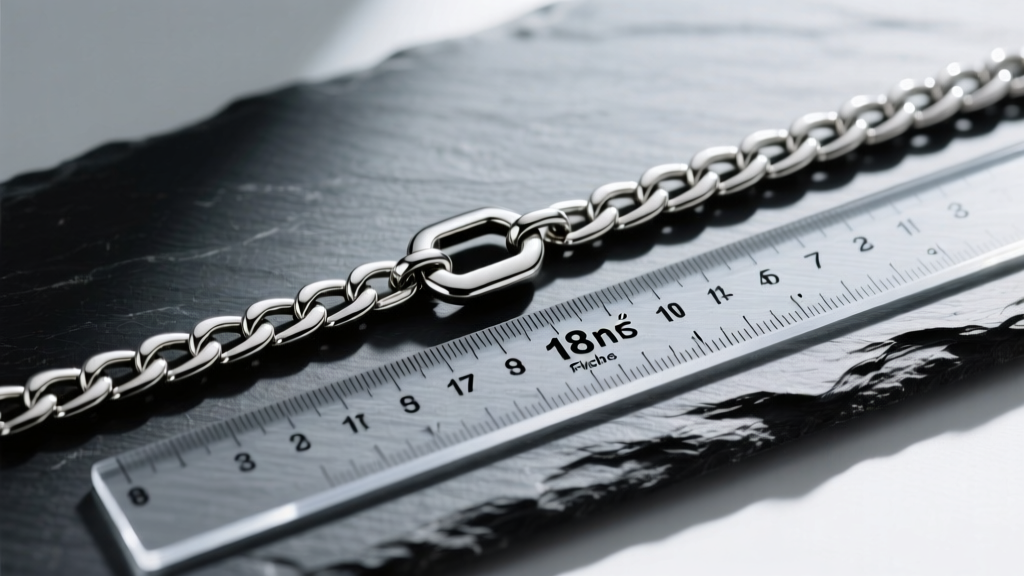
If you are measuring an existing chain to replicate its fit, you must measure from the very tip of the clasp to the very end of the jump ring on the opposite side. Do not measure just the chain links. A standard 12mm lobster clasp and two 4mm jump rings add nearly 0.75 inches of total length. Lay the necklace perfectly flat on a hard surface, gently pull it taut so the links align without stretching, and use a clear acrylic ruler. If your chain has a permanent pendant, measure the chain separately, then add the exact millimeter drop of the pendant from the bail hole to the bottom tip.
Method 2: The Neck Circumference + Drop Calculation
If you are shopping online and do not have a physical chain to measure, you must calculate your personal drop. Use a flexible tailor's measuring tape to measure the circumference of your neck at the exact point where a choker would sit (usually the mid-neck). Add exactly 2 inches to this number for a standard collar fit, 4 inches for a princess length, and 6 inches for a matinee length. For example, if your mid-neck measures 13 inches, a 16-inch chain (13 + 3) will sit comfortably just below the Adam's apple or collarbone hollow. Keep in mind that weight fluctuations of just 5 pounds can alter neck circumference by up to 0.5 inches, which is why extender chains are vital.
Troubleshooting Common Fit Disasters
Even with perfect measurements, physical dynamics can ruin the way a necklace sits. Here is how to troubleshoot the most common structural failures.
The Clasp Migration (Pendant Flip)
There is nothing more annoying than a necklace clasp that constantly slides to the front of your neck, resting right next to the pendant. This happens due to a center-of-gravity imbalance. If you have a heavy pendant (e.g., a 10-gram solid gold charm) on a lightweight chain (e.g., a 1.5mm hollow cable chain), the weight of the pendant pulls the front down, forcing the lighter clasp to slide forward. The Fix: Upgrade to a heavier chain style like a 2.5mm Figaro or Rope chain, which provides enough counterweight at the back of the neck. Alternatively, have a jeweler solder a small, decorative counterweight bead onto the chain directly opposite the clasp.
The Awkward Collarbone Clash
A pendant that lands exactly on the clavicle bone will bounce, flip, and irritate the skin. This usually happens with 16-inch chains on individuals with shorter torsos. The Fix: If you are caught between sizes, utilize a 2-inch extender chain. This allows you to drop the pendant into the soft tissue of the upper chest, ensuring it lays flat against the sternum rather than pivoting on the bone.
The Bail-to-Chain Mismatch
If your pendant constantly flips upside down, the issue is rarely the chain length; it is the bail size. A large 5mm pendant bail sliding freely on a thin 1.2mm chain creates too much negative space, allowing the pendant to rotate 360 degrees. The Fix: Match the chain thickness to at least 60% of the bail's inner diameter, or switch to a fixed bail (soldered directly to the chain) for heavy, asymmetrical pendants.
Layering Mathematics: Calculating the Perfect Gap
Layering necklaces is an exercise in geometry. The golden rule of layering is the 2-Inch Delta Rule. To prevent tangling and ensure each piece is visible, there must be a minimum 2-inch difference in length between consecutive chains. However, you must account for pendant drops. If your base layer is a 16-inch chain with a 1.5-inch pendant, its effective visual length is 17.5 inches. Therefore, your second layer should not be an 18-inch chain; it should be a 20-inch chain to maintain the visual gap. Tangling occurs most frequently when chains are of similar weight and weave. Pair a smooth, polished Snake chain with a textured, matte Bead chain to reduce friction and prevent them from twisting together.
Data Table: Neckline to Necklace Length Matrix
Choosing the right length is heavily dependent on the garment you are wearing. The The Knot Jewelry Styling Guide emphasizes that necklaces should either mirror the neckline or contrast it intentionally. Use this matrix to solve your daily styling dilemmas:
| Garment Neckline | Ideal Chain Length | Pendant Drop Allowance | Recommended Chain Style |
|---|---|---|---|
| Strapless / Sweetheart | 14 - 16 inches | None to 1 inch | Choker, Collar, or Tennis Necklace |
| Crew Neck / T-Shirt | 18 - 20 inches | 1 - 2 inches | Cable, Curb, or Rope with medium pendant |
| V-Neck / Wrap Dress | 20 - 24 inches | 2 - 3 inches (Y-drop) | Lariat, Snake chain, or layered Princess lengths |
| Button-Down / Collared | 24 - 30 inches | N/A (Long pendants) | Matinee or Opera length, thin Figaro |

Pro Tips for Clasp and Extender Hardware
Hardware is the unsung hero of necklace fit. If you are struggling with how do you measure necklace length accurately for custom pieces, always factor in the clasp. A standard spring ring clasp is lightweight but difficult to operate with one hand, often leading to dropped jewelry. Upgrade to a 10mm or 12mm Lobster clasp for security and ease of use. For those whose neck size fluctuates due to swelling, temperature, or weight changes, investing in a custom 2-inch or 3-inch extender chain is the ultimate troubleshooting hack. This simple addition transforms a rigid 16-inch choker into a versatile 18-inch princess chain, solving multiple fit problems with a single, inexpensive component. Always ensure the jump rings connecting your extender are soldered closed to prevent the chain from pulling apart under the weight of heavy pendants.


