Megalodon Shark Tooth Necklace: Authenticity, Grading & Mounting Guide
Master the megalodon shark tooth necklace market. Learn fossil grading, authentication techniques, and secure custom mounting methods for heavy pendants.

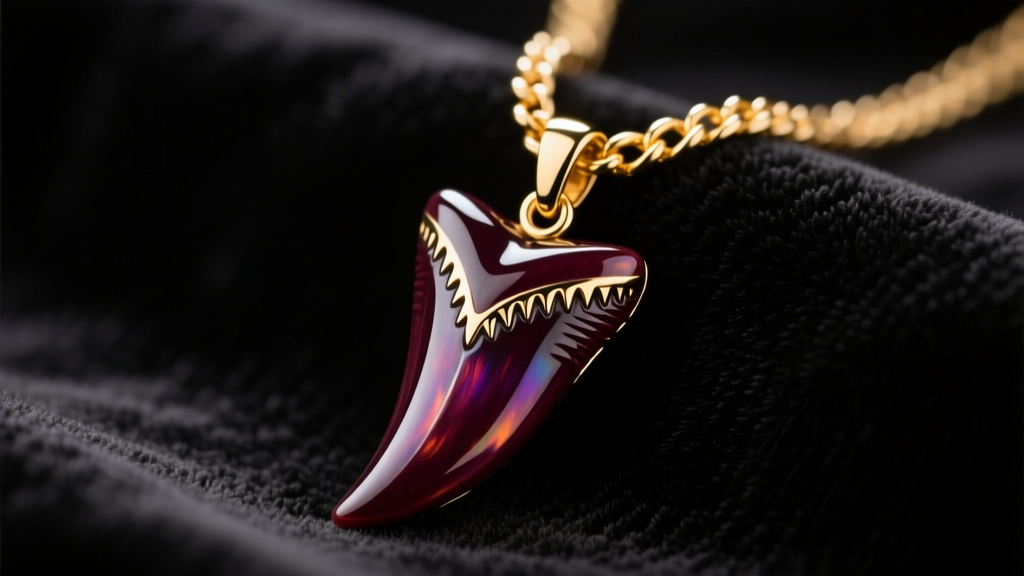
The Anatomy of an Authentic Megalodon Fossil
Building or buying a genuine megalodon shark tooth necklace requires an understanding of paleontology just as much as jewelry design. Unlike modern shark teeth, which are composed of calcium phosphate and fluorapatite, authentic megalodon teeth are fully fossilized. During the permineralization process over millions of years, groundwater rich in dissolved minerals replaces the original organic structure. According to the Florida Museum of Natural History, this process fundamentally alters the tooth's density, weight, and optical properties.
Crown, Dentine, and Root Integrity
A premium megalodon pendant is judged by three distinct anatomical zones:
- The Crown (Enamel): The biting surface. High-grade specimens feature sharp, intact serrations and a flawless, glossy enamel cap without peeling or flaking.
- The Dentine: The exposed area between the crown and the root. It should display natural, organic texturing.
- The Root (Bourlette): The most fragile section. A complete, symmetrical root with intact lobes significantly increases the fossil's value. Crumbling or asymmetrical roots indicate poor preservation or aggressive cleaning.
Color Grading and Mineralization
The color of a megalodon tooth is dictated by the specific minerals present in the sediment where it fossilized. Iron oxide yields deep reds, burgundies, and browns, while copper and phosphate interactions create rare blues and greens. Specimens sourced from the Lee Creek Mine in North Carolina are highly prized for their striking blue and teal hues, often commanding a 30% to 50% premium over standard brown or grey teeth of the same size.
Spotting Fakes: Resin, Carved Bone, and 3D Prints
As the demand for prehistoric jewelry has surged, so has the sophistication of counterfeit megalodon teeth. Unscrupulous vendors use a mix of bone dust and epoxy resin, or high-resolution 3D printing, to cast replicas. To protect your investment, you must employ rigorous authentication protocols.
| Property | Genuine Fossil | Resin / Epoxy Fake | Carved Bone / Ivory |
|---|---|---|---|
| UV Light Reaction | Inert (No glow, unless artificially coated) | Fluoresces brightly under 365nm UV | Slight dull glow or inert |
| Specific Gravity | High (2.8 - 3.1 g/cm³) | Low (1.1 - 1.3 g/cm³) | Medium (1.7 - 2.0 g/cm³) |
| Root Pores | Irregular, natural vascular channels | Smooth, molded, or completely absent | Haversian canals visible under 10x loupe |
| Temperature Test | Cold to the touch, slow to warm | Room temperature, warms quickly in hand | Slightly cool, warms moderately |
Always inspect the serrations under a 10x jeweler's loupe. Genuine fossilized serrations will show microscopic wear patterns and natural asymmetry, whereas molded fakes will exhibit uniform, repetitive ridges. For a deeper understanding of material density and optical properties in gemological and fossilized materials, the Gemological Institute of America (GIA) provides extensive resources on identifying synthetic versus natural mineral structures.
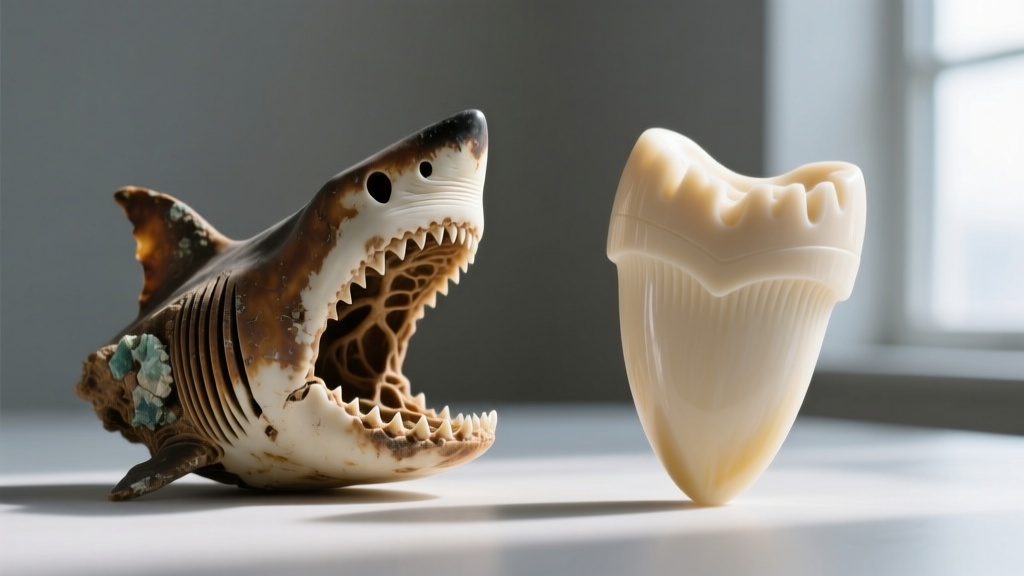
Structural Mounting: Engineering for Heavy Pendants
The most common failure point in a megalodon shark tooth necklace is not the fossil itself, but the jewelry hardware. A high-quality 5-inch megalodon tooth can weigh between 80 and 150 grams. Standard jewelry bails and lightweight chains will inevitably snap under this dynamic load.
The Bail and Wire Wrapping Debate
Never drill into a genuine megalodon tooth. Drilling destroys the structural integrity of the fossil, causes micro-fractures in the brittle root, and instantly halves its collector value. Instead, professional fossil jewelers use one of two non-destructive mounting methods:
- Custom Wire Wrapping: Using 14-gauge to 16-gauge dead-soft wire (in 14k solid gold, sterling silver, or tarnish-resistant Argentium), a jeweler creates a tension-based harness that cradles the root and bourlette. This distributes the weight evenly without adhesives.
- The Cap and Bail Method: A custom-cast metal cap is fitted over the top of the root, secured with a museum-grade, reversible consolidant like Paraloid B-72. A heavy-duty soldered ring is then attached to the cap.
Chain Gauge and Clasp Failure Points
Pairing a 120-gram pendant with a standard 1.5mm cable chain is a recipe for disaster. The chain must be engineered for high-tensile loads.
- Chain Style: Opt for 5mm to 7mm Rolo, Cuban, or Figaro chains. Avoid hollow rope chains, which are prone to crushing and kinking under heavy pendants.
- Metallurgy: Marine-grade 316L stainless steel offers exceptional tensile strength and is hypoallergenic. If using precious metals, ensure the chain is solid 14k or 18k gold, not gold-plated brass, which lacks the yield strength to support the fossil.
- Clasp Mechanics: Standard spring-ring clasps will fail. Use a heavy-duty lobster clasp with a reinforced jump ring, or a mechanical T-bar toggle clasp, which relies on physics rather than a fragile internal spring to stay closed.
Preservation and Long-Term Care
Fossilized teeth are remarkably durable, but they are not invincible. The root structure remains porous and can absorb oils, lotions, and environmental pollutants, leading to dark, irreversible staining.
Expert Preservation Tip: If you acquire a specimen with a slightly friable (crumbly) root, do not use superglue or hardware-store epoxies. Apply a thin coat of Paraloid B-72, an acrylic resin used by professional paleontologists. It penetrates the pores, stabilizes the structure, and remains 100% reversible with acetone if future conservation is required.
When wearing your megalodon necklace, remove it before swimming in chlorinated pools, entering saltwater, or applying aerosol cosmetics. To clean the enamel crown, use only a soft microfiber cloth and a mild, non-abrasive soap solution. Never use ultrasonic jewelry cleaners; the high-frequency vibrations can shatter micro-fissures hidden within the dentine.
Pricing Tiers and Market Value
The market for megalodon jewelry is highly stratified based on size (measured diagonally from the tip of the crown to the furthest point of the root), color, and condition. Understanding these tiers prevents overpaying for commercial-grade specimens.
- Commercial Grade (2.5" - 3.5"): $50 - $150. Often featuring worn serrations, minor root damage, or common grey/brown coloration. Usually mounted in basic sterling silver wire wraps.
- Collector Grade (4" - 5"): $250 - $800. Sharp serrations, intact roots, and vibrant colors (reds, oranges, or polished blacks). Requires heavy-duty custom mounting.
- Museum / Investment Grade (5.5" - 7"+): $1,500 - $10,000+. Flawless enamel, rare blue/green Lee Creek coloration, and perfect symmetry. These are typically set in custom 14k/18k gold harnesses and worn only on special occasions due to their extreme weight and value.
By prioritizing structural integrity, demanding verifiable authenticity, and respecting the paleontological significance of the specimen, you can curate a megalodon shark tooth necklace that serves as both a striking piece of statement jewelry and a legitimate historical artifact.


