Technical Guide to Buying a Premium Mens Rosary Necklace
Discover technical specs for a premium mens rosary necklace. Learn about bead materials, chain gauges, structural failure points, and exact sizing guides.

The Anatomy of a Heirloom-Grade Rosary
The modern mens rosary necklace has transcended its strictly liturgical origins, evolving into a staple of high-end streetwear and contemporary menswear styling. However, the market is saturated with mass-produced, fragile iterations that fail within months of daily wear. As a domain expert in jewelry construction, I evaluate a mens rosary necklace not just by its aesthetic appeal, but by its structural engineering, material grade, and tensile resilience. A true heirloom-grade piece requires a precise balance between bead weight, chain gauge, and junction reinforcement. This deep dive will equip you with the technical specifications necessary to identify, evaluate, and invest in a premium rosary that withstands the rigors of daily wear.
Material Grades: Gemstone Hardness and Bead Integrity
The primary visual and tactile component of any rosary is the bead sequence. For men's jewelry, semi-precious stones and hardwoods dominate the market. However, not all stones are created equal when subjected to the friction of daily movement.
Evaluating Stones via the Mohs Scale
According to the Gemological Institute of America (GIA), the Mohs scale of mineral hardness is the critical metric for predicting bead longevity. When beads clack together during wear, softer stones will chip, pit, or crack around the drill hole.
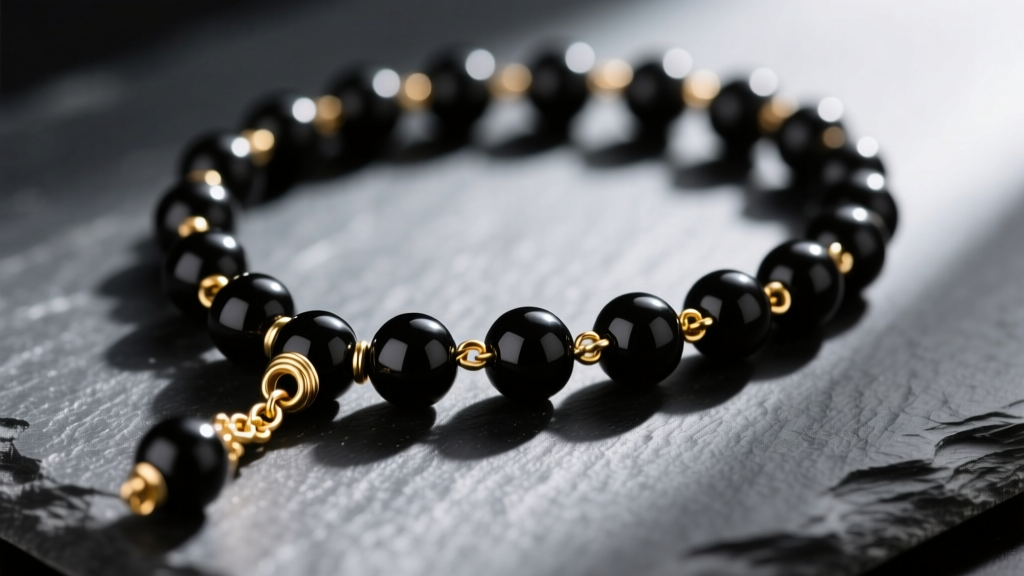
- Black Onyx (Mohs 7): The gold standard for mens rosary necklaces. It offers exceptional scratch resistance, takes a high polish or a sophisticated matte finish, and withstands impacts without micro-fracturing.
- Tiger’s Eye (Mohs 7): Highly durable with a natural chatoyancy that catches the light. The fibrous structure of Tiger's Eye makes it incredibly resistant to shattering.
- Lapis Lazuli (Mohs 5.5): Visually striking but structurally vulnerable. Lapis is a composite rock, not a single mineral, making it prone to pitting and water damage. If you choose Lapis, ensure the beads are heavily stabilized with resin.
- Black Spinel (Mohs 8): A premium, often overlooked alternative to onyx. It is harder, more brilliant, and virtually impervious to daily abrasion.
Drill Hole Tolerances and Micro-Fractures
A hidden failure point in cheap rosaries is the bead drill hole. Mass-manufacturers use high-speed diamond core bits that create micro-fractures in the stone, resulting in a rough, jagged 0.8mm hole. Over time, this rough interior acts like a saw against the metal chain. Premium manufacturers use slow-speed drilling followed by tumble-polishing to create a smooth 1.2mm to 1.5mm channel, often lining the hole with a microscopic silicone or Teflon tube to eliminate metal-on-stone friction entirely.
Metallurgy and Hardware Selection
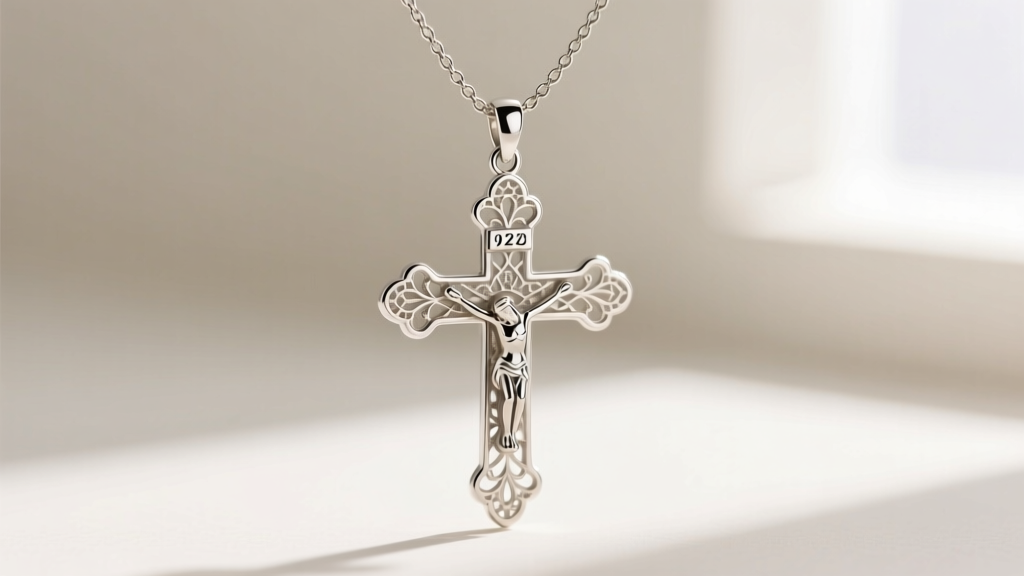
The hardware—the chain links, jump rings, and crucifix—dictates the structural lifespan of the necklace. The Silver Institute outlines the specific mechanical properties of precious metals, which directly inform how they perform under the heavy load of stone beads.
925 Sterling Silver vs. 316L Surgical Steel
Sterling silver (92.5% silver, 7.5% copper) is the traditional choice, offering a bright luster and high value. However, the copper content makes it susceptible to tarnishing and, more importantly, lowers its tensile strength. A standard 925 silver chain will stretch and deform under continuous heavy loads.
Conversely, 316L surgical stainless steel contains molybdenum, which provides immense corrosion resistance and a tensile strength nearly three times that of sterling silver. For a heavy 10mm bead rosary, 316L steel is mechanically superior, though it lacks the intrinsic resale value of precious metals.
Solid Gold Alloys (14k and 18k)
If budget permits, 14k gold (58.5% pure gold) offers the best compromise between luxury and durability. 18k gold is too soft for the spacer chains of a heavy rosary and will quickly succumb to link deformation. Always avoid gold-plated brass or zinc alloys; the base metals will oxidize and turn your skin green once the microscopic plating wears off from friction.
Chain Gauges, Tensile Strength, and Failure Modes
The most critical engineering flaw in mass-produced rosaries is the mismatch between bead weight and chain gauge. The "spacer" chain between the beads and the "drop" chain leading to the crucifix must be calibrated to handle both static weight and dynamic kinetic energy (the pendulum effect when walking).
Gauge Compatibility Matrix
The following table outlines the minimum required chain gauges based on bead diameter and total loop weight. Note that these gauges assume a high-quality cable or box chain construction with fully soldered links.
| Bead Diameter | Avg. Loop Weight | Min. 925 Silver Gauge | Min. 316L Steel Gauge | Recommended Chain Style |
|---|---|---|---|---|
| 4mm - 6mm | 35g - 50g | 0.8mm | 0.6mm | Rolo or Curb |
| 8mm (Standard) | 60g - 85g | 1.0mm | 0.8mm | Box or Wheat |
| 10mm (Heavy) | 90g - 130g | 1.2mm - 1.5mm | 1.0mm | Wheat or Figaro |
Common Structural Failure Modes
- The Centerpiece Junction: The intersection where the main loop meets the drop chain is the highest stress point. Cheap rosaries use a simple, unsoldered jump ring here. A premium rosary will feature a custom-cast, solid-metal junction or a laser-welded, reinforced figure-8 link to prevent the drop from tearing away.
- Crucifix Pendulum Fatigue: A solid metal crucifix can weigh 15g to 30g. As you walk, the crucifix swings, creating kinetic shockwaves that travel up the drop chain. If the link attaching the crucifix is not a heavy-duty, soldered oval jump ring, metal fatigue will snap it within weeks.
- Clasp Incompatibility: A standard spring-ring clasp is entirely insufficient for a mens rosary necklace. The piece must utilize a heavy-duty lobster clasp (minimum 12mm length) or a custom toggle clasp with a tensile rating exceeding 15 lbs.
"A rosary is not just a necklace; it is a kinetic sculpture. Every time the wearer moves, the beads collide and the chains flex. If the metallurgy and gauge tolerances are not engineered for dynamic load, the piece is destined for the repair bench." — Master Bench Jeweler
Proportional Sizing for the Male Silhouette
Unlike standard chain necklaces, a rosary has a complex geometry consisting of the main loop and the terminal drop. Getting the proportions wrong results in a piece that looks either like a choked choker or an awkwardly long pendant.
The Ideal Men's Measurements
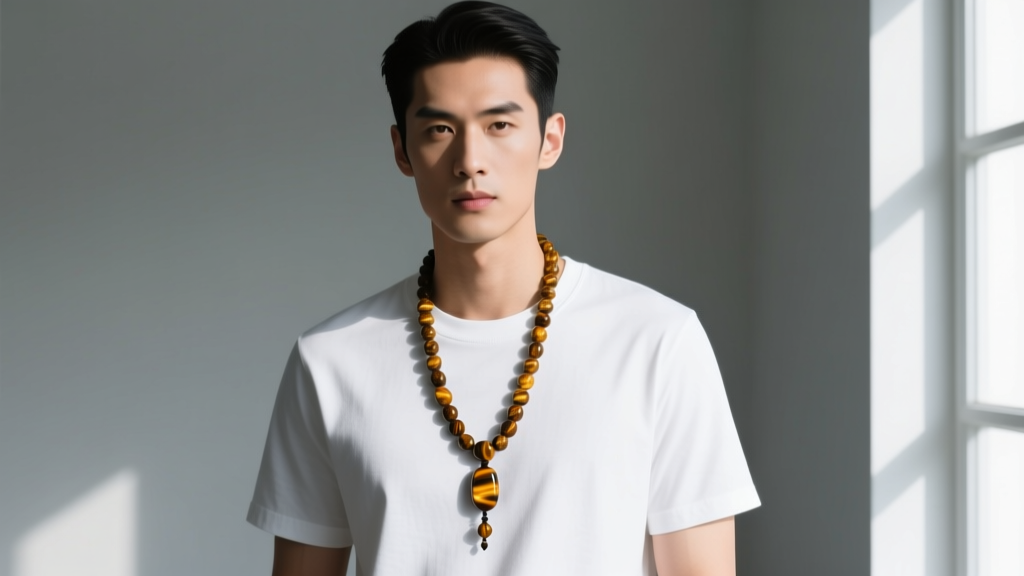
- Main Loop Length (22 to 24 inches): This allows the main sequence of beads to rest comfortably below the collarbone, accommodating the broader neck and chest circumference of the average male. A 22-inch loop sits perfectly over a crewneck t-shirt, while a 24-inch loop is ideal for layering over hoodies or button-down shirts.
- Drop Length (2.5 to 3.5 inches): The drop should be long enough to allow the crucifix to rest visibly on the sternum, but short enough that it doesn't swing wildly or catch on belts and desk edges. A 3-inch drop is the universally flattering standard for men.
- Crucifix Dimensions: For an 8mm bead sequence, the crucifix should measure approximately 1.5 inches (38mm) in height. Anything larger overwhelms the beads; anything smaller looks like an afterthought.
Maintenance and Tarnish Prevention Protocols
Because a mens rosary necklace features intricate links and porous stone surfaces, standard jewelry cleaning methods can be disastrous. Never use ultrasonic cleaners on a rosary featuring Lapis Lazuli, Turquoise, or Malachite, as the high-frequency vibrations will shatter the stones or strip their stabilizing resins.
For 925 sterling silver hardware, utilize a specialized silver polishing cloth impregnated with anti-tarnish compounds once a month. If the beads accumulate skin oils and environmental dust, wash the piece in a bowl of lukewarm water with a single drop of pH-neutral dish soap. Use a soft-bristled baby toothbrush to gently clean the chain links and the drill holes of the beads. Rinse thoroughly and dry immediately with a microfiber cloth to prevent water spots on the stones. By adhering to these strict material and maintenance standards, your rosary will transition from a mere fashion accessory into a resilient, lifelong artifact.