Choosing the Best Metal for Your Minimalist Cross Necklace
Discover the best metals for a minimalist cross necklace. Compare 14k gold, sterling silver, platinum, and titanium for durability, price, and style.

The Structural Demands of Minimalist Jewelry
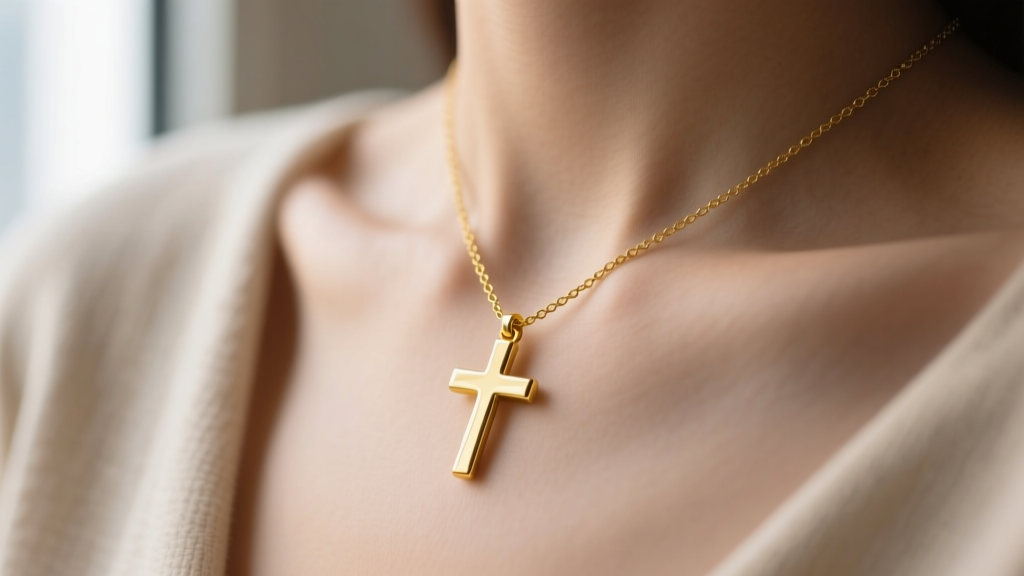
When selecting a minimalist cross necklace, the design's simplicity places an outsized importance on the underlying metallurgy. Unlike heavy, ornate pendants that rely on mass for structural integrity, minimalist jewelry operates on a micro-scale. The cross pendant itself may measure a mere 8mm to 12mm in height, with a thickness of just 1.0mm to 1.5mm. At these dimensions, the choice of metal dictates not only the aesthetic warmth and skin compatibility but also the tensile strength, scratch resistance, and long-term survivability of the piece.
A minimalist cross necklace is typically worn daily, subjected to the friction of clothing, the acidity of sweat, and the occasional accidental snag. Understanding the specific alloy compositions and hardness ratings of available metals is critical to making an investment that will not warp, snap, or tarnish prematurely. Below, we dissect the most common materials used in fine and contemporary jewelry to help you choose the optimal metal for your lifestyle.
Precious Metals Evaluated
Solid Gold: 14k vs. 18k Alloys
Gold remains the benchmark for fine jewelry, but pure 24k gold is far too soft (measuring roughly 25-30 on the Vickers Hardness scale) for a delicate chain and small pendant. Therefore, it is alloyed with metals like copper, silver, and zinc. According to the Gemological Institute of America (GIA), 14k gold contains 58.5% pure gold, while 18k contains 75%.
- 14k Gold: With a Vickers hardness of approximately 140-160 HV, 14k gold offers superior scratch resistance and tensile strength. It is the ideal choice for the ultra-thin chains (0.8mm - 1.0mm) required for a true minimalist aesthetic, as it resists stretching and snapping under tension.
- 18k Gold: Softer (around 120-130 HV) and richer in color, 18k gold is highly prized for its deep yellow hue and hypoallergenic properties. However, an 18k minimalist cross pendant with sharp, thin edges may round off or scratch more easily over years of daily wear.
Sterling Silver (925)
Sterling silver is an alloy comprising 92.5% pure silver and 7.5% copper, as verified by hallmarking standards outlined by the Birmingham Assay Office. The copper addition provides the necessary rigidity for minimalist stamping and casting. However, copper is highly reactive to sulfur and moisture, leading to inevitable tarnishing.
For a minimalist cross necklace, sterling silver is an excellent entry-level precious metal, often priced between $40 and $120. To mitigate tarnish, many jewelers apply a micro-layer of rhodium plating. Be aware that once this plating wears off on high-friction areas (like the bail where the chain meets the cross), the underlying silver will oxidize and require regular polishing with a treated jeweler's cloth.
Platinum (950)
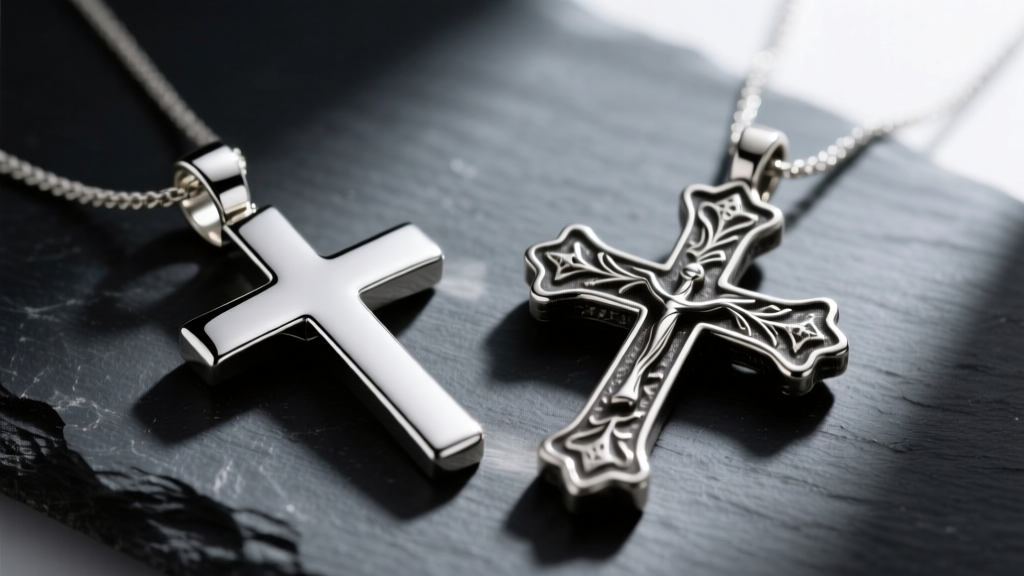
Platinum is the ultimate premium choice, typically alloyed at 95% purity with 5% ruthenium or iridium. It is exceptionally dense (21.45 g/cm³), meaning a minimalist platinum cross will feel noticeably heavier and more substantial on the neck than its gold or silver counterparts. Platinum does not tarnish and is naturally hypoallergenic. When scratched, platinum does not lose metal; rather, the metal is displaced, developing a soft, satiny 'patina' over time. Due to its high melting point and density, platinum minimalist necklaces command a premium, generally starting above $600 for a simple chain and pendant set.
High-Performance Alternative Metals
Grade 5 Titanium (Ti-6Al-4V)
While pure Grade 2 titanium is common in budget jewelry, Grade 5 (an aerospace alloy containing 6% aluminum and 4% vanadium) is the superior choice for minimalist designs. Grade 5 titanium boasts a tensile strength of up to 1,170 MPa, making it virtually impervious to bending or snapping. It is completely impervious to saltwater, chlorine, and sweat, making it the ultimate 'never take it off' metal. The primary drawback is that titanium cannot be resized or easily soldered by traditional jewelers, and it lacks the intrinsic resale value of precious metals.
316L Surgical Stainless Steel
316L stainless steel contains molybdenum, which drastically improves its resistance to pitting and corrosion compared to standard 304 steel. It is highly affordable ($20-$60) and takes a brilliant, mirror-like polish that mimics white gold or platinum. However, 316L does contain trace amounts of nickel (typically 10-14%), which can trigger contact dermatitis in highly sensitive individuals. For a minimalist cross necklace, steel offers exceptional rigidity, ensuring the thin geometric lines of the cross will never warp.
Comprehensive Material Comparison Matrix
| Metal / Alloy | Vickers Hardness (HV) | Tarnish Resistance | Hypoallergenic | Avg. Price Range |
|---|---|---|---|---|
| 14k Solid Gold | 140 - 160 | Excellent | Yes (Usually) | $250 - $500 |
| 18k Solid Gold | 120 - 130 | Excellent | Yes | $400 - $800 |
| Sterling Silver (925) | 60 - 75 | Poor (Oxidizes) | No (Copper alloy) | $40 - $120 |
| Platinum (950) | 110 - 130 | Excellent | Yes | $600 - $1,500+ |
| Grade 5 Titanium | 330 - 350 | Excellent | Yes | $50 - $150 |
| 316L Stainless Steel | 150 - 190 | Very Good | No (Contains Nickel) | $20 - $60 |
Chain Gauge and Clasp Mechanics
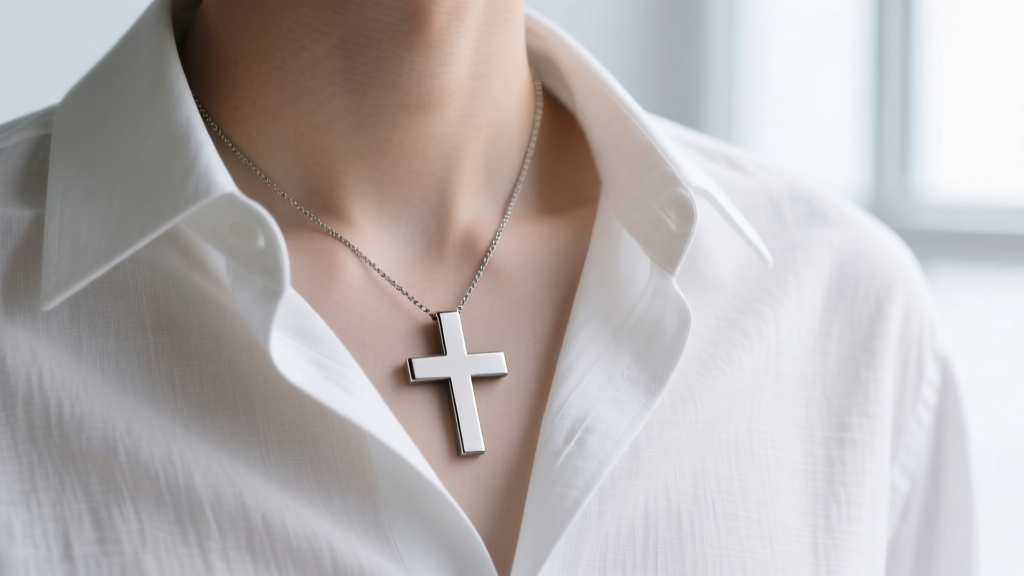
The pendant is only half the equation; the chain dictates the overall minimalist aesthetic and functional lifespan. For a small, lightweight cross pendant, the chain gauge should ideally fall between 0.8mm and 1.2mm. Anything thicker overpowers the minimalist silhouette, while anything thinner than 0.7mm is highly prone to catastrophic failure.
Chain Styles for Minimalist Pendants
- Cable Chains: The classic choice, featuring uniform oval links. While aesthetically perfect for minimalism, cable chains under 1.0mm are vulnerable at the soldered seams. If snagged, the links will pull apart.
- Box Chains: Composed of square, interlocking links. A 0.9mm box chain offers significantly higher tensile strength than a 0.9mm cable chain because the square links distribute tension more evenly and lack fragile solder points.
- Rope Chains: Twisted links that catch the light beautifully. However, the intricate twisting can trap skin oils and lotions, requiring more frequent ultrasonic cleaning to maintain brilliance.
Clasp Selection
Do not overlook the clasp. Standard spring-ring clasps (often found on chains under $100) are notoriously difficult to operate with one hand and feature a weak internal spring that degrades over time. Always upgrade to or seek out a lobster clasp. For a true minimalist look, a 5mm or 7mm lobster clasp provides robust security without adding visual bulk to the nape of the neck.
Final Selection Framework
Choosing the right material for your minimalist cross necklace ultimately depends on your daily environment and maintenance tolerance. If you work in a clinical environment, frequently swim in chlorinated pools, or refuse to remove your jewelry in the shower, Grade 5 Titanium or 14k Solid Gold are your most resilient options. If you prioritize heirloom value, intrinsic worth, and traditional luxury, Platinum or 18k Gold are unmatched. For those seeking a fashion-forward, budget-conscious piece who do not mind occasional polishing with a silver cloth, Sterling Silver remains a timeless, elegant choice.


