Decoding Mood Necklace Colors: Thermochromic Material Properties
Discover the science behind mood necklace colors. We compare thermochromic liquid crystals, temperature triggers, and material durability.

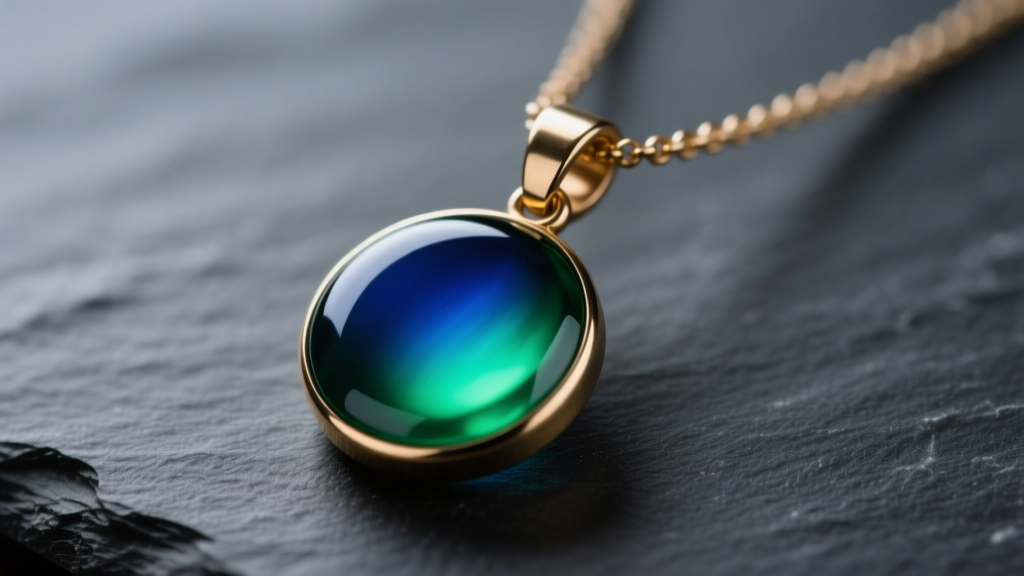
The Chemistry of Color: How Thermochromic Materials Work
When you slip a mood necklace over your head, the immediate shift in the pendant's hue feels almost magical. However, the shifting mood necklace colors you observe are not reacting to your emotional state or aura; they are responding to subtle changes in your peripheral skin temperature. This phenomenon is driven by thermochromism, a material property where a substance changes color due to a temperature variation. To truly understand these pendants, we must look past the 1970s marketing myths and examine the actual chemistry occurring inside the stone.
Historically, mood jewelry relied on cholesteric liquid crystals. These are organic compounds that exist in a phase between a solid and a liquid. According to Compound Interest, these liquid crystals twist into a helical structure. The pitch of this helix—the distance it takes for the molecules to complete one full twist—changes as the temperature fluctuates. When the pitch changes, it alters the wavelength of light that is reflected back to your eye via Bragg diffraction. A tighter twist reflects shorter wavelengths (blues and violets), while a looser twist reflects longer wavelengths (reds and oranges).
In modern 2026 jewelry manufacturing, pure liquid crystals have largely been replaced by microencapsulated leuco dyes. Leuco dyes, such as crystal violet lactone, are mixed with a weak acid and a solvent, then sealed inside microscopic polymer shells. When the solvent melts at a specific threshold, the dye and acid separate, causing the color to vanish or shift. This encapsulation makes modern mood pendants far more durable than their vintage counterparts, though it fundamentally changes the precision of the color spectrum.
Decoding Mood Necklace Colors and Temperature Triggers
The colors displayed by a thermochromic pendant correspond directly to the surface temperature of the skin resting against the metal backing. When you are stressed or anxious, your body undergoes vasoconstriction, pulling blood away from your extremities and skin surface to protect vital organs. This drops your skin temperature, resulting in darker or cooler colors. Conversely, excitement or warmth causes vasodilation, increasing blood flow to the skin and triggering warmer colors.
Below is a standardized material response chart detailing the thermal thresholds of modern leuco-dye mood pendants:
| Color Display | Temperature Range | Physiological State | Emotional Myth |
|---|---|---|---|
| Black / Opaque | Below 72°F (22°C) | Extreme vasoconstriction or cold environment | Stressed, anxious, or fearful |
| Deep Blue / Purple | 72°F - 80°F (22°C - 26°C) | Resting baseline, cool skin | Calm, relaxed, or thoughtful |
| Teal / Green | 81°F - 88°F (27°C - 31°C) | Normal active circulation | Happy, balanced, or friendly |
| Yellow / Orange | 89°F - 94°F (31°C - 34°C) | Increased blood flow, mild exertion | Excited, playful, or creative |
| Red / Pink | Above 95°F (35°C) | High heat, flushing, or fever | Passionate, romantic, or angry |
It is crucial to note that ambient room temperature heavily influences these readings. A pendant worn over a sweater will trap body heat and remain green or orange, while a pendant worn against bare skin in an air-conditioned room may stay blue regardless of your actual mood.
Vintage 1970s vs. Modern 2026 Thermochromic Pendants
If you are comparing a vintage mood necklace from the 1970s to a newly manufactured piece, the material science is vastly different. Understanding these differences is vital for collectors and buyers seeking longevity.
The Vintage Glass Quartz Capsules
Original mood stones were essentially hollow quartz or glass capsules filled with raw liquid crystals. While these offered a beautifully smooth, continuous gradient of color, they were incredibly fragile. The glass was sealed with adhesives that degraded over time. Furthermore, the raw liquid crystals were highly susceptible to UV degradation. Prolonged exposure to sunlight would permanently bleach the molecules, leaving the stone stuck in a permanent, cloudy yellow or clear state.
Modern Polymer Microencapsulation
Today's thermochromic pendants use a completely different architecture. The color-changing leuco dyes are suspended in a resin or polymer matrix. This solid-state approach eliminates the risk of the stone 'leaking' if cracked. Modern manufacturers use melamine-formaldehyde microcapsules that protect the dye from moisture and minor chemical exposures. While the color transitions in modern stones are slightly more abrupt (shifting in distinct bands rather than a seamless gradient), the material stability is exponentially higher.
Material Durability: Why Your Mood Necklace Stops Changing
The most common complaint among thermochromic jewelry owners is the dreaded 'black stone' failure mode. When a mood necklace turns black and refuses to change, it is rarely a reflection of your emotional state; it is a material failure. Here are the primary chemical and physical reasons your pendant stops working:
- Water Ingress and Emulsion Breakdown: Even in modern polymer-set stones, the bezel setting is rarely waterproof. If you shower or swim with your necklace, water seeps behind the stone or into the microscopic pores of the resin. Water disrupts the chemical bond between the leuco dye and the weak acid developer, permanently locking the stone in its unexcited, black state.
- UV Photobleaching: While modern dyes are more resilient, prolonged exposure to direct ultraviolet light will eventually break down the molecular bonds of the crystal violet lactone. If you leave your necklace on a sunny dashboard, the organic dye molecules will fracture, resulting in a permanent loss of thermochromic properties.
- Thermal Shock: Exposing the pendant to extreme heat (such as leaving it near a radiator or dropping it in boiling water) can melt the internal polymer matrix. Once the matrix cools and solidifies unevenly, the dye molecules are trapped and can no longer migrate to create color shifts.
To maximize the lifespan of your thermochromic jewelry, treat it as a delicate scientific instrument rather than everyday hardware. Remove it before bathing, applying lotions, or spending extended time in direct, harsh sunlight.
Thermal Conductivity: The Importance of the Backing Metal
A frequently overlooked aspect of mood necklace colors is the metal backing that sits between your skin and the thermochromic stone. The stone itself does not touch your skin; it relies on the metal to conduct your body heat. Therefore, the choice of metal directly dictates the sensitivity and reaction time of the pendant.
Copper and Brass Alloys: Copper is an exceptional thermal conductor. Vintage and high-end modern mood necklaces often use a copper or brass base plate. This allows rapid heat transfer, meaning the stone will change color within seconds of touching your skin. However, copper can oxidize and cause green discoloration on the skin if not properly sealed with a rhodium or clear enamel coating.
316L Stainless Steel: Many modern, hypoallergenic mood pendants use surgical-grade stainless steel. While excellent for sensitive skin and highly resistant to tarnish, stainless steel is a relatively poor thermal conductor compared to copper. Pendants with steel backings take significantly longer to register temperature changes and may never reach the 'red' or 'orange' thresholds unless the wearer is physically hot, as the metal insulates the stone from rapid heat transfer.
Sterling Silver: Silver offers a middle ground. It conducts heat better than steel and is less prone to causing skin reactions than raw copper. When shopping for a highly responsive mood necklace, look for a sterling silver or copper-alloy backing, and avoid thick, heavy steel settings if you want the full spectrum of color transitions.
How to Spot High-Quality Thermochromic Jewelry
When evaluating a mood necklace, look beyond the initial color flash. Inspect the bezel setting. High-quality pieces will feature a secure, rolled bezel that tightly grips the thermochromic stone, minimizing the gap where moisture can infiltrate. Check the backing material; a thin, slightly domed metal plate will conform better to the hollow of the collarbone, ensuring maximum skin contact and more accurate thermal readings. According to material experts featured in Live Science, the precision of the temperature threshold is entirely dependent on the chemical ratio mixed into the resin, meaning cheaper, mass-produced pendants often have a very narrow color range, usually getting stuck between blue and green. Premium manufacturers calibrate their leuco dye mixtures to trigger precisely at 82°F (27.7°C), ensuring a vibrant and accurate display of the full thermochromic spectrum.


