Moss Agate Bead Necklace Properties: Durability, Grades & Care
Discover the material properties of a moss agate bead necklace. Compare durability, bead grades, and stringing options against jade and aventurine.

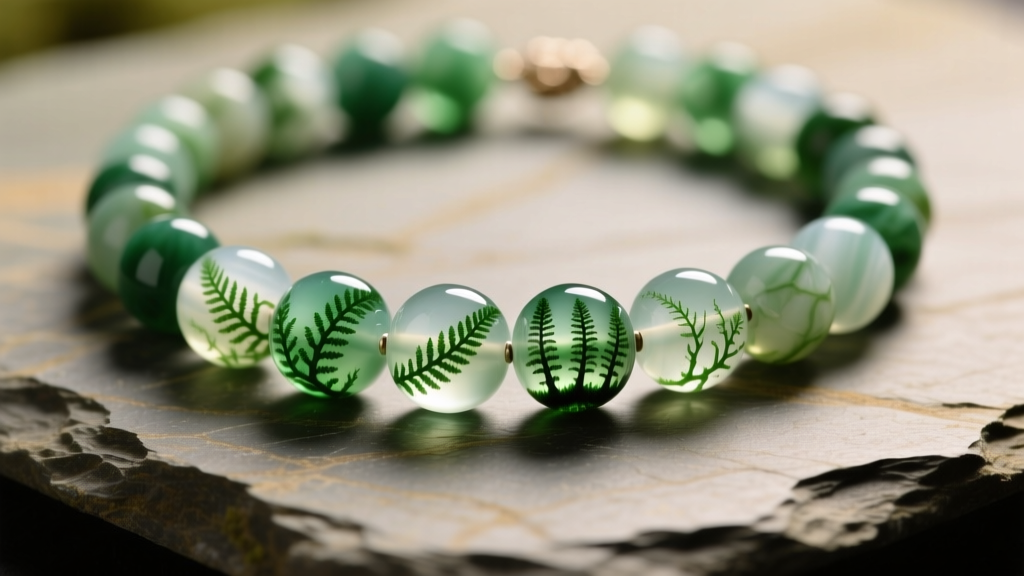
The Mineralogy of Moss Agate: Beyond the Botanical Illusion
When evaluating a moss agate bead necklace, most buyers focus solely on the aesthetic appeal of the botanical inclusions. However, from a gemological and jewelry-making perspective, understanding the underlying material properties is critical for ensuring longevity, proper stringing, and accurate valuation. Despite its name, moss agate is not a true agate. True agates are defined by their concentric banding, whereas moss agate is a variety of dendritic chalcedony, a cryptocrystalline form of quartz. According to the Gemological Institute of America (GIA), chalcedony features a Mohs hardness of 6.5 to 7, making it highly suitable for daily-wear bead necklaces.
The 'moss' or 'fern' patterns are not organic matter but rather dendritic inclusions composed of manganese or iron oxides. These mineral inclusions form when water rich in metal ions permeates the microscopic fissures of the silica gel during the stone's formation. Because the base matrix is silica (SiO2), a moss agate bead necklace possesses excellent scratch resistance. However, the intersection of the silica matrix and the metallic dendrites creates internal structural boundaries that jewelry makers must account for during drilling and stringing.
Material Comparison: Moss Agate vs. Green Lookalikes
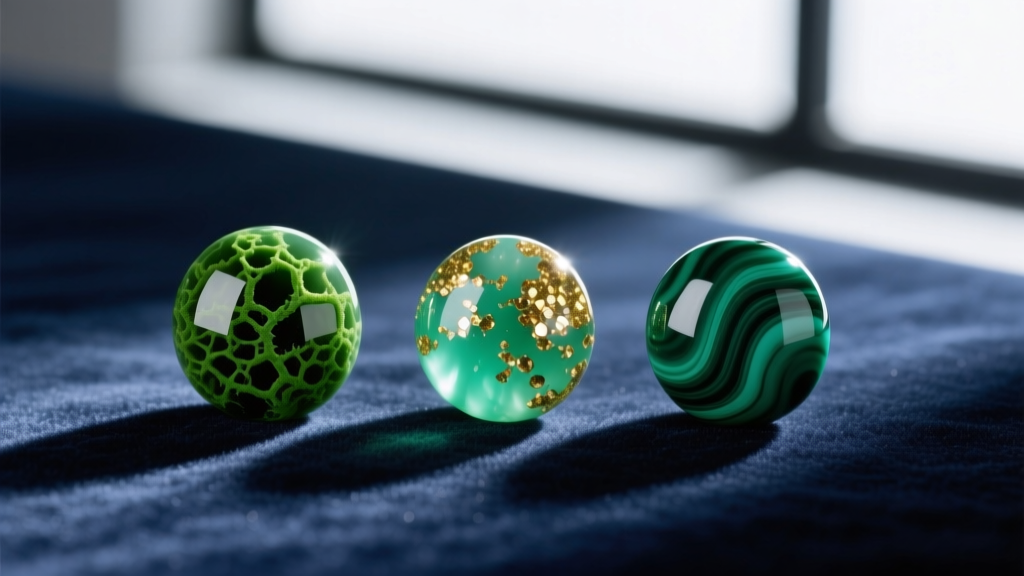
To truly understand the durability of a moss agate bead necklace, we must compare it to other popular green gemstones frequently used in beadwork. While they may look similar in a finished strand, their physical properties dictate entirely different care and stringing requirements. Encyclopedia Britannica notes that cryptocrystalline quartz varieties like chalcedony have a specific gravity of roughly 2.58 to 2.64, which influences the drape and weight of the final necklace.
| Material | Mohs Hardness | Toughness | Porosity | Avg. Price (8mm Strand) |
|---|---|---|---|---|
| Moss Agate (Chalcedony) | 6.5 - 7.0 | Moderate | Very Low | $25 - $45 |
| Green Aventurine (Quartz) | 7.0 | Moderate | Low | $15 - $30 |
| Nephrite Jade | 6.0 - 6.5 | Exceptional | Low | $60 - $150+ |
| Malachite (Copper Carbonate) | 3.5 - 4.0 | Fragile | High | $40 - $80 |
While Nephrite Jade has a slightly lower Mohs hardness, its interlocking fibrous crystal structure gives it superior toughness (resistance to breaking) compared to moss agate. Malachite, conversely, is highly porous, chemically reactive to skin acids, and prone to scratching, making it a high-maintenance alternative to the relatively stable moss agate bead necklace.
Grading Moss Agate Beads: What to Look For
The value and visual impact of a moss agate bead necklace depend heavily on the grading of the beads. The market generally categorizes these beads into three distinct tiers based on matrix transparency and dendrite contrast:
- AAA Grade (Gem Quality): The chalcedony matrix is highly transparent (ice-like or faintly yellow/green). The dendritic inclusions are sharp, well-defined, and exhibit high contrast (deep black or vivid forest green). These beads command premium prices and are typically used in high-end, unknotted wire-strung necklaces.
- AA Grade (Commercial Quality): The matrix is semi-translucent to milky. The dendrites are visible but may appear slightly blurred or 'cloudy' due to the opaque silica base. This is the most common grade found in mainstream retail bead necklaces.
- A Grade (Opaque): The base is largely opaque, white, or gray. The green inclusions lack contrast and appear muddy. These beads are often dyed to enhance their color, a treatment that significantly lowers their material value and requires careful cleaning to prevent dye leaching.
Stringing Mechanics: Choosing the Right Core Material
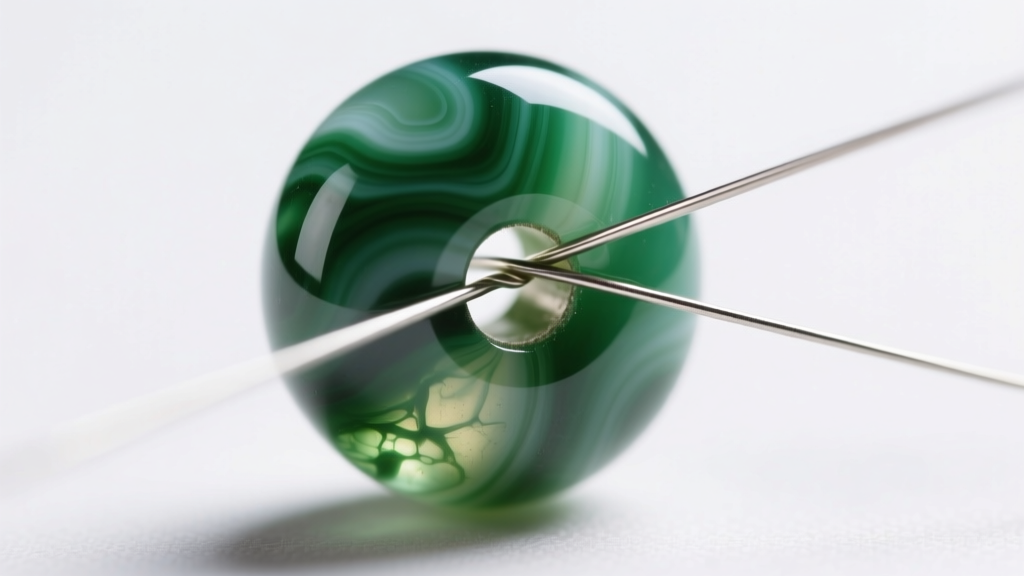
Constructing a durable moss agate bead necklace requires selecting the correct stringing medium. Because chalcedony is a hard material (Mohs 6.5-7), it can act like a saw blade against softer stringing materials over time. Furthermore, the drill holes in 4mm to 8mm beads typically range from 0.8mm to 1.2mm in diameter. If the beads are not tumble-polished perfectly, the interior edges of the drill holes can be microscopically sharp.
Why Silk is a Poor Choice
Traditional silk thread is highly susceptible to friction wear from chalcedony. Within 12 to 18 months of daily wear, the sharp interior edges of moss agate beads can fray and snap a silk core, leading to catastrophic necklace failure. If you prefer the drape of knotted silk, you must use a heavy-duty synthetic alternative like Power Pro braided polyethylene thread (0.008 inch diameter), which offers high tensile strength and abrasion resistance.
The Professional Standard: Coated Micro-Wire
For unknotted moss agate bead necklaces, the industry standard is 49-strand coated stainless steel micro-wire (such as Beadalon 49-strand in 0.018 inch / 0.46mm thickness). The 49-strand construction provides a supple, thread-like drape while the nylon coating prevents the steel from reacting with the environment. Always finish the wire with 2x2mm sterling silver crimp beads and crimp covers to protect the clasp jump rings from metal-on-metal fatigue.
Long-Term Wear, Care, and Failure Modes
While a moss agate bead necklace is highly durable against scratches, it is vulnerable to specific environmental and mechanical stressors. Understanding these failure modes is essential for long-term preservation.
Warning: Never clean a moss agate bead necklace in an ultrasonic cleaner. The high-frequency vibrations and localized heat can cause micro-fractures along the boundaries where the manganese dendrites meet the silica matrix, due to differing thermal expansion coefficients.
Chemical Vulnerabilities
Chalcedony is generally chemically stable, but prolonged exposure to harsh alkaline substances or hydrofluoric acid will etch the surface. More commonly, the accumulation of lotions, perfumes, and natural skin oils can build up in the microscopic surface pits of the beads, causing the necklace to appear dull and cloudy over time. To restore the luster, wash the necklace in lukewarm water with a mild, pH-neutral dish soap, using a soft microfiber cloth to gently buff each bead.
Thermal Shock Risks
Sudden temperature changes can induce internal stress fractures. Leaving a moss agate bead necklace on a car dashboard in direct summer sunlight, or wearing it into a hot sauna followed by a cold plunge, can cause the stones to crack internally. These fractures often originate at the densest clusters of dendritic inclusions, where the structural integrity of the silica matrix is naturally interrupted.
Expert Sourcing and Pricing Benchmarks
When sourcing a moss agate bead necklace, price is a strong indicator of material quality and treatment. Untreated, AAA-grade 8mm strands typically wholesale between $30 and $50, retailing for $80 to $150 depending on the clasp hardware. If you encounter a vivid, perfectly uniform green moss agate necklace selling for under $20, it is almost certainly dyed chalcedony or a glass imitation. Always inspect the beads under a 10x jeweler's loupe; natural dendrites will show organic, branching fractal patterns, whereas dyed stones will reveal concentrated color pooling in the surface-reaching micro-fractures.


