Mother Mary Necklace Gold: An Expert Guide to Karats & Craft
Discover how to select the perfect mother mary necklace gold piece. We analyze 14k vs 18k alloys, casting methods, and chain pairings for lasting wear.

The Metallurgy of Devotion: Choosing the Right Gold Alloy
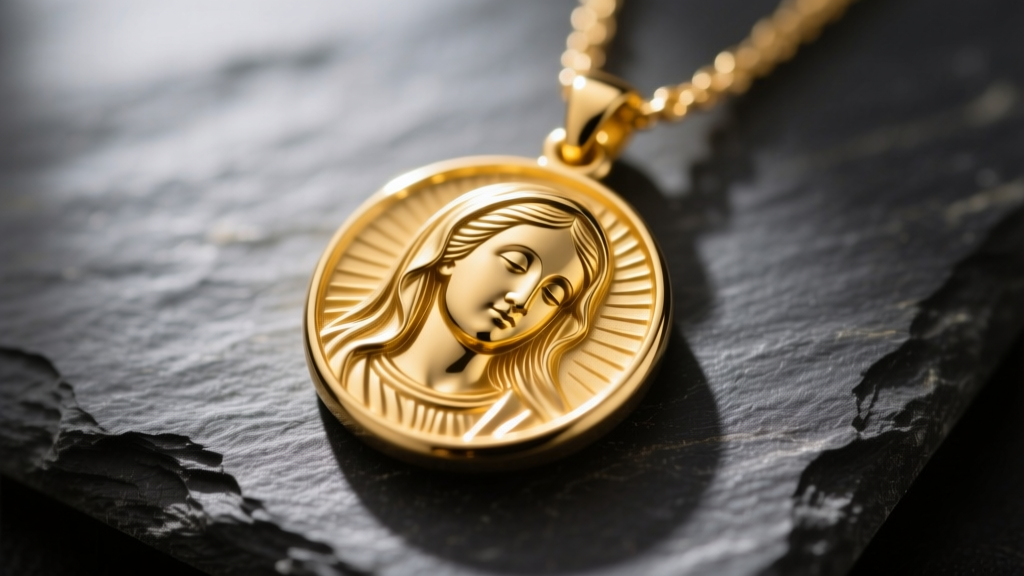
When investing in a mother mary necklace gold piece, understanding the metallurgical properties of the alloy is critical for long-term wear. Pure 24-karat gold is exceptionally soft, registering a mere 25 on the Vickers Hardness (HV) scale. While it offers a rich, uncompromised yellow hue, it is entirely unsuitable for high-relief religious medallions that are worn daily, as the intricate details of the Virgin Mary’s veil and facial features will quickly flatten and scratch.
To achieve the necessary structural integrity, gold is alloyed with metals like copper, silver, and zinc. According to the Gemological Institute of America (GIA), the karat weight dictates not only the color but the tensile strength of the pendant. Below is a technical breakdown of standard gold alloys used in religious jewelry manufacturing:
| Karat | Gold Purity | Vickers Hardness (HV) | Durability Profile | Ideal Application |
|---|---|---|---|---|
| 10k | 41.7% | 130 - 150 HV | Extremely high; resists deep scratching and deformation. | Budget-friendly, high-impact daily wear pieces. |
| 14k | 58.5% | 110 - 130 HV | Excellent balance of hardness and rich color. | The industry standard for heirloom-quality medallions. |
| 18k | 75.0% | 80 - 100 HV | Moderate; prone to surface marring but highly lustrous. | Special occasion pieces or pendants worn over clothing. |
| 22k | 91.6% | 40 - 60 HV | Poor for high-relief; bends easily under pressure. | Flat, die-struck cultural or traditional amulets. |
For a mother mary necklace gold pendant featuring deep sculptural folds, 14k yellow or rose gold remains the optimal choice. The copper content in rose gold not only provides a warm, vintage aesthetic that complements religious iconography but also increases the alloy's overall hardness.
Manufacturing Techniques: Cast vs. Die-Struck Medallions
The method used to form the gold blank fundamentally alters the pendant's density, weight, and longevity. There are two primary manufacturing techniques utilized in fine religious jewelry:
Lost-Wax Casting
Most modern, three-dimensional Mother Mary pendants are created via lost-wax casting. A 3D-printed or hand-carved wax model is encased in investment plaster and burned out in a kiln. Molten gold is then injected into the cavity using a vacuum or centrifugal machine. While this allows for incredible artistic freedom and deep undercut details, improper burnout temperatures can lead to porosity—microscopic gas bubbles trapped within the gold. Porosity weakens the bail (the loop connecting the pendant to the chain) and creates tiny pits on the surface that trap skin oils and dirt.
Die-Striking (Stamping)
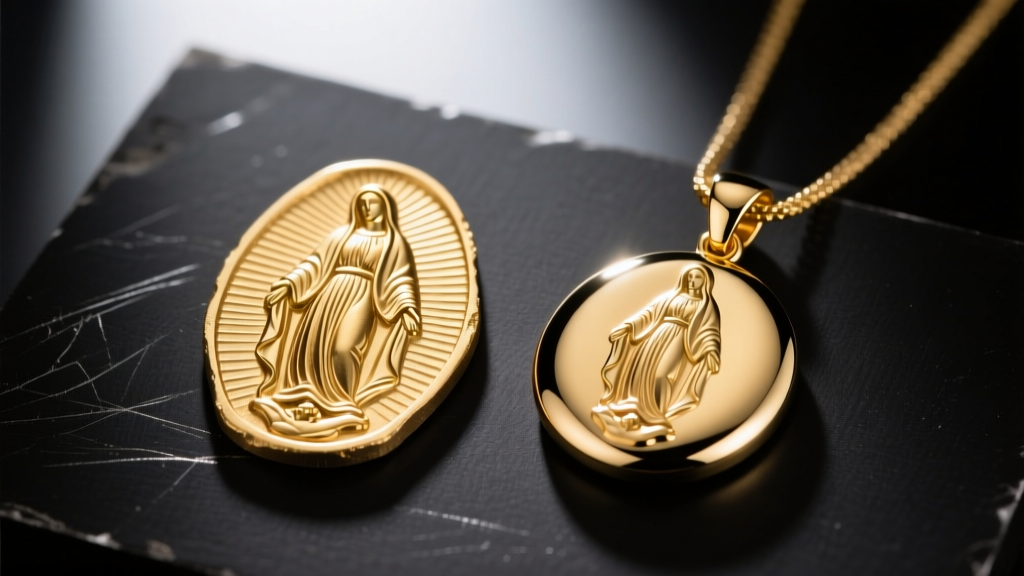
Die-striking involves using immense hydraulic pressure to stamp a gold sheet between two hardened steel dies. This process compresses the gold's molecular structure, resulting in a piece that is significantly denser and harder than a cast equivalent. Die-struck medallions are typically flatter (bas-relief) but are virtually impervious to the porosity issues seen in casting. If you prefer a sleek, vintage-style oval or round medal, a die-struck 14k gold piece will outlast a cast one by decades.
Enamel Embellishments: Vitreous vs. Epoxy
Many premium Mother Mary pendants incorporate blue or white enamel to highlight the halo, robes, or background stars. As a buyer, you must distinguish between true vitreous enamel and synthetic epoxy resin.
- Vitreous Enamel (Champlevé or Cloisonné): This is powdered glass fused to the gold substrate at temperatures exceeding 1400°F (760°C). It is highly resistant to UV fading, chemicals, and scratching. Champlevé involves carving troughs into the gold and filling them, while Cloisonné uses fine gold wires to create cellular boundaries. Vitreous enamel will last centuries without yellowing.
- Epoxy Resin (Cold Enamel): Often found in mass-market or lower-tier gold jewelry, epoxy is essentially a hardened plastic. While it offers vibrant initial colors, it is susceptible to UV degradation, yellowing over time, and can be dissolved by common solvents like acetone or harsh perfumes.
Always inspect the product specifications or ask the jeweler explicitly if the enamel is kiln-fired glass. A genuine vitreous enamel piece will feel glass-smooth and cold to the touch, whereas epoxy may feel slightly warm or waxy.
Chain Selection: Engineering the Perfect Drape and Security
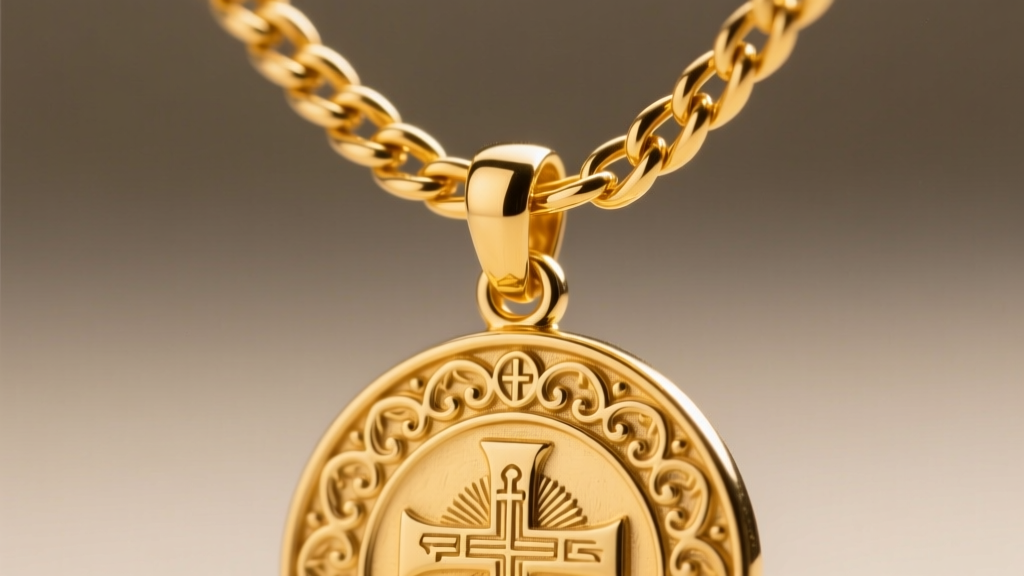
A heavy gold medallion requires a chain engineered for tensile strength. Pairing a 15-gram solid gold pendant with a delicate, hollow chain is a primary cause of jewelry loss. The Federal Trade Commission (FTC) Jewelry Guides strictly regulate the marking of gold weights, but structural integrity is up to the consumer to verify.
Recommended Chain Styles for Heavy Pendants
- Wheat (Spiga) Chain: Composed of interlocking, figure-eight links, the wheat chain is arguably the strongest flexible chain style. Its braided appearance distributes the weight of a heavy Mary pendant evenly, preventing kinking and snapping.
- Box Chain: Featuring square, interlocking links, box chains offer excellent tensile strength and a modern, geometric contrast to the organic curves of a religious medallion. Ensure the links are solid, not hollow.
- Avoid Rope Chains: While visually striking, traditional rope chains are notorious for snagging on clothing and hair. Furthermore, the twisted links can easily crush under the pendulum-like swinging motion of a heavy pendant, leading to structural failure.
Clasp Mechanics
Never rely on a spring-ring clasp for a valuable gold pendant. The internal spring mechanism is prone to fatigue and failure. Always upgrade to a lobster claw clasp or a box clasp with a figure-eight safety catch for pendants exceeding 10 grams.
Hallmark Verification and Avoiding Counterfeits
Authenticating a mother mary necklace gold piece requires looking beyond the surface shine. In the United States and Europe, gold jewelry must bear specific hallmarks indicating its fineness. Look for stamps such as 14K, 585, 18K, or 750. However, a stamp alone is not proof of authenticity, as counterfeiters frequently stamp base metals or gold-plated brass.
For absolute certainty, professional jewelers utilize X-ray Fluorescence (XRF) spectrometers. This non-destructive testing method bombards the pendant with X-rays, measuring the exact elemental composition of the alloy in seconds. If you are purchasing a vintage or estate Mother Mary medallion, insist on an XRF verification to ensure the gold content matches the hallmark and that the piece is not merely heavy gold electroplate (HGE) over a tungsten or brass core.
Maintenance and Patina Management
Gold is non-reactive and will not tarnish like silver, but the alloying metals (particularly copper and silver) can oxidize when exposed to sulfur, chlorine, and human sebum. To maintain the high-polish finish of your pendant's relief details:
- Ultrasonic Cleaning: Safe for plain, solid gold medallions. The high-frequency cavitation will dislodge trapped dirt from the deep crevices of the Virgin Mary's robes. Warning: Never use ultrasonic cleaners if your pendant features vitreous enamel, as the vibrations can shatter the glass.
- Steam Cleaning: Highly effective for blasting away oils from behind the pendant bail and chain links without chemical exposure.
- Polishing: Avoid frequent abrasive polishing. Every time a jeweler uses a rouge wheel to buff out scratches, a microscopic layer of gold is removed. Over a lifetime, aggressive polishing can soften the sharp, high-relief edges of the medallion's facial features.
By prioritizing 14k or 18k solid alloys, verifying the manufacturing technique, and pairing the pendant with a structurally sound wheat or box chain, your mother mary necklace gold piece will remain a pristine, enduring symbol of faith for generations.


