Material Guide: Choosing a Multi Colored Jade Necklace
Discover the material properties, grading systems, and value factors of a natural multi colored jade necklace before you buy.

The Mineralogy Behind Multi Colored Jade
When collectors and gemologists discuss jade, they are typically referring to two distinct minerals: nephrite and jadeite. While both have been carved into jewelry for millennia, a genuine multi colored jade necklace is almost exclusively crafted from jadeite. Nephrite, an amphibole mineral with the chemical formula Ca2(Mg,Fe)5Si8O22(OH)2, tends to form in monochromatic bands of deep green, creamy white, or black. Jadeite, a pyroxene mineral (NaAlSi2O6), possesses a more complex crystalline structure that readily accepts a wider variety of trace elements during its metamorphic formation, resulting in the spectacular color zoning prized by high-end jewelers.
The presence of multiple colors in a single jadeite boulder is a geological anomaly. It requires highly specific shifts in temperature, pressure, and chemical environments over millions of years. According to the Gemological Institute of America (GIA), jadeite forms in high-pressure, low-temperature subduction zones. As hydrothermal fluids permeate the rock fractures, they deposit different trace minerals at varying stages of crystallization, creating the distinct, sharp color boundaries seen in premium multi-color bead necklaces.
The Chemistry of Color Zoning
To understand the value of these necklaces, one must understand the chemical drivers of jadeite's color palette:
- Imperial and Apple Green: Driven by chromium (Cr3+) substituting for aluminum in the crystal lattice.
- Lavender and Lilac: Historically debated, but modern spectroscopy points to manganese (Mn3+) and trace titanium interacting with the crystal field.
- Russet, Yellow, and Brown: Caused by secondary oxidation. Iron (Fe3+) rich fluids seep into the microscopic grain boundaries of the jadeite long after its initial formation, creating a 'rind' or outer layer of warm earth tones.
- Icy White: Represents pure, unadulterated sodium aluminum silicate without trace element interference.
Decoding the Colors: Natural vs. Treated
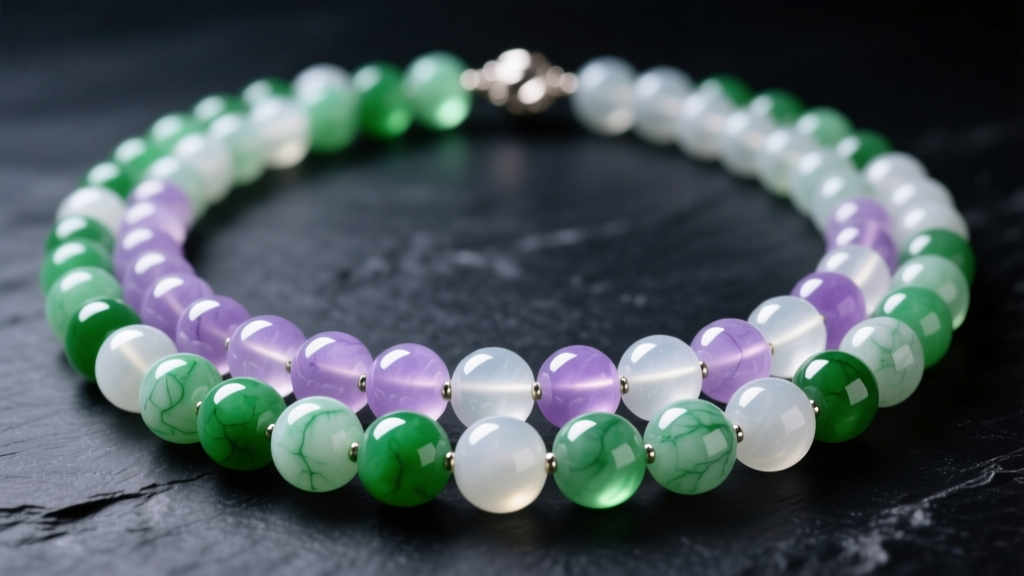
The most sought-after multi colored jade necklace configuration is the 'Fu Lu Shou' (Happiness, Prosperity, Longevity) tri-color combination, featuring green, lavender, and white or yellow in a single strand. Because natural tri-color jadeite of high translucency is astronomically rare, the market is heavily saturated with treated alternatives. Understanding the ABC grading system is non-negotiable for serious buyers.
The Jade Treatment Matrix
The GIA's comprehensive guide on jade treatments outlines how chemical alterations impact both the beauty and the structural integrity of the stone. Below is a comparison of the standard market grades:
| Grade | Treatment Process | Material Impact | Value Retention | UV Fluorescence |
|---|---|---|---|---|
| Type A | Untreated (only traditional plum wax polishing) | Preserves natural interlocking granular structure | Excellent (Appreciates over time) | Inert to weak green |
| Type B | Acid-bleached and polymer-impregnated | Destroys crystal boundaries; resin fills voids | Poor (Yellows and degrades in 5-10 years) | Strong blue-white (from resin) |
| Type C | Chemically dyed | Dye concentrates along grain boundaries and fractures | Negligible (Fades with UV/sweat exposure) | Varies (often red/orange under filter) |
| Type B+C | Bleached, polymer-impregnated, and dyed | Severe structural compromise; entirely artificial color | None (Considered costume jewelry) | Strong blue-white with dye patches |
When evaluating a multi colored jade necklace, pay close attention to the transition lines between colors. In natural Type A jadeite, color boundaries are often sharp but exhibit subtle microscopic blending. In dyed Type C jade, the green or lavender pigment will visibly pool in the microscopic fractures and grain boundaries, creating a 'spiderweb' effect under 10x magnification.
Durability and Wearability Metrics
Jade is famously durable, but its material properties require specific care, especially when fashioned into a bead necklace where individual stones knock against one another. Jadeite registers a 6.5 to 7 on the Mohs hardness scale, making it slightly softer than quartz or beryl. However, hardness (scratch resistance) should not be confused with toughness (fracture resistance).
Jadeite's exceptional toughness stems from its interlocking granular crystal habit. Unlike diamonds, which possess distinct cleavage planes that can split upon impact, jadeite lacks true cleavage. This means a high-quality multi colored jade bead necklace can withstand significant daily wear and tear without chipping. However, if the beads are Type B (acid-bleached), the internal crystal lattice has been compromised. The polymer resin used to fill the acid-etched voids has a Mohs hardness of only 2.5 to 3. Over time, the resin will scratch, dull, and eventually chip away, leaving the bead structurally fragile and prone to catastrophic cracking.
Pricing Tiers for Multi Colored Jade Necklaces
The valuation of a multi colored jade necklace is dictated by the 'Four Cs' adapted for jade: Color, Clarity (translucency), Cut (bead symmetry), and Carat (overall weight). Because multi-color stones often sacrifice some translucency for color saturation, pricing is heavily weighted toward the distinctness and vibrancy of the color zoning.
'A natural, untreated tri-color jadeite bead necklace with high translucency and vivid saturation is not just jewelry; it is a tangible asset class that frequently outperforms traditional equities at international auction houses.' — Asian Art Auction Analytics, 2025 Market Report.
Market Price Breakdown (2026 Estimates)
- Investment Grade (Type A, High Translucency): $50,000 to $500,000+. Beads are perfectly matched, colors are vivid (e.g., imperial green + deep lavender), and the stone has an icy, glass-like luster. Requires documentation from top-tier labs like SSEF or Gubelin.
- Commercial Fine (Type A, Opaque to Semi-Translucent): $3,000 to $15,000. Colors are distinct and natural, but the jadeite has a heavier, more opaque 'glutinous rice' texture. Excellent for daily wear and long-term retention.
- Utility/Treated Grade (Type B+C): $50 to $300. Mass-produced, chemically altered stones. The colors are often unnaturally bright and uniformly distributed. Sold in tourist markets and fast-fashion outlets.
How to Authenticate Your Jade Necklace
Relying on the 'cold to the touch' test or the 'sound of clinking beads' is insufficient for modern gemological verification. To ensure your multi colored jade necklace is a natural Type A specimen, professional testing is mandatory.
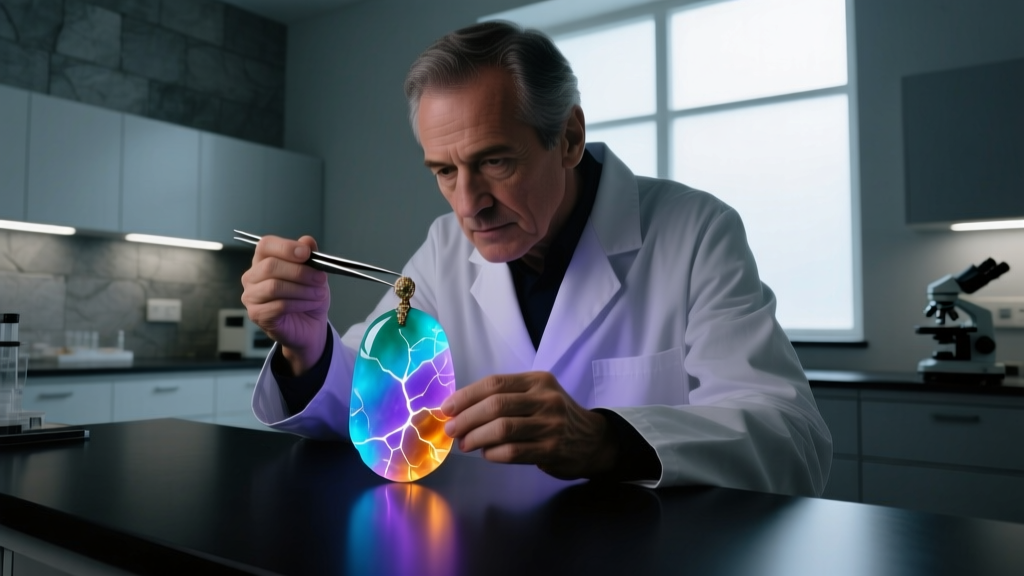
Gemologists utilize a refractometer to check for jadeite's characteristic point reading of 1.66. Furthermore, specific gravity testing is crucial; natural jadeite will consistently measure between 3.30 and 3.36. If a multi-color necklace measures closer to 2.50, it is likely quartz (aventurine) dyed to mimic jade. Finally, infrared spectroscopy (FTIR) is the definitive test for detecting the polymer resins used in Type B treatments, as the resin produces a distinct absorption peak in the 2800-3100 cm-1 range that natural jadeite completely lacks.
Final Verdict: Sourcing with Confidence
A multi colored jade necklace is a masterpiece of geological chance. When sourcing, always demand a recent gemological certificate from a reputable, independent laboratory that explicitly states 'No indications of treatment' or 'Natural Jadeite Type A.' Avoid sellers who use vague terminology like 'Grade A jade' without the accompanying spectroscopic data. By understanding the mineralogy, treatment matrices, and structural durability of jadeite, you can confidently acquire a piece that is not only visually breathtaking but geologically authentic and financially enduring.