Multi Gemstone Necklaces: A Gemological & Structural Deep Dive
Explore the gemology, metallurgy, and structural engineering behind high-end multi gemstone necklaces in this expert technical deep dive.

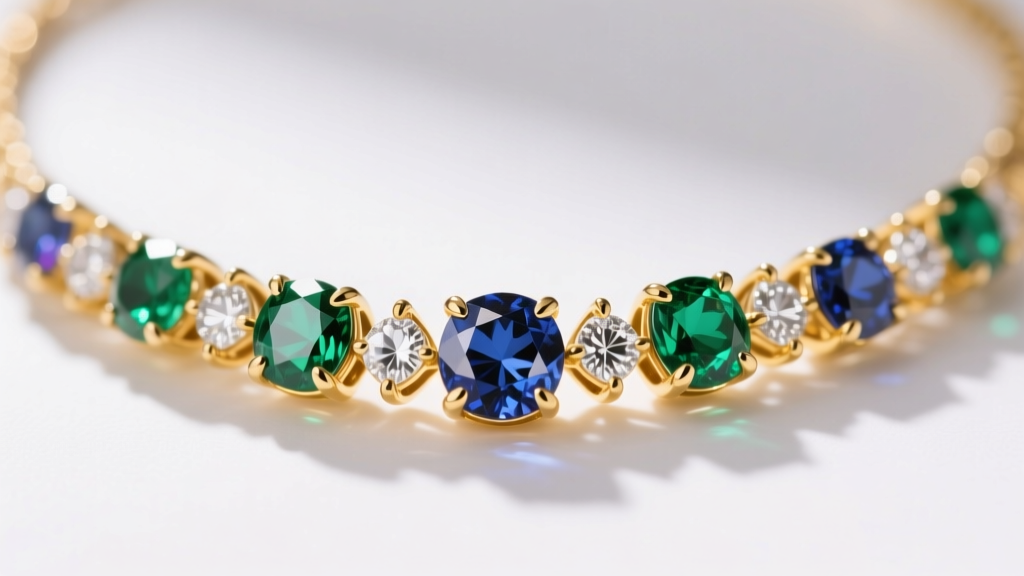
Multi gemstone necklaces represent one of the most complex intersections of gemology, metallurgy, and structural engineering in fine jewelry. While a single-stone pendant relies on a centralized weight distribution and uniform hardness, a multi-stone array introduces dynamic stress points, differential wear rates, and optical interference. In this expert deep dive, we dissect the technical specifications that separate heirloom-quality multi gemstone necklaces from structurally compromised pieces.
The Gemological Challenge of Mixed Hardness
When designing or purchasing multi gemstone necklaces, the Mohs scale of mineral hardness is your primary blueprint for longevity. However, a common misconception is that the Mohs scale is linear. It is, in fact, logarithmic. A diamond (Mohs 10) is not merely twice as hard as a topaz (Mohs 8); it is approximately four times harder than corundum (Mohs 9) and exponentially harder than quartz (Mohs 7).
If a jeweler sets a diamond directly adjacent to an emerald (Mohs 7.5-8) in a shared prong or bead setting, the diamond will act as an abrasive. Over years of wear, the microscopic friction will dull the emerald's girdle and potentially cause chipping along its natural cleavage planes.
Actionable Framework: Always group gemstones within a 1-point Mohs tolerance in shared settings. If a design requires mixing diamonds with softer stones like opal (Mohs 5.5-6.5) or turquoise (Mohs 5-6), the softer stones must be isolated using bezel settings or separated by metalwork dividers (such as milgrain or gold beads) to prevent stone-on-stone contact. For more on gemstone durability, refer to the Gemological Institute of America (GIA) gem care guidelines.
Metallurgy and Chain Tensile Strength
The aggregate weight of multi gemstone necklaces frequently exceeds standard jewelry parameters. A well-calibrated necklace featuring forty 2-carat mixed stones carries roughly 80 carats (16 grams) of gemstone weight alone. When combined with an 18k gold setting, the total pendant or center-cluster weight can easily surpass 35 grams.
Standard 14k gold cable chains at 1.0mm thickness possess a tensile yield point that will permanently deform under a static load of just 12-15 grams. To support multi-stone arrays, structural upgrades are non-negotiable.
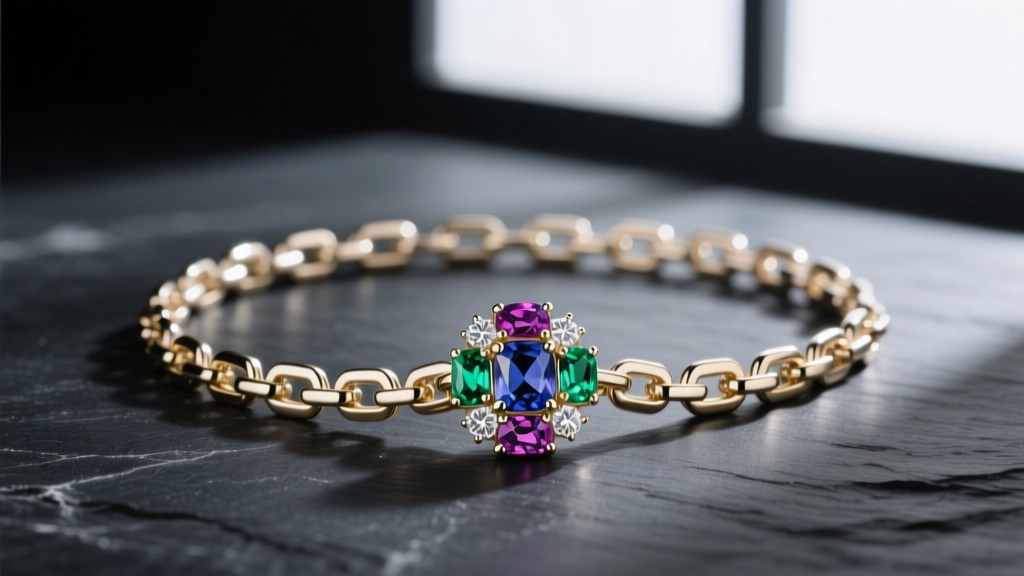
Chain Selection Matrix for Heavy Arrays
- Wheat Chains (1.5mm - 2.0mm): The interlocking, multi-directional links distribute weight laterally, offering superior tensile strength for heavy center clusters.
- Box Chains (2.0mm+): Excellent for geometric, Art Deco-style multi-stone pieces, though the sharp internal corners of the links can cause accelerated wear if the jump ring is not perfectly soldered.
- Rope Chains (2.5mm+): Ideal for flexible, draped multi-stone bib necklaces, providing high shear strength and excellent drape.
Expert Note: Always ensure the jump ring connecting the clasp to the chain is laser-welded or soldered shut. A simple open jump ring will slowly pull apart under the pendulum effect of a heavy multi-stone centerpiece.
Setting Techniques for Multi-Stone Arrays
The setting architecture dictates both the security of the stones and the overall light return. In multi gemstone necklaces, the transition between different cuts requires specialized setting techniques to maintain structural integrity.
| Setting Type | Best Application | Security Level | Light Performance |
|---|---|---|---|
| Shared Prong | Uniform round stones of identical mm size | Medium | Maximum (85%+ light return) |
| Bezel | Softer stones (opal, tanzanite) or active wear | High | Reduced (blocks crown angles) |
| Channel | Calibrated baguettes or princess cuts | High | Moderate (requires precise depth) |
| Flush/Gypsy | Heavy, durable stones (sapphire, ruby) | Very High | Low (stone sits below metal) |
Never use shared prongs for stones with varying girdle thicknesses. A thick-girdled diamond next to a thin-girdled aquamarine will force the prong to sit unevenly, creating a fulcrum point that will eventually pop the aquamarine out of the setting under minor torsional stress.
Color Theory and Refractive Index Matching
Beyond physical durability, the optical physics of multi gemstone necklaces dictate their visual success. Every gemstone possesses a specific Refractive Index (RI), which measures how much light bends as it enters the stone.
Diamond has an RI of 2.42, while amethyst sits at 1.54-1.55. When placed directly next to each other in a poorly lit environment, the diamond will capture and bend ambient light aggressively, while the amethyst will appear flat, glassy, and "dead" by comparison.
The Optical Solution: Master jewelers use "transitional stones" or strategic metalwork to bridge vast RI gaps. For instance, placing a high-RI white sapphire (1.76-1.77) between a diamond and a lower-RI colored stone creates a gradual optical step-down, preserving the brilliance of the entire array. Furthermore, utilizing open-back (à jour) settings ensures that light enters the pavilion of lower-RI stones from behind, compensating for their inherent optical limitations.
Pricing, Valuation, and Appraisal Metrics
Appraising multi gemstone necklaces requires a highly specialized approach, as the value is rarely a simple sum of its parts. In the wholesale market, smaller accent stones (under 0.15 carats) are traded in "parcels" priced by total carat weight, rather than individually graded.
However, in high-end multi-stone pieces, the color-matching tolerance dictates the premium. A necklace featuring 20 perfectly matched Paraíba tourmalines (neon blue-green) commands an exponential premium over 20 slightly mismatched stones, even if the total carat weight and clarity grades are identical.
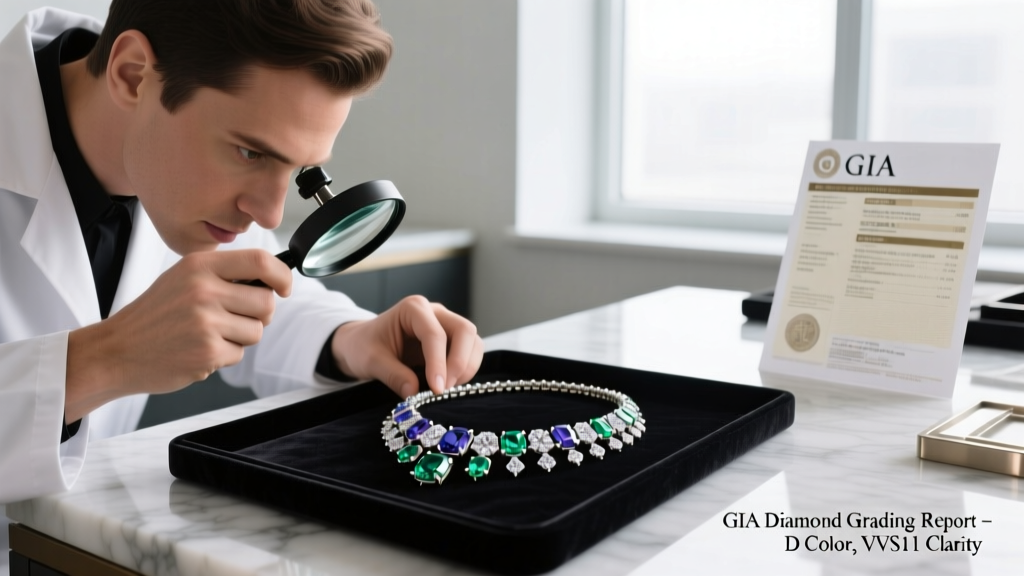
When reviewing an appraisal, ensure the document specifies the origin and treatment of every major stone type. A multi-stone necklace featuring unheated Burmese rubies and untreated Colombian emeralds requires laboratory reports to substantiate the valuation. According to the GIA laboratory reporting standards, full disclosure of treatments like fracture-filling or lattice diffusion is legally required for accurate insurance replacement valuation.
Maintenance and Ultrasonic Cleaning Risks
The most common point of catastrophic failure for multi gemstone necklaces occurs not during wear, but during cleaning. The standard industry practice of using ultrasonic cleaners is highly dangerous for mixed-stone jewelry.
Ultrasonic waves create microscopic cavitation bubbles that implode against the jewelry. While this safely removes sebum and dirt from diamonds and sapphires, it will shatter emeralds (which are almost universally fracture-filled with cedar oil or Opticon), strip the polish from opals, and cause severe pitting in turquoise.
Safe Cleaning Protocol for Mixed Arrays
- Identify the Weakest Link: Base your cleaning method on the most fragile stone in the necklace, not the most durable.
- Thermal Shock Prevention: Never use hot water on multi-stone pieces containing tanzanite or opal, as rapid temperature changes can cause internal fracturing.
- The Brush Method: Use a soft, untreated goat-hair brush with a mild, non-detergent soap (like Castile soap) and lukewarm distilled water. Avoid tap water, as the chlorine and fluoride can degrade the polish of softer organic gems like pearls or coral often integrated into multi-stone designs.
By respecting the gemological and metallurgical boundaries of the materials involved, collectors and designers can ensure that multi gemstone necklaces remain structurally sound and optically brilliant for generations.


