Is My Cross Necklace Real? Technical Appraisal & Metal Testing
Learn to appraise, test, and restore your jewelry. Our expert guide covers metal hallmarks, chain gauges, and structural integrity for my cross necklace.


When evaluating a cherished piece of jewelry, particularly one with sentimental or religious significance, determining its exact material composition and structural integrity is paramount. Many individuals inherit or purchase a piece and eventually ask, 'Is my cross necklace real?' Answering this requires moving beyond superficial visual inspections and employing professional gemological and metallurgical testing methods. This expert deep dive explores the technical specifications of cross necklaces, from decoding microscopic hallmarks and understanding specific gravity to analyzing chain gauge tolerances and bail mechanics.
Decoding Hallmarks: The First Step in Appraisal
The most immediate indicator of metal purity is the hallmark, typically stamped on the bail (the loop connecting the pendant to the chain) or the clasp of the necklace. However, hallmarks can be easily faked or worn away over decades of use. According to the Federal Trade Commission's Jewelry Guides, manufacturers must adhere to strict tolerances when stamping karatage, but vintage or imported pieces may follow different international standards.
Common Purity Stamps and Their Meanings
- 925 or Sterling: Indicates 92.5% pure silver and 7.5% alloy (usually copper). If your piece is marked '925' but has a yellow gold appearance, it is likely gold vermeil (which legally requires a minimum of 2.5 microns of gold plating over sterling silver).
- 10K (417), 14K (585), 18K (750): These numbers represent the parts per thousand of pure gold. 14K gold is the industry standard for durable everyday chains, offering an optimal balance of tensile strength and rich color.
- 1/20 14K GF: This denotes 'Gold Filled,' meaning 1/20th of the total weight of the item is 14K gold mechanically bonded to a brass core. This is vastly superior to standard electroplating and will not easily flake.
If the hallmark on your piece is rubbed smooth, professional assay testing becomes mandatory to verify the authenticity of the metal.
Non-Destructive and Micro-Destructive Testing Methods
To definitively answer whether the metal in your piece is solid, plated, or an entirely different base alloy, jewelers utilize a hierarchy of testing methods. The Gemological Institute of America (GIA) emphasizes the importance of using multiple testing modalities to confirm metal identity, especially when dealing with heavily oxidized or antique pieces.

Testing Modalities Comparison
| Testing Method | Mechanism | Accuracy & Limitations |
|---|---|---|
| Magnet Test | Checks for ferromagnetic base metals (iron, steel, nickel). | Low accuracy. Gold and silver are non-magnetic, but so are copper, brass, and lead. Only useful for ruling out cheap steel fakes. |
| Specific Gravity (SG) | Calculates density by weighing the piece in air vs. suspended in water. | High accuracy for solid items. Fails if the cross pendant is hollow, contains trapped air, or is heavily set with gemstones. |
| Acid Testing (Touchstone) | Scratches the metal on a stone and applies nitric acid of varying strengths. | Medium accuracy. Micro-destructive. Can accurately differentiate between 10K, 14K, and 18K based on the dissolution rate of the alloy. |
| XRF Spectrometry | Uses X-ray fluorescence to read the exact elemental composition at the surface level. | Extremely high accuracy for surface alloys. Cannot detect thick lead or tungsten cores hidden beneath heavy gold plating. |
For a standard appraisal of a solid gold or silver cross, specific gravity testing is the most reliable non-destructive method. Pure 24K gold has a specific gravity of 19.32 g/cm³, while 14K yellow gold typically measures around 13.5 g/cm³, and sterling silver sits at 10.3 g/cm³. If your piece registers a significantly lower density, it is likely hollow or heavily plated over a lightweight base metal like aluminum or resin.
Chain Gauge, Bail Mechanics, and Structural Failure Points
A cross necklace is only as secure as its weakest mechanical link. The intersection of the chain, the clasp, and the pendant bail is subjected to continuous kinetic stress. Understanding the engineering of these components is crucial for long-term preservation.
Bail Engineering and Compatibility
The bail dictates how the pendant hangs and interacts with the chain. Standard loop bails are soldered to the top of the cross and work best with flexible chains like box or rope chains. Tube bails enclose the chain entirely, providing a seamless look but restricting the chain width to under 2.0mm. Hidden bails (often used in diamond-encrusted crosses) feature a folding mechanism that snaps shut over the chain. The primary failure point in hidden bails is the micro-hinge, which can accumulate skin oils and debris, eventually seizing or snapping under tension.
Chain Gauge and Tensile Strength
When evaluating the chain accompanying your piece, gauge thickness is the primary metric for durability. A delicate 0.8mm to 1.0mm cable chain is suitable for lightweight, hollow-backed crosses weighing under 3 grams. However, if your piece is a solid 18K gold crucifix weighing 10 grams or more, a 1.0mm chain will eventually suffer from link elongation and failure. For heavier pendants, a 2.0mm to 3.0mm rope or Figaro chain is required. These chains feature interlocking or twisted links that distribute the pendant's weight across multiple surface area contact points, drastically reducing the risk of tensile snapping.
Clasp Mechanics: Spring Ring vs. Lobster
Many vintage necklaces feature spring ring clasps. These rely on a tiny internal steel spring that is highly susceptible to corrosion from sweat and humidity. Once the internal spring fails, the clasp becomes inoperable. Upgrading to a cast lobster claw clasp or a box clasp with a safety figure-eight catch is a standard technical recommendation for securing valuable religious pendants.
Professional Restoration vs. DIY Maintenance
Maintaining the structural and aesthetic integrity of your jewelry requires knowing when to intervene and when to seek professional bench jewelers. Improper cleaning or repair attempts frequently cause irreversible damage to antique and vintage pieces.
The Dangers of Ultrasonic Cleaning
While ultrasonic cleaners operating at 40 kHz frequencies are excellent for removing sebum and dirt from bare metal chains, they are highly destructive to certain gemstones often set in vintage crosses. Emeralds are almost universally treated with cedar oil to mask internal fractures; ultrasonic vibrations will boil the oil out, leaving the stone cloudy and heavily fractured. Turquoise, opals, and lapis lazuli are porous and can absorb the cleaning solution, leading to permanent discoloration or structural shattering. For gemstone-set crosses, professional steam cleaning or gentle manual brushing with a soft-bristle brush and mild surfactant is the only safe protocol.
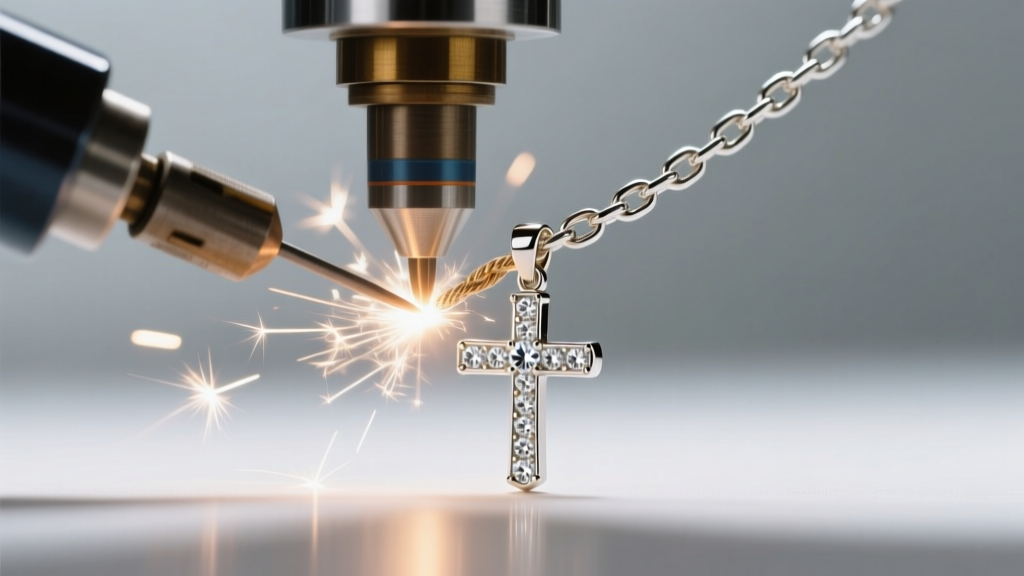
Laser Welding for Prong Retipping and Chain Repair
If the diamonds or gemstones in your cross are loose, traditional torch soldering poses a severe risk of thermal shock to the stones. Modern bench jewelers utilize laser welding technology, which focuses a high-intensity beam of light onto a microscopic 0.2mm area. Using argon gas shielding to prevent oxidation, a jeweler can retip a worn prong or fuse a broken 1.5mm chain link without transferring heat to the surrounding gemstones or altering the temper of the gold alloy. When seeking restoration, always inquire if the jeweler possesses laser welding capabilities, as this is the gold standard for precision repair on delicate religious jewelry.
Ultimately, answering the question of authenticity and quality requires a systematic approach. By verifying hallmarks, conducting specific gravity tests, and evaluating the mechanical engineering of the chain and bail, you can ensure that your piece remains structurally sound and materially verified for generations to come.


