The Nail Cross Necklace: Metallurgy, Sizing & Chain Pairing Guide
Explore the technical details of the nail cross necklace. Learn about 316L steel vs cast silver, chain weight ratios, and oxidation finishes.

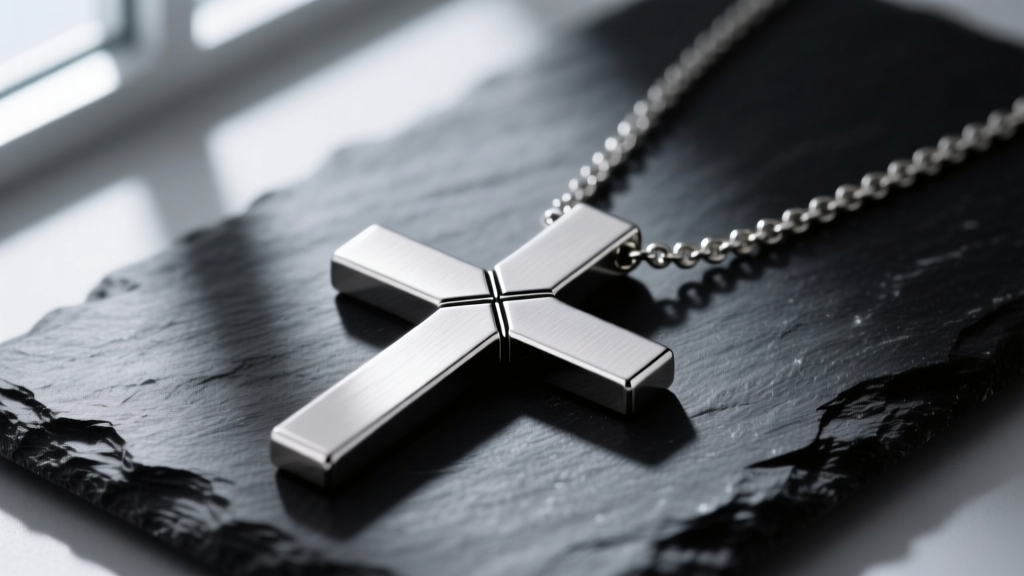
The Anatomy of a Nail Cross Pendant
The nail cross necklace represents a striking intersection of industrial brutalism and traditional iconography. Unlike standard die-struck religious jewelry, a true nail cross relies on raw, linear geometry—two intersecting cylinders that mimic forged carpentry nails. From a metallurgical and design perspective, executing this aesthetic requires precise attention to weight distribution, material porosity, and structural integrity. In this deep dive, we examine the engineering and styling mechanics behind the nail cross pendant, moving beyond superficial fashion trends into the tangible data of jewelry fabrication.
Custom Forging vs. Lost-Wax Casting
The manufacturing method dictates the pendant's durability and surface texture. Artisan blacksmiths typically use custom forging for carbon steel and iron nail crosses. Forging aligns the metal's grain structure, resulting in a denser, more impact-resistant piece with a naturally rugged surface. Conversely, commercial lost-wax casting is the standard for sterling silver and bronze variants. While casting allows for intricate detailing (such as simulated rust pitting or wood grain textures), it can introduce microscopic porosity if the investment flask is not properly degassed. When purchasing a cast silver nail cross, inspect the intersection joint; a poorly cast piece will show a visible seam line or pitting at the cruciform junction.
Material Grades & Corrosion Resistance
Because the nail cross motif heavily leans into oxidized, weathered, or raw industrial aesthetics, material selection is critical to prevent unwanted degradation. Human skin has an average pH of 4.7 to 5.75, which is acidic enough to accelerate the oxidation of reactive metals.
| Material | Grade / Standard | Mohs Hardness | Corrosion Risk | Avg. Price Range |
|---|---|---|---|---|
| Carbon Steel | 1045 / 1095 High Carbon | 5.5 - 6.5 | High (Requires clear coat or wax) | $40 - $90 |
| Stainless Steel | 316L Surgical (Marine Grade) | 5.5 - 6.0 | Extremely Low (Molybdenum additive) | $35 - $75 |
| Sterling Silver | 925 (7.5% Copper Alloy) | 2.5 - 3.0 | Moderate (Tarnishes, requires polishing) | $120 - $280 |
| Bronze | Jeweler's Bronze (90% Cu, 10% Zn) | 3.0 - 4.0 | Moderate (Develops verdigris patina) | $60 - $140 |
According to metallurgical standards outlined by the Jewelers of America, 316L stainless steel is vastly superior to 304 stainless for body-worn jewelry. The addition of molybdenum in 316L specifically inhibits chloride corrosion, making it impervious to sweat and saltwater. If you want the look of raw iron without the rust stains on your collarbone, 316L with a dark gunmetal PVD (Physical Vapor Deposition) coating is the optimal technical choice.
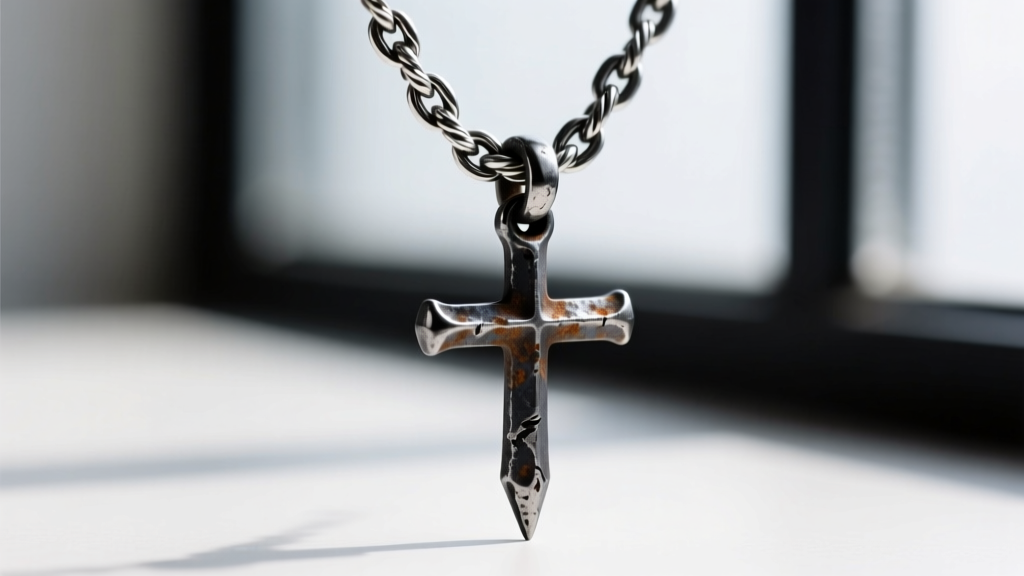
Chain Mechanics: Load-Bearing & Tension
A common failure point in heavy, industrial-style pendants is the chain. Forged steel nail crosses frequently weigh between 20g and 45g. Suspending this mass requires an understanding of dynamic loading—the sudden tensile spikes that occur when the pendant swings and catches on clothing.
Calculating the Pendant-to-Chain Weight Ratio
As a structural rule of thumb, the pendant should not exceed 30% of the chain's rated tensile breaking point for daily wear. Furthermore, the bail (the loop connecting the pendant to the chain) must accommodate the chain's thickness without causing abrasive wear.
- Cable Chains (1.5mm - 2.0mm): Unsoldered links will pull apart under a 30g+ nail cross. Avoid for heavy pendants.
- Curb Chains (3.0mm - 5.0mm): Interlocking, flat links distribute weight laterally. A 4mm solid curb chain offers exceptional tensile strength and complements the brutalist geometry of the nail cross.
- Rope Chains (2.5mm - 4.0mm): The twisted helix structure provides high flexibility and a tensile strength that easily supports heavy cast silver or bronze nail crosses.
Always verify that the chain features soldered links. If a link is merely bent shut, the lateral torque of a heavy nail cross will eventually pry it open.
Surface Finishes & Oxidation Techniques
The visual impact of a nail cross relies heavily on its surface finish. To achieve an authentic, weathered look without compromising the structural integrity of the metal, jewelers employ specific chemical patinas.
"True industrial patina isn't just paint; it's a controlled chemical reaction. For silver nail crosses, we use liver of sulfur to drive oxygen into the copper alloy, creating a permanent black sulfide layer in the crevices, while leaving the high-polish edges bright." — Master Silversmith Bench Notes
For carbon steel, artisans often use browning solutions (selenium dioxide-based) or controlled flash rusting sealed with a micro-crystalline wax. The Gemological Institute of America (GIA) notes that proper hallmarking and finishing documentation is essential when purchasing oxidized silver, ensuring the darkening is a chemical sulfide rather than a superficial acrylic wash that will chip over time.

Sizing & Proportional Styling Framework
The linear geometry of the nail cross demands precise drop-length selection to align with the wearer's anatomy and wardrobe. Unlike wide or circular pendants, the verticality of the nail cross creates a strong directional line.
Drop Lengths for Different Necklines
- 18-Inch (Collarbone Drop): Best for slender, minimalist nail crosses (under 1.5 inches tall). Sits above the crew-neck line, making it ideal for t-shirts and casual streetwear.
- 22-Inch (Sternum Drop): The optimal length for standard 2-inch to 3-inch nail crosses. The pendant rests on the upper sternum, perfectly framed by the open V of an unbuttoned Oxford shirt or a deep henley.
- 26 to 28-Inch (Layering Drop): Reserved for oversized, heavy forged steel pieces. This length allows the nail cross to hang over hoodies, denim jackets, or serve as the terminal anchor in a multi-chain layering stack.
Maintenance & Rust Prevention Protocols
Maintaining a nail cross necklace requires specific protocols depending on the material and finish. Never use ultrasonic cleaners on chemically oxidized (blackened) silver or bronze nail crosses; the high-frequency cavitation will strip the patina from the recessed intersection joints, leaving the piece looking flat and artificially bright.
For raw carbon steel or iron nail crosses, moisture is the enemy. After wearing the piece against the skin, wipe it down with a microfiber cloth to remove acidic sebum. Apply a micro-thin layer of Renaissance Wax or a specialized jewelry-grade ceramic clear coat every three months. This creates a hydrophobic barrier that preserves the raw, forged texture of the metal while completely neutralizing the risk of iron oxide (rust) transfer onto your clothing. By understanding the metallurgy and mechanics of the nail cross necklace, you can select a piece that is not only visually striking but engineered to last a lifetime.


