The Perfect Necklace to Wear With a Black Dress: A Buying Guide
Discover the perfect necklace to wear with a black dress. Our expert buying guide covers neckline pairings, metal grades, and lengths for any occasion.


The Anatomy of the Little Black Dress Pairing
Finding the ideal necklace to wear with a black dress is an exercise in contrast, proportion, and material science. The 'Little Black Dress' (LBD), a concept immortalized by Coco Chanel and continually reinvented on modern runways, acts as a visual vacuum. Black fabric absorbs nearly all ambient light, meaning any jewelry resting against it must possess inherent brilliance, structural weight, or striking color contrast to avoid looking dull or disconnected. According to style historians at Vogue, the LBD is a blank canvas, but treating it as a simple backdrop often leads to underwhelming styling choices. This buying guide dissects the precise metrics—chain gauge, metal karat, refractive index, and clasp mechanics—required to select a necklace that elevates rather than competes with your black dress.
Matching Necklace Lengths to Specific Necklines
The most critical failure point when styling a black dress is ignoring the neckline architecture. A necklace must either mirror the dress's geometry or intentionally disrupt it to create a flattering vertical line. Below is a technical matrix for pairing chain lengths with standard LBD necklines.
| Neckline Type | Ideal Length | Chain Style & Pendant | Why It Works |
|---|---|---|---|
| V-Neck | 17-19 inches (Princess) | 1.5mm Cable chain with a Y-drop or solitaire | Elongates the neck and mirrors the V geometry without resting on the fabric hem. |
| Scoop Neck | 14-16 inches (Choker) | Multi-strand or 3.0mm Figaro chain | Fills the negative space above the scoop line, keeping the focus on the collarbone. |
| Boatneck (Bateau) | 20-24 inches (Matinee) | Long pendant or layered opera-length strands | Breaks the harsh horizontal line of the boatneck, drawing the eye downward. |
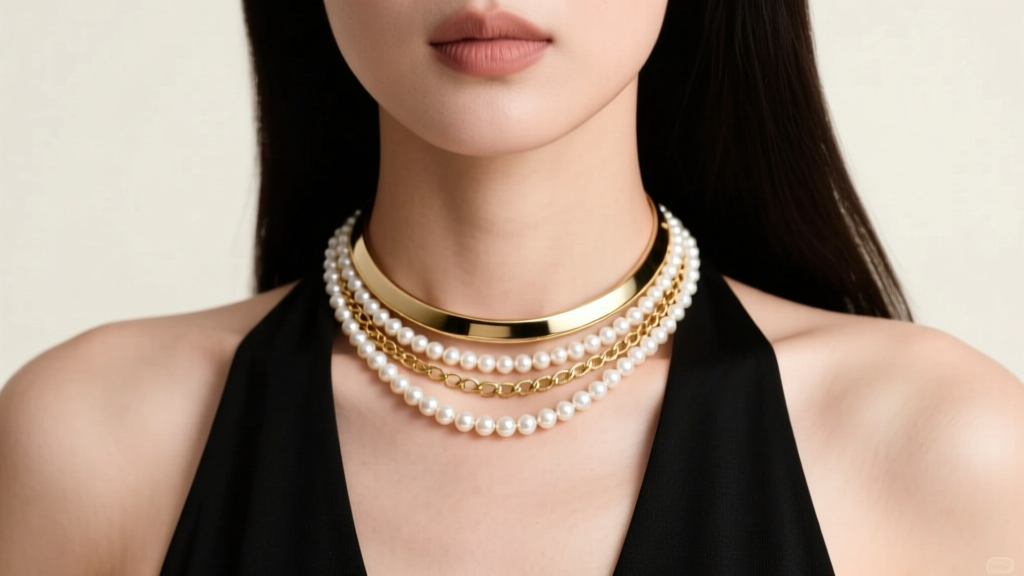
| Halter | 12-13 inches (Collar) or None | Thick metallic collar or skip for earrings | Halters crowd the neck; a rigid collar sits above the fabric tie, avoiding tangles. |
| Sweetheart | 16-18 inches (Choker/Princess) | Curved bar pendant or diamond tennis necklace | Follows the natural curve of the bustline without crossing the sweetheart dip. |
For a comprehensive breakdown of how these lengths sit on various body types, jewelry educators at Brilliance recommend measuring your exact neck circumference and adding the desired drop length before purchasing, as a 16-inch chain will sit entirely differently on a 13-inch neck versus a 15-inch neck.
Material & Metal Grade Guide: What Actually Works
Because black absorbs light, the metal grade you choose dictates the necklace's visibility and longevity. Fashion alloys often look muddy against dark fabrics. Here is what to look for in the metal composition.
Yellow Gold (14k vs. 18k)
Yellow gold provides the highest natural contrast against black. An 18k yellow gold chain (75% pure gold) possesses a rich, buttery hue that practically glows against dark cotton or silk. However, 18k is softer. If you are buying a delicate chain (under 1.2mm) to wear frequently, opt for 14k yellow gold (58.3% pure gold), which is alloyed with silver and copper for higher tensile strength, preventing the chain from stretching or snapping under the weight of a pendant.
White Gold and Platinum
White metals can sometimes look flat against black if they lack a high-polish finish. If choosing white gold, ensure it is freshly rhodium-plated. Rhodium is a platinum-group metal that provides a mirror-like, highly reflective surface. This reflectivity is crucial; without it, the underlying pale-yellow hue of unplated white gold will look dingy against the stark black dress. Platinum (95% pure) is naturally white and hypoallergenic, making it an excellent, albeit heavier and more expensive, choice for statement pieces.
Sterling Silver and Tarnish Risks
Sterling silver (92.5% silver, 7.5% copper) is a budget-friendly alternative to white gold. However, the copper content makes it prone to oxidation. When wearing sterling silver against a black dress, ensure the piece is rhodium-plated or treated with an anti-tarnish coating like e-coating. Unsealed silver can react with skin oils and humidity, leaving unsightly gray or greenish smudges on the collar of your expensive black dress.
Gemstone Selection: Refractive Index and Contrast
Not all gemstones survive the visual gravity of a black dress. The secret lies in the gemstone's Refractive Index (RI) and opacity. According to the Gemological Institute of America (GIA), a diamond's exceptional RI of 2.42 and high dispersion create the 'fire' and 'brilliance' necessary to stand out in low-light evening settings where black dresses are most commonly worn.
- Diamonds & Moissanite: The ultimate choice for LBDs. Their ability to reflect ambient light ensures the necklace remains the focal point.
- Pearls: White Akoya pearls offer a striking, classic contrast. Avoid dark Tahitian pearls unless they exhibit strong, vibrant peacock or aubergine overtones; otherwise, they will visually sink into the black fabric.
- Emeralds & Sapphires: Deep green and blue stones look regal against black, provided they are well-lit. Ensure the stones are not overly included or dark in tone, as 'inky' sapphires will disappear.
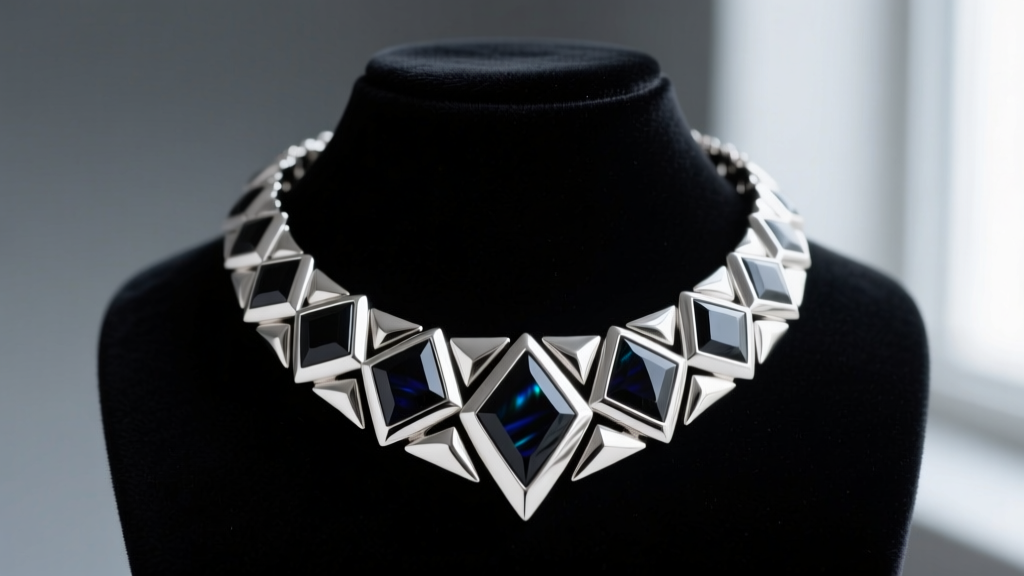
- Stones to Avoid: Solid black onyx, dark obsidian, and jet. Unless set in heavy, textured yellow gold bezels, black-on-black styling often lacks the necessary dimension and reads as a styling error rather than an intentional choice.
Troubleshooting Common LBD Jewelry Mistakes
Even with the right length and metal, mechanical failures can ruin your outfit. Here are specific troubleshooting frameworks for common issues.
The 'Flipping' Pendant Problem
If your solitaire pendant constantly flips backward, hiding the stone against your skin, the chain is too light for the pendant's center of gravity. The Fix: Upgrade to a chain with a heavier gram weight or a different weave. A 2.0mm rope chain or a box chain provides a wider surface area and more friction against the skin and fabric, keeping the pendant anchored facing forward.
Clasp Snagging on Delicate Fabrics
Black dresses are frequently made from delicate materials like chiffon, silk, or fine knits. Standard spring-ring clasps or lobster clasps with exposed levers can catch and pull threads. The Fix: Look for necklaces featuring a seamless barrel clasp, a hidden magnetic clasp, or a polished toggle clasp. If you must use a lobster clasp, ensure the lever is flush and the soldering at the jump rings is completely smooth.
Sweat and Perfume Degradation
Black fabric hides sweat stains, but your jewelry will absorb the salt and acids, accelerating tarnish. Furthermore, applying perfume directly to the décolletage before putting on a pearl or porous gemstone necklace will degrade the nacre over time. The Fix: Always apply cosmetics and fragrances 15 minutes before dressing. Wipe your necklace down with a dry, lint-free microfiber cloth immediately after taking it off to remove acidic skin oils.
Final Sizing & Purchasing Checklist
Before checking out, run your selection through this final quality-assurance checklist:
- Verify the Karat Stamp: Look for 14k, 18k, 585, or 750 stamps on gold, and 925 for sterling silver.
- Check the Clasp Mechanism: Ensure the clasp is proportional to the chain. A heavy pendant requires a reinforced lobster clasp, not a tiny spring ring.
- Evaluate the Bail: The bail (the loop connecting the pendant to the chain) should be lined with a hard metal or have a smooth interior to prevent it from acting like a saw, slowly cutting through your chain over time.
- Confirm the Return Policy: Lighting in stores or online renders colors differently. Ensure you can return the piece if the metal tone does not provide enough contrast against your specific black dress in your home lighting.
Selecting the right necklace to wear with a black dress is not about following fleeting trends; it is about mastering the interplay of light, geometry, and metallurgy. By prioritizing high-contrast metals, appropriate refractive gemstones, and snag-free mechanics, you ensure your jewelry enhances the timeless elegance of the LBD rather than detracting from it.


