Necklace Cross Women's Styles: A Technical Buying Guide
Explore the metallurgy and engineering of necklace cross women's styles. Expert insights on gold alloys, chain tensile strength, and manufacturing.


When evaluating the structural integrity and aesthetic longevity of a necklace cross women's styles demand for daily wear, one must look far beyond the surface polish. The intersection of faith, fashion, and metallurgical engineering dictates how well a pendant will survive decades of friction, tension, and environmental exposure. As a senior jewelry analyst, I frequently see consumers prioritize carat weight or gemstone clarity while entirely ignoring the grain structure of the metal, the tensile strength of the chain, and the load-bearing mechanics of the bail.
This technical deep dive deconstructs the anatomy of the cross pendant. We will examine the Vickers hardness of various gold alloys, compare the microscopic differences between cast and die-struck manufacturing, and establish a data-driven framework for selecting a chain that will not fail under dynamic stress. Whether you are sourcing a delicate 10k gold piece or a heavy platinum crucifix, understanding these engineering principles is non-negotiable.
Metallurgical Science: Gold Alloys and the Vickers Scale
The durability of a gold cross pendant is not determined by its purity, but by its alloy composition. Pure 24k gold is far too malleable for daily wear; a thin arm on a 24k cross would bend permanently if caught on a heavy sweater. To achieve structural rigidity, gold is alloyed with metals like copper, silver, zinc, and nickel.
14k vs. 18k Gold: The Hardness Trade-off
According to data from the World Gold Council, 18k gold contains 75% pure gold and typically registers around 125 on the Vickers Hardness (HV) scale. It offers a rich, warm color but is relatively soft. Conversely, 14k gold (58.5% pure gold) is alloyed with a higher percentage of copper and silver, pushing its hardness to approximately 135-145 HV. For a classic, flat cross pendant with thin, elongated arms, 14k gold provides superior yield strength, resisting deformation and retaining its sharp, stamped edges far longer than 18k.
Platinum and White Gold: Density and Rhodium Plating
For those preferring a silver hue, the choice between platinum and white gold involves a trade-off between density and maintenance. Platinum (usually 95% pure, alloyed with ruthenium or iridium) is incredibly dense and heavy, giving a substantial feel to the cross. However, platinum is prone to developing a soft patina over time due to metal displacement, not metal loss. White gold, an alloy of yellow gold and white metals like palladium or nickel, is harder but requires periodic rhodium plating to maintain its bright, reflective white finish. If the cross features intricate filigree, platinum is superior as it holds microscopic details without the risk of the rhodium plating wearing away in the crevices.
Manufacturing Techniques: Cast vs. Die-Struck
The method used to form the cross pendant fundamentally alters its internal grain structure, which directly impacts its durability and light reflection.

Lost-Wax Casting: Best for 3D and Ornate Designs
Most modern jewelry, especially intricate 3D crosses or those with heavy gemstone pavé, is created via lost-wax casting. Molten metal is forced into a plaster mold under vacuum or centrifugal pressure. While excellent for complex geometries, casting can introduce microscopic porosity—tiny gas bubbles trapped inside the metal. According to manufacturing standards outlined by Rio Grande, high-quality casters use HIP (Hot Isostatic Pressing) to eliminate this porosity, but lower-tier mass-market castings may have weak points that can fracture under stress.
Die-Striking: The Pinnacle of Structural Integrity
For flat, classic cross designs, die-striking is the superior manufacturing method. A massive hydraulic press forces a hardened steel die into a sheet of gold or platinum with hundreds of tons of pressure. This cold-forging process compresses the metal, aligning its molecular grain structure and eliminating all porosity. The result is a pendant that is significantly denser, harder, and more reflective than a cast equivalent. A die-struck 14k gold cross will resist scratching and bending far better than a cast 18k piece of the exact same dimensions.
Chain Link Integrity and Tensile Strength
The pendant is only as secure as the chain that holds it. The chain is the primary failure point in any necklace assembly, subjected to constant dynamic loading, torsion, and friction. Selecting the right chain requires understanding link mechanics.
- Box Chains: Composed of interlocking square links. They offer excellent tensile strength and lie flat against the skin. However, if a link snaps, the geometric nature of the chain makes it nearly impossible to repair without leaving a visible, rigid weak point.
- Rope Chains: Created by twisting oval links into a spiral. They offer brilliant light refraction but are highly susceptible to snagging on clothing. Once a rope chain kinks, the structural integrity of the twisted links is compromised permanently.
- Cable Chains: The traditional oval-link chain. While they have lower tensile strength than box chains of the same gauge, they are incredibly easy to repair and maintain a fluid, flexible drape.
Metal Alloy and Chain Performance Data
| Metal Alloy | Composition | Vickers Hardness (HV) | Tensile Strength | Best Cross Style Match |
|---|---|---|---|---|
| 14k Yellow Gold | 58.5% Au, Cu, Ag, Zn | ~135 HV | High | Flat, die-struck classic crosses |
| 18k Yellow Gold | 75% Au, Cu, Ag | ~125 HV | Medium | Thicker, cast 3D crosses |
| 950 Platinum | 95% Pt, Ru/Ir | ~130 HV (High Density) | Very High | Heavy, gemstone-set crucifixes |
| Sterling Silver | 92.5% Ag, 7.5% Cu | ~65 HV | Low | Lightweight, casual everyday crosses |
Bail Mechanics and Pendant Engineering
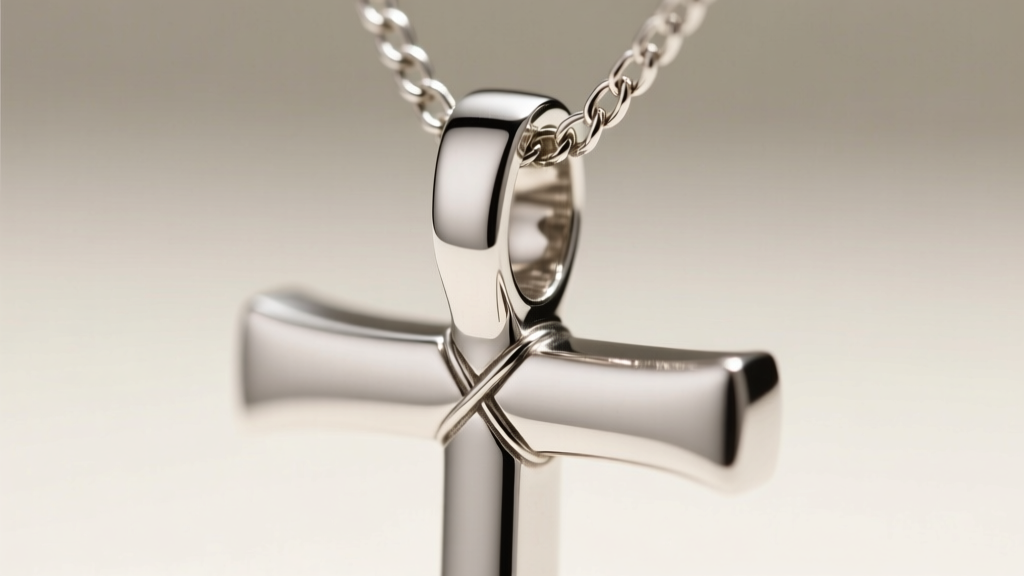
The bail—the component that connects the cross to the chain—is the critical stress node. It must accommodate the lateral movement of the chain while supporting the vertical dead weight of the pendant. The Gemological Institute of America (GIA) frequently notes that improper bail selection is the leading cause of pendant loss.
Pinch Bails vs. Tube Bails
Pinch Bails: These feature two small prongs that are squeezed into pre-drilled holes at the top of the cross. While they allow the cross to hang flush without a visible loop, they rely entirely on friction and the tensile strength of the prongs. For heavy solid gold or platinum crosses, pinch bails are a critical failure risk; a sharp tug will pull the prongs from their seating.
Tube Bails and Soldered Loops: A tube bail is a solid cylinder of metal soldered horizontally across the back or top of the cross. This distributes the dynamic load across a wider surface area of the pendant. For heavy pieces, a laser-welded, solid tube bail is the only structurally sound engineering choice. Ensure the interior diameter of the bail is at least 20% larger than the thickness of your chosen chain to prevent abrasive wear on both the chain and the bail.
Ultrasonic Cleaning and Maintenance Protocols
Maintaining the brilliance of a cross pendant requires understanding how cleaning agents and frequencies interact with specific alloys and gemstone inclusions.
When to Avoid Ultrasonic Cleaners
Ultrasonic cleaners use high-frequency sound waves to create microscopic cavitation bubbles in a liquid solution, which implode and blast away dirt. While excellent for plain metal crosses, they are highly destructive to certain configurations:
- Fracture-Filled Diamonds: If your cross features diamonds that have been clarity-enhanced with lead-glass filling, the ultrasonic vibrations and alkaline cleaning solutions will dissolve the filler, leaving the stones cloudy and fractured.
- Oxidized Silver Details: Many sterling silver crosses feature intentionally blackened crevices (oxidation) to highlight the relief pattern. Ultrasonic cleaning will strip this oxidation, flattening the visual depth of the piece.
- Tension-Set Stones: The high-frequency vibrations can loosen the precise tolerances required to hold stones in tension settings.
The Proper Manual Cleaning Protocol
For daily maintenance of a diamond or plain metal cross, use a solution of warm distilled water and a few drops of mild, non-detergent surfactant (like baby shampoo). Soak the pendant for 15 minutes to loosen sebum and cosmetic buildup. Use a soft-bristled, untreated horsehair brush to gently agitate the back of the cross and the bail area, where skin oils accumulate. Rinse with distilled water to prevent hard water spotting, and dry immediately with a lint-free microfiber cloth. Avoid using compressed air to dry the piece, as the propellant can leave a chemical residue on high-polish surfaces.
Final Engineering Considerations
Investing in a high-quality cross pendant is an exercise in applied materials science. By prioritizing die-struck construction for flat designs, selecting 14k gold for optimal yield strength, and pairing the pendant with a structurally sound box or cable chain, you ensure the piece will withstand the rigors of daily wear. Always inspect the bail and the chain clasp every six months for signs of metal fatigue or abrasive thinning. True luxury in jewelry is not just about the initial visual impact; it is about the enduring, flawless execution of its underlying engineering.


