Necklace H Letter Guide: Material Properties & Care
Compare metals for your necklace h letter. Explore 14k gold, platinum, and silver properties, structural durability, and pricing for initial pendants.

The Structural Challenge of the "H" Initial Pendant
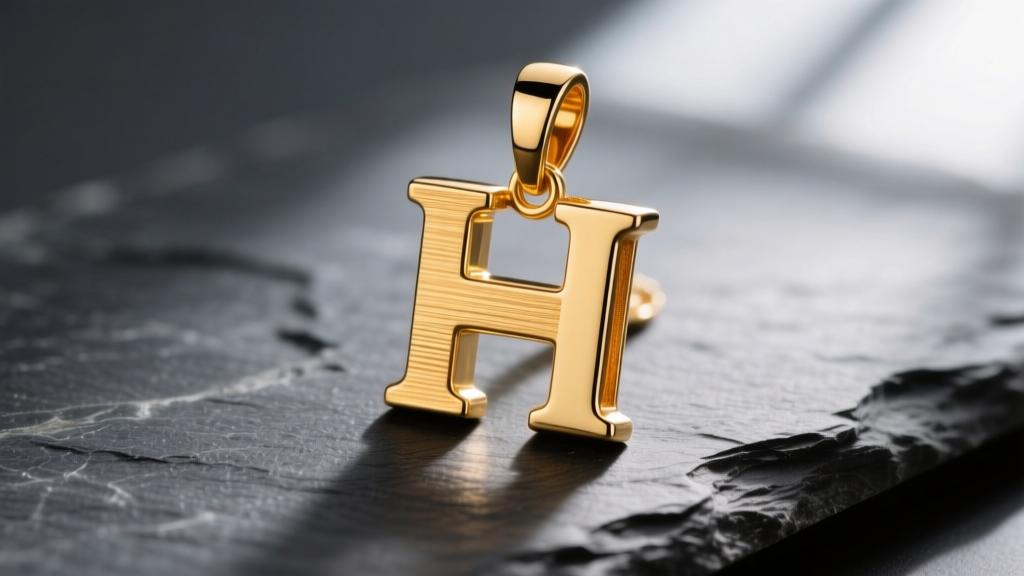
When selecting an initial pendant, the letter "H" presents a unique metallurgical and structural challenge that many buyers overlook. Unlike curved letters such as "S" or "C," or solid letters like "O" or "D," the "H" features a horizontal crossbar connecting two vertical posts. This geometry creates a natural stress concentrator at the junction points. If a necklace h letter pendant is manufactured using thin, stamped sheet metal, the crossbar becomes highly susceptible to bending, warping, or outright snapping under lateral tension.
To ensure longevity, jewelers typically employ two manufacturing methods for H pendants: die-stamping and lost-wax casting. Die-stamped pendants are cut from flat sheets of metal. For an H pendant to survive daily wear in a stamped format, the metal must be at least 16-gauge (1.29mm thick). Anything thinner, such as 20-gauge (0.81mm), will inevitably bend. Cast pendants, on the other hand, allow for three-dimensional depth and beveled edges, but they must be carefully designed so the crossbar maintains a minimum thickness of 1.2mm to prevent shear failure.
Precious Metals: Gold Karats and Platinum
The material you choose for your necklace h letter dictates not only the color and price but also the tensile strength and scratch resistance of the crossbar. According to the Gemological Institute of America (GIA), the alloy mix in gold significantly impacts its durability.
14k Gold (58.3% Pure Gold)
14k gold is the industry standard for everyday initial necklaces. Alloyed with copper, silver, and zinc, 14k yellow gold achieves a Vickers Hardness (HV) of approximately 140-160. This hardness provides excellent resistance to the micro-abrasions that occur when the pendant rubs against the chain bail. A solid 1.5-gram 14k gold H pendant typically retails between $180 and $300, making it the optimal balance of durability and cost.
18k Gold (75% Pure Gold)
While 18k gold offers a richer, deeper yellow hue, it is notably softer, with a Vickers Hardness of around 120-130 HV. For an H letter pendant, this means the high-polish edges and the crossbar will accumulate scratches more rapidly. Furthermore, the bail loop will wear down faster due to chain friction. If you choose 18k gold, ensure the pendant is cast with a reinforced, thickened bail.
Platinum 950
Platinum is exceptionally dense and possesses high tensile strength, meaning the crossbar of an H pendant will almost never snap. However, platinum has a lower Vickers Hardness (around 80 HV) than 14k gold, meaning it displaces metal rather than losing it when scratched, developing a patina over time. Because of its density, a solid platinum H pendant will weigh roughly 60% more than its gold counterpart, requiring a heavier chain to support it without dragging. Expect to pay between $450 and $700 for a solid platinum H initial.
Material Comparison Chart
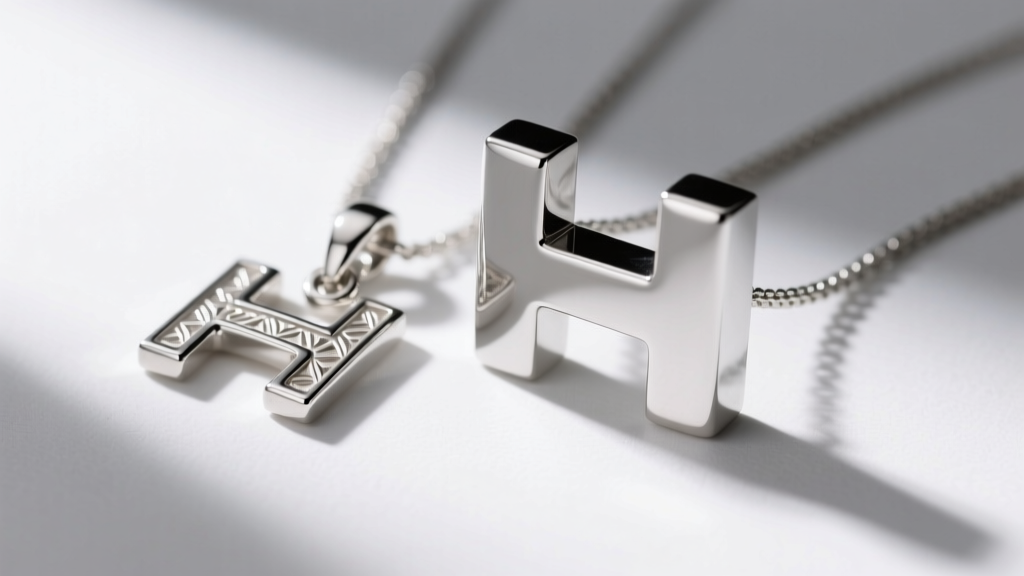
Use the following data table to compare the physical properties and market pricing for a standard 1.5-gram H letter pendant across popular jewelry metals.
| Material | Vickers Hardness (HV) | Tensile Strength | Avg. Price (1.5g) | Best For |
|---|---|---|---|---|
| 14k Yellow Gold | 140 - 160 | Moderate-High | $180 - $300 | Daily wear, high scratch resistance |
| 18k Yellow Gold | 120 - 130 | Moderate | $250 - $400 | Occasional wear, rich color preference |
| Platinum 950 | 80 - 90 | Very High | $450 - $700 | Heirloom pieces, structural integrity |
| Sterling Silver (925) | 60 - 70 | Low-Moderate | $40 - $85 | Budget-friendly, fashion layering |
| Grade 5 Titanium | 334 | Extremely High | $60 - $120 | Active lifestyles, hypoallergenic needs |
Alternative Metals: Titanium and Stainless Steel
For those seeking maximum durability or hypoallergenic properties, alternative metals offer compelling benefits for a necklace h letter design.
Titanium (Grade 2 vs. Grade 5)
Titanium is incredibly lightweight and completely hypoallergenic. However, not all titanium is equal. Grade 2 titanium is commercially pure but relatively soft. Grade 5 titanium (Ti-6Al-4V) is an aerospace-grade alloy that boasts a Vickers Hardness of 334 HV. An H pendant machined from Grade 5 titanium is virtually indestructible in everyday scenarios. The crossbar will not bend, and the bail will not wear through. The trade-off is that titanium cannot be easily resized or repaired by traditional jewelers using standard torches.
316L Stainless Steel
Surgical-grade 316L stainless steel is highly resistant to tarnish and corrosion. It is an excellent choice for a budget-friendly H pendant that will be exposed to sweat and moisture. However, steel is notoriously difficult to cast with fine detail, so steel H pendants are almost exclusively laser-cut or stamped, resulting in sharper, less refined edges compared to cast precious metals.
Diamond Pavé vs. Solid Metal H Pendants
Many buyers opt for a diamond pavé necklace h letter, where the surface of the gold or platinum is encrusted with micro-set diamonds. While visually stunning, pavé settings introduce significant structural vulnerabilities. The process of drilling micro-holes into the metal to set the stones removes material from the pendant, effectively thinning the crossbar and vertical posts.
If you choose a pavé H pendant, the base metal must be platinum or 14k gold to maintain structural integrity; 18k gold and sterling silver are too soft to securely hold micro-prongs under stress. Furthermore, the horizontal crossbar of the H is prone to catching on fabrics, which can lift the tiny prongs and result in diamond loss. According to the Jewelers of America, pavé jewelry requires professional prong-checking at least twice a year to prevent stone loss.
Chain Pairings: Matching Weight and Bail Size
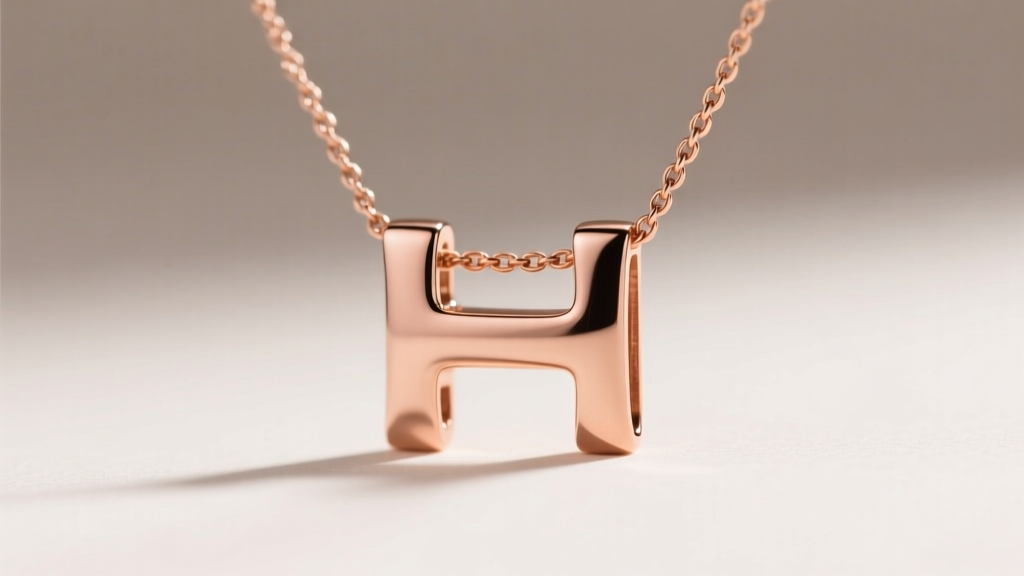
The structural integrity of your necklace h letter is only half the equation; the chain you pair it with must complement the pendant's weight and bail dimensions. The bail is the loop at the top of the H through which the chain passes.
- Lightweight Stamped Pendants (Under 1 gram): Pair with delicate chains such as a 0.8mm to 1.0mm cable or box chain. A heavier chain will cause the lightweight H pendant to constantly flip backward.
- Solid Cast Pendants (1.5 to 3 grams): Require a 1.2mm to 1.5mm rope, curb, or Figaro chain. The bail on these pendants is typically larger, accommodating thicker links.
- Heavy Platinum or Oversized Pendants (Over 4 grams): Demand a robust chain, such as a 2.0mm Cuban link or a reinforced wheat chain, to prevent the chain's clasp from failing under the pendant's pendulum-like momentum.
Maintenance and Failure Modes
Understanding the common failure modes of initial jewelry helps you maintain your piece for decades. The Federal Trade Commission (FTC) Jewelry Guides mandate accurate metal stamping, ensuring you know exactly what alloy you are maintaining.
Tarnish in Crevices
If your H pendant is cast in sterling silver or lower-karat gold, the sharp inner corners where the crossbar meets the vertical posts will trap skin oils, lotions, and environmental sulfur. This leads to localized tarnishing that is difficult to reach with a standard polishing cloth. Use a soft-bristled toothbrush with a mild dish soap solution to agitate these crevices monthly.
Bail Wear and Tear
The bail of an H pendant experiences continuous friction as the chain moves. Over 3 to 5 years of daily wear, a thin 14k gold bail can wear completely through, causing the pendant to detach and potentially be lost. To prevent this, inspect the top of the bail every six months. If the metal has thinned to less than half its original thickness, take it to a jeweler to have a new bail soldered on before it snaps.
By understanding the specific metallurgical properties and structural demands of the letter H, you can select a necklace h letter that is not only a beautiful personal statement but also a durable, lifelong accessory.


