Mastering Necklace Lighting: How Metals and Gems Reflect Light
Discover how necklace lighting affects metals and gems. Compare refractive indices, metal reflectivity, and luster to choose the perfect pendant.

The Physics of Gemstone Luster and Refraction
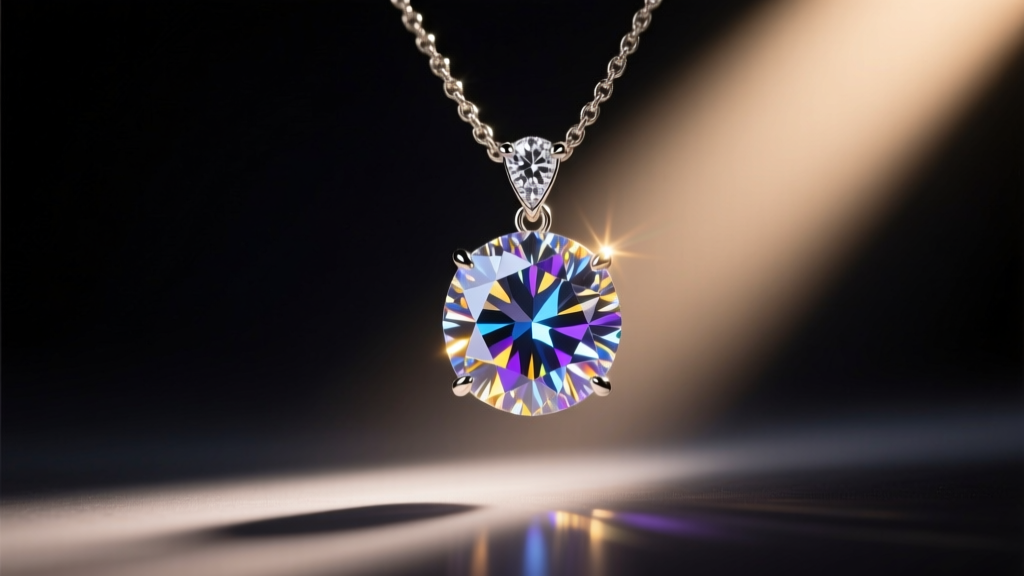
When evaluating fine jewelry, most buyers focus heavily on carat weight, clarity, or metal purity. However, the true visual impact of a pendant or chain is dictated by how it interacts with its environment. Understanding necklace lighting dynamics—specifically how different materials absorb, refract, and reflect light—is essential for both collectors and designers. The brilliance of a gemstone is not an inherent glow; it is a complex optical performance determined by its Refractive Index (RI) and the precision of its faceting.
The Refractive Index measures how much light bends as it enters a material. According to the Gemological Institute of America (GIA), a diamond possesses an RI of 2.417, meaning light slows down and bends significantly upon entry, allowing for total internal reflection before exiting back to the viewer's eye. In contrast, Moissanite boasts an even higher RI of 2.65 to 2.69, resulting in a more intense, sometimes chaotic, dispersion of light known as the 'disco ball effect.' Cubic Zirconia sits lower at 2.15, which is why it can appear slightly glassy or flat under dim ambient lighting compared to natural diamonds.
Dispersion and the Role of Cut
Beyond simple refraction, dispersion dictates how a gemstone splits white light into spectral colors. Diamond has a dispersion rate of 0.044. When a brilliant-cut diamond pendant is subjected to direct, focused necklace lighting, the precise angles of its 57 or 58 facets act as tiny prisms. Step-cut stones, like emerald or baguette pendants, feature larger, open facets that prioritize luster and mirror-like reflections over spectral fire. Therefore, if your primary environment features soft, diffused lighting, a step-cut gemstone will maintain its elegant hall-of-mirrors effect, whereas a brilliant-cut stone may require direct, pinpoint light sources to achieve maximum scintillation.
Metal Reflectivity: Silver, Platinum, and Gold Alloys
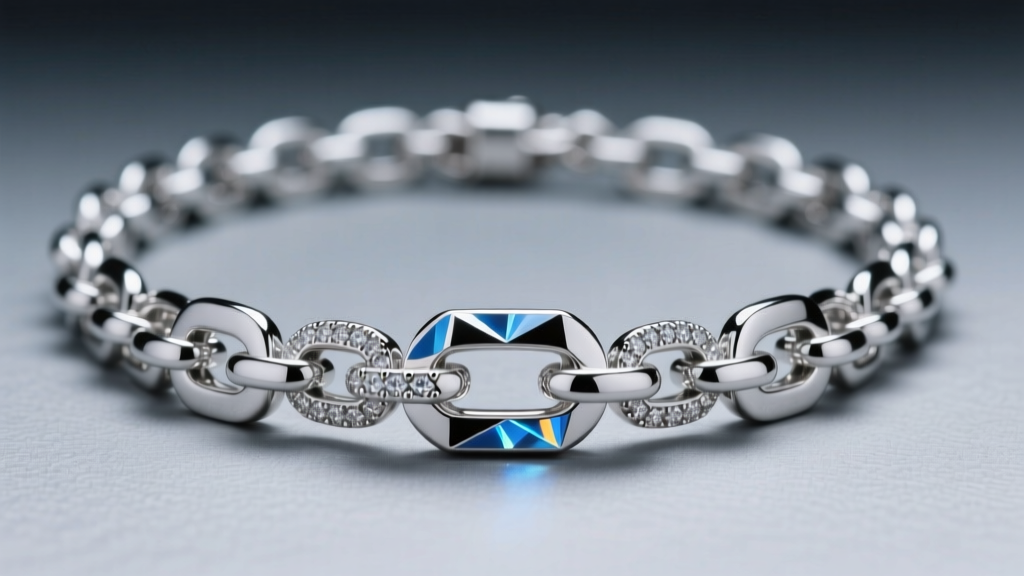
The metal supporting your pendant plays an equally critical role in the overall luminosity of the piece. Metal reflectivity is measured by the percentage of visible light that bounces off its surface rather than being absorbed. This property drastically alters how a necklace performs under varying color temperatures.
- Sterling Silver and Rhodium Plating: Pure silver is the most reflective of all precious metals, bouncing back approximately 95% of visible light. However, because pure silver tarnishes and is too soft for chains, it is alloyed into 925 sterling silver. To maximize reflectivity and prevent oxidation, high-end silver necklaces are plated with rhodium. A standard rhodium plating thickness of 0.75 to 1.0 microns creates a mirror-like, cool-toned finish that thrives under bright, daylight-balanced LEDs (5000K+).
- Platinum: Despite its premium price tag and immense density, platinum only reflects about 66% of visible light. Its luster is described as 'metallic' rather than 'mirror-like.' Under warm candlelight or dim restaurant lighting, platinum absorbs more shadows, giving it a sophisticated, muted patina that develops character over time as microscopic scratches create a soft, satiny finish.
- Gold Alloys: Gold's reflectivity is highly dependent on its alloy composition. 24k pure gold reflects roughly 50% of light but is entirely impractical for necklace chains due to its malleability. 18k yellow gold (75% pure gold mixed with copper and silver) absorbs blue and violet wavelengths, reflecting warm, rich tones that look exceptionally vibrant under incandescent or warm halogen lighting (2700K-3000K). White gold, much like silver, relies on a microscopic rhodium flash to achieve high reflectivity, but as the plating wears down to the 75% gold base, the necklace lighting interaction shifts from cool and bright to slightly warm and muted.
Organic Materials: Nacre, Orient, and Diffused Light
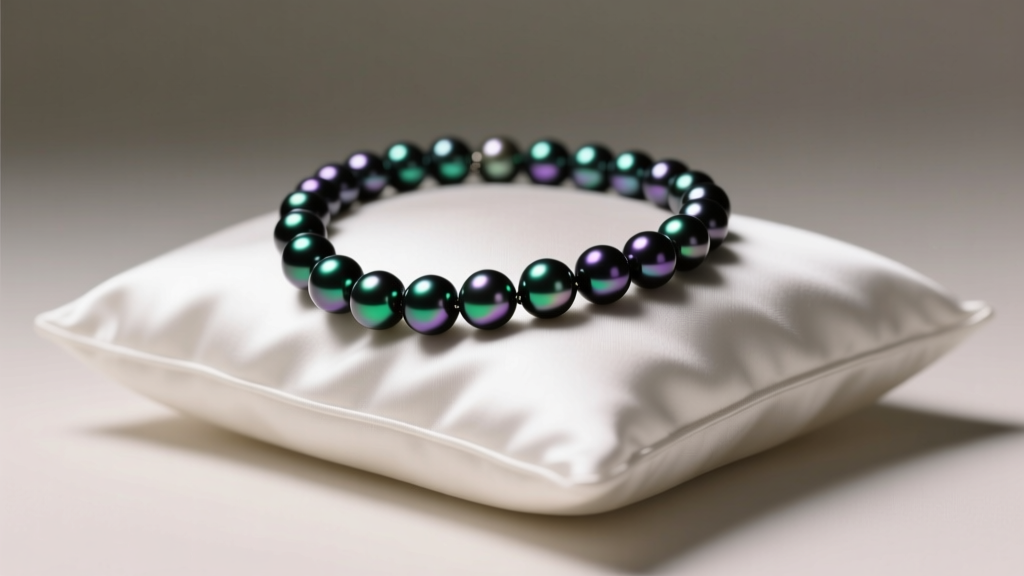
Unlike faceted gemstones that rely on refraction, pearls and organic materials interact with light through scattering and interference. The luster of a pearl is determined by the quality, thickness, and translucency of its nacre layers. When light hits a pearl, it penetrates the microscopic aragonite crystals and conchiolin layers, bouncing back to create a deep, inner glow.
The phenomenon known as 'orient'—the iridescent, rainbow-like shimmer seen on the surface of high-quality pearls—is highly dependent on the angle of illumination. Tahitian black pearls, famous for their peacock and aubergine overtones, require broad, diffused necklace lighting to reveal their complex color play. Direct, harsh spotlighting will wash out the subtle overtones, leaving the pearl looking flat and overly dark. Conversely, Akoya pearls, prized for their sharp, mirror-like luster, perform beautifully under direct, pinpoint lighting, which emphasizes their crisp surface reflections. For a comprehensive breakdown of historical pearl grading and light interaction, the educational resources at Lang Antiques provide excellent visual comparisons of nacre depth and orient.
Material Lighting Properties Chart
To help you select the right material for your specific lifestyle and ambient environments, refer to the optical properties table below.
| Material | Optical Metric | Luster Type | Ideal Lighting Environment |
|---|---|---|---|
| Diamond (Brilliant Cut) | RI: 2.417 | Adamantine | Direct, pinpoint spotlights |
| Rhodium-Plated Silver | Reflectivity: ~95% | Mirror / Metallic | Cool LED, Daylight (5000K) |
| 18k Yellow Gold | Reflectivity: ~60% | Metallic / Warm | Incandescent, Candlelight (2700K) |
| Akoya Pearl | Nacre Thickness: 0.4mm+ | Vitreous / Mirror | Mixed ambient, soft directional |
| Platinum (950) | Reflectivity: ~66% | Satiny / Metallic | Low-light, warm evening settings |
Matching Necklace Materials to Ambient Color Temperatures
A common mistake jewelry buyers make is evaluating a necklace exclusively under the intense, multi-directional halogen lamps of a retail display case. To ensure your necklace maintains its beauty in the real world, you must consider the Kelvin (K) color temperature of your daily environments.
Warm Environments (2000K - 3000K)
Think of candlelit dinners, upscale restaurants, and cozy living rooms. In these warm, yellow-orange light settings, yellow gold and rose gold chains absorb the ambient warmth and radiate a rich, buttery glow. Gemstones with warm body colors, such as citrine, imperial topaz, and certain sapphires, will look deeply saturated. Diamonds will exhibit less spectral fire but will appear softer and more romantic.
Neutral and Cool Environments (4000K - 6000K)
Modern office spaces, retail stores, and overcast daylight fall into this category. This is where white metals dominate. Platinum, white gold, and rhodium-plated silver will appear crisp, bright, and highly reflective. Cool-toned gemstones like aquamarine, tanzanite, and blue sapphires will pop with vivid intensity. If you wear a yellow gold pendant in a 5000K office environment, the metal may appear slightly brassy or washed out, losing its romantic warmth.
Expert Tips for Photographing and Displaying Necklaces
If you are a reseller, collector, or content creator, mastering necklace lighting for photography is paramount. Never use a single, direct flash, as this will blow out the highlights on reflective metals and create harsh, unflattering shadows behind the pendant. Instead, utilize a 'darkfield' lighting setup for transparent gemstones. By placing the necklace over a piece of frosted acrylic and illuminating it from beneath and behind, you force light to travel through the pavilion facets, maximizing the stone's internal brilliance without overexposing the metal chain.
For highly reflective metals like polished silver, use large, continuous diffusion panels (softboxes) placed at 45-degree angles on either side of the necklace. This creates long, elegant gradient reflections along the curves of the chain links, proving the metal's high polish without introducing the harsh, pixelated hotspots caused by bare LED bulbs. By understanding the precise optical physics of your materials, you can curate a jewelry collection that looks breathtaking in any room, under any light source.


