Choosing the Right Orange Bead Necklace: A Material Guide
Compare carnelian, amber, and coral to find your perfect orange bead necklace. Expert insights on Mohs hardness, pricing, and care for every gem.

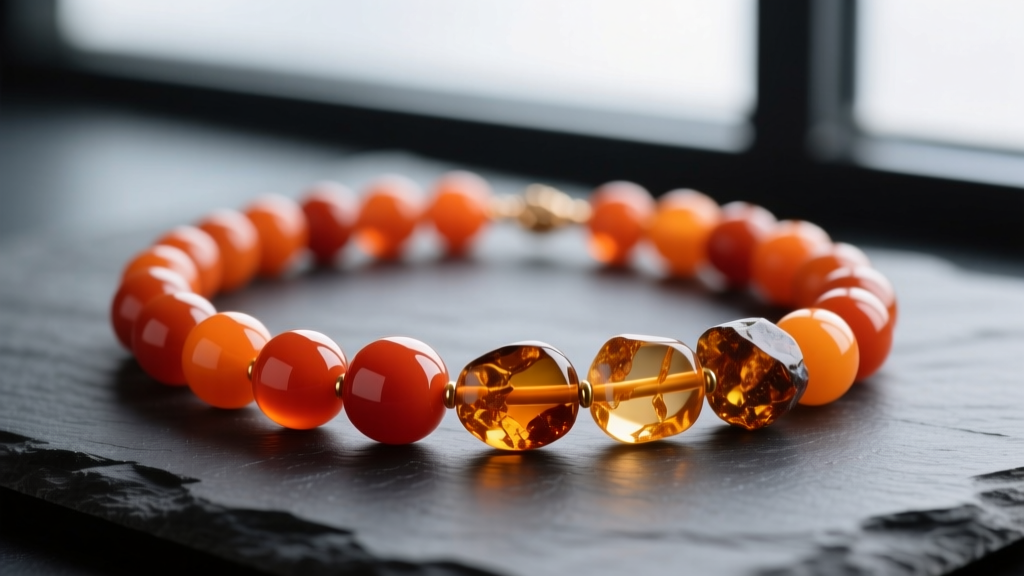
An orange bead necklace is more than just a vibrant accessory; it is a statement of warmth, energy, and geological history. However, not all orange beads are created equal. The market is flooded with materials ranging from ancient fossilized resins to dyed chalcedony and synthetic glass. For jewelry collectors and everyday wearers alike, understanding the material properties of your orange bead necklace is critical for determining its durability, value, and required care. This comprehensive guide breaks down the physical properties, failure modes, and authentication methods for the most common orange bead materials on the market.
The Big Three: Carnelian, Amber, and Coral
When shopping for a natural orange bead necklace, you will predominantly encounter three distinct materials. Each possesses unique chemical compositions and structural vulnerabilities that dictate how they should be worn and strung.
Carnelian (Silicon Dioxide)
Carnelian is a variety of chalcedony (microcrystalline quartz) colored by iron oxide impurities. With a Mohs hardness of 6.5 to 7, it is highly durable and suitable for everyday wear. However, the gemological market is saturated with dyed carnelian. According to the Gemological Institute of America (GIA), most commercial carnelian is actually grayish chalcedony that has been treated with a sugar-acid solution and heated to produce a deep, uniform orange. True, untreated carnelian exhibits a cloudy, uneven color distribution and a distinct waxy luster, whereas dyed stones often show color concentration in microscopic fractures.
Amber (Fossilized Resin)
Amber is not a stone, but an organic polymer (primarily C10H16O) formed from the fossilized resin of extinct coniferous trees. Baltic amber is the most prized for bead necklaces, offering a translucent, honey-orange hue. With a Mohs hardness of just 2 to 2.5, amber is exceptionally soft. It can be easily scratched by dust (which contains quartz particles at a Mohs 7) and will melt or craze if exposed to high heat or harsh solvents like acetone. Furthermore, buyers must beware of 'copal'—immature amber that is only thousands of years old rather than millions, which is significantly less stable and prone to surface checking.
Precious Coral (Calcium Carbonate)
Orange and red corals are organic gems secreted by marine polyps. Composed primarily of calcium carbonate, coral sits at a 3 to 4 on the Mohs scale. It is highly porous and sensitive to acids, meaning everyday exposure to sweat, perfumes, and citrus can permanently etch and dull the surface of a coral bead necklace. Due to severe overharvesting, many coral species are now protected under CITES regulations. Ethical sourcing is paramount; vintage or antique coral beads are often the most responsible choice for modern collectors.
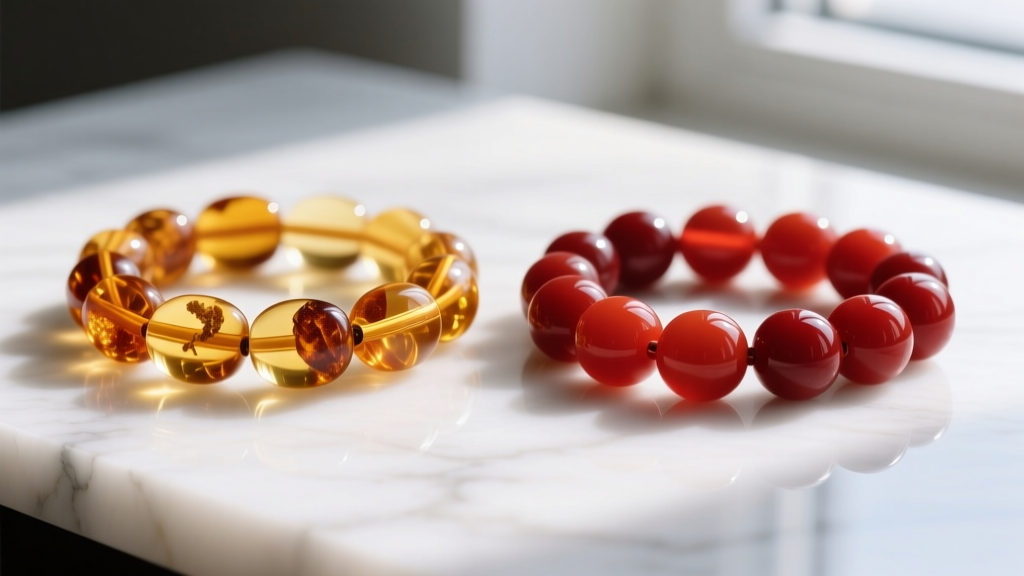
Synthetic and Manufactured Orange Beads
If durability and budget are your primary concerns, manufactured orange beads offer excellent alternatives to fragile organics and expensive gemstones.
- Lampwork Glass: Hand-torched glass beads offer unparalleled color control and internal patterns. Glass sits at a 5.5 to 6 on the Mohs scale, making it resistant to scratching but vulnerable to shattering upon hard impacts.
- Resin and Polymer Clay: Modern epoxy resins and polymer clays can mimic the look of amber or turquoise matrix. While lightweight and inexpensive (often under $20 per strand), they degrade under prolonged UV exposure, turning brittle and yellowing over time.
- Ceramic: Kiln-fired ceramic beads with an orange glaze are incredibly durable, waterproof, and chemically inert. They are an excellent choice for beachwear or active lifestyles where saltwater and sunscreen would destroy natural amber or coral.
Material Properties Comparison Chart
Use this data table to compare the physical properties and market realities of popular orange bead materials before making a purchase.
| Material | Mohs Hardness | Refractive Index | Avg. Price (16" Strand) | Primary Vulnerability |
|---|---|---|---|---|
| Carnelian (Natural) | 6.5 - 7.0 | 1.53 - 1.54 | $80 - $250 | Chipping from hard impacts |
| Carnelian (Dyed) | 6.5 - 7.0 | 1.53 - 1.54 | $15 - $40 | Color fading in direct UV |
| Baltic Amber | 2.0 - 2.5 | 1.54 | $100 - $500+ | Scratching, melting, solvents |
| Precious Coral | 3.0 - 4.0 | 1.48 - 1.65 | $200 - $1,000+ | Acid etching (sweat, perfume) |
| Sunstone (Oregon) | 6.0 - 6.5 | 1.53 - 1.58 | $150 - $400 | Cleavage plane fracturing |
| Murano Glass | 5.5 - 6.0 | 1.50 - 1.70 | $40 - $120 | Shattering from drops |
Durability, Failure Modes, and Stringing Techniques
The longevity of your orange bead necklace depends heavily on how it is strung. Matching the stringing material to the bead's physical properties is a hallmark of professional jewelry design.
Stringing Heavy Carnelian and Sunstone
Carnelian and sunstone beads are dense and heavy, especially in 8mm to 12mm sizes. Using silk thread will result in rapid stretching and eventual snapping. These stones require a 49-strand stainless steel beading wire, such as Beadalon in a 0.018-inch or 0.024-inch gauge. Always use crimp tubes secured with a crimping tool, and finish with a wire guardian to prevent the metal wire from sawing through the clasp jump ring over time.
Protecting Soft Amber and Coral
Amber and coral require a completely different approach. Because they are soft, drilling perfectly smooth holes is difficult, and microscopic burrs inside the bead holes can slowly saw through standard nylon threads. Furthermore, amber beads will chip and scratch each other if they clack together. Therefore, a high-quality orange amber bead necklace must be strung on 100% silk thread (like Griffin size No. 4 or No. 6) and feature hand-tied knots between every single bead. This knotting technique prevents bead-on-bead abrasion and ensures that if the necklace breaks, you only lose one bead rather than the entire strand.
Expert Insight: Never use ultrasonic cleaners or steamers on any orange bead necklace. The high-frequency vibrations will shatter amber and coral, while the heat can permanently alter the color of heat-treated carnelian.
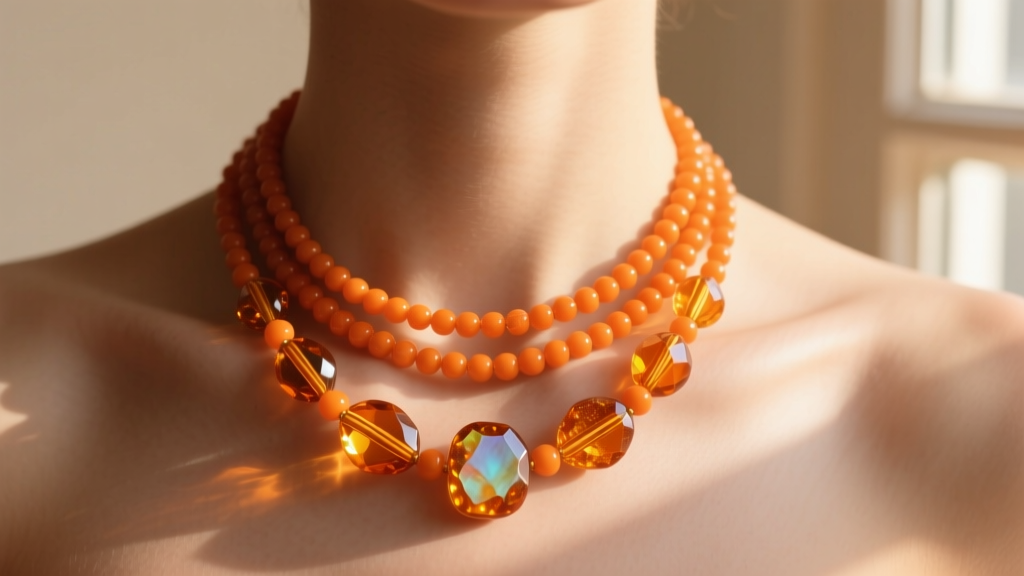
How to Authenticate Your Orange Beads at Home
Because orange is a highly sought-after color, misrepresentation is common. Here are three non-destructive tests you can perform to verify your materials, supported by mineralogical data from sources like Mindat.org.
The Saltwater Float Test (For Amber)
To distinguish true amber from glass or plastic imitations, mix a solution of 1 part table salt to 4 parts warm water. Stir until the salt is completely dissolved. True Baltic amber has a specific gravity of 1.05 to 1.10, meaning it will float in this saturated saline solution. Glass and most solid plastics will sink. Note: Copal will also float, so this test only rules out glass and heavy resins.
The UV Fluorescence Test (For Amber and Coral)
Shine a 365nm ultraviolet flashlight on your beads in a dark room. Genuine Baltic amber will exhibit a distinct pale blue, green, or milky white fluorescence. Plastic imitations will typically show no reaction or a dull, flat purple glow. Natural red and orange coral will often show a faint, chalky white fluorescence, whereas dyed bamboo coral (a common cheap substitute) will appear dark or show patchy, uneven fluorescence where the dye has pooled.
The Loupe Inspection (For Carnelian)
Examine your carnelian beads under a 10x jeweler's loupe. Look closely at the drill holes and any surface-reaching fractures. If you see dark, concentrated lines of color trapped inside the micro-cracks, the stone has been dyed. Natural carnelian will show a smooth, even color transition and may exhibit natural banding or cloudy inclusions, but never sharp, artificial color pooling.
Final Thoughts on Styling and Care
An orange bead necklace is a versatile wardrobe staple that bridges the gap between earthy bohemian styles and refined, minimalist elegance. A 16-inch choker length featuring small, 4mm faceted carnelian beads pairs beautifully with a crisp white linen shirt or a deep V-neckline, providing a sharp, geometric contrast. Conversely, a 24-inch opera-length strand of chunky, unpolished amber beads serves as an excellent layering piece over heavy winter knits or turtlenecks. Regardless of the material you choose, always store your orange bead necklaces flat in a soft pouch, away from direct sunlight and extreme temperature fluctuations, to preserve their vibrant hue for generations to come.


