Orb Necklace Material Guide: Metals, Resin & Gemstones
Discover the best materials for your orb necklace. We compare solid metals, glass, resin, and gemstone spheres for durability and style.

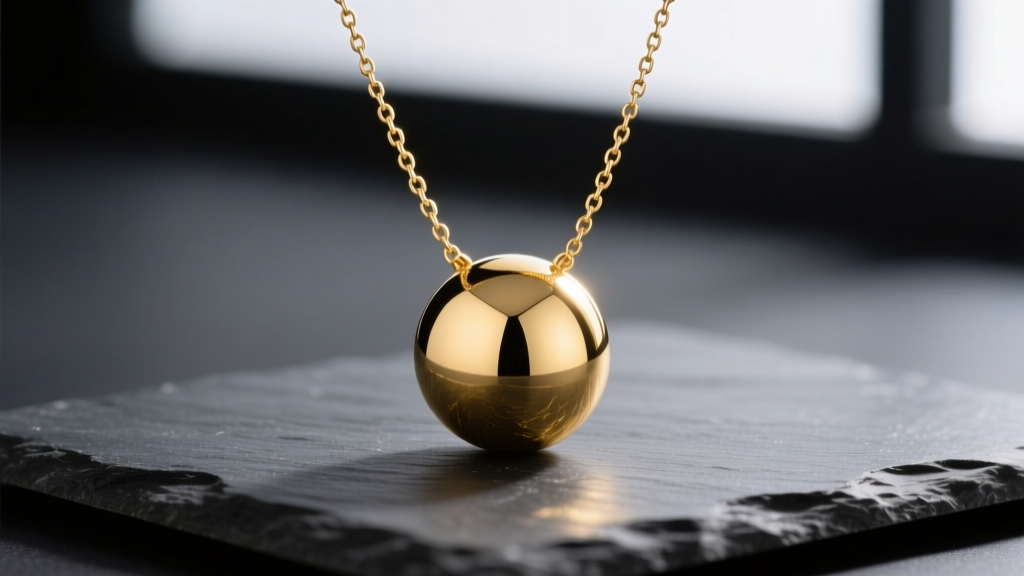
The Physics and Aesthetics of the Orb Necklace
The orb necklace—a perfectly spherical pendant suspended from a chain—is a masterclass in geometric minimalism. However, the perfect sphere presents unique structural and aesthetic challenges that flat or faceted pendants do not. Because an orb lacks edges, its visual impact relies entirely on surface tension, light reflection, and material density. More importantly, the physics of a sphere dictates how it wears. An orb swings like a pendulum, meaning it is highly prone to striking tables, doorframes, and your own sternum. Choosing the right material is not just about color; it is about specific gravity, Mohs hardness, and impact resistance.
In this comprehensive guide, we break down the exact material properties of metal, gemstone, glass, and resin orb necklaces, providing you with the technical data needed to select a piece that balances visual weight with physical durability.
Solid vs. Hollow Metal Orbs: The Weight Dilemma
When selecting a metal orb necklace, the most critical factor is often misunderstood: volumetric weight. Metals are dense, and a sphere maximizes volume relative to its footprint. To understand this, we must look at the specific gravity (density) of common jewelry metals.
Consider a standard 20mm diameter orb pendant. The mathematical volume of a 20mm sphere is approximately 4.18 cubic centimeters (cm³). If that orb is cast in solid sterling silver (density of 10.49 g/cm³), the pendant alone will weigh roughly 43.8 grams. For context, a standard heavy men's wedding band weighs about 8 grams. A 44-gram pendant will aggressively pull on the cervical spine, stretch delicate chains, and constantly flip upside down due to the pendulum effect. According to the Jewelers of America, understanding metal density is crucial for balancing wearable jewelry.
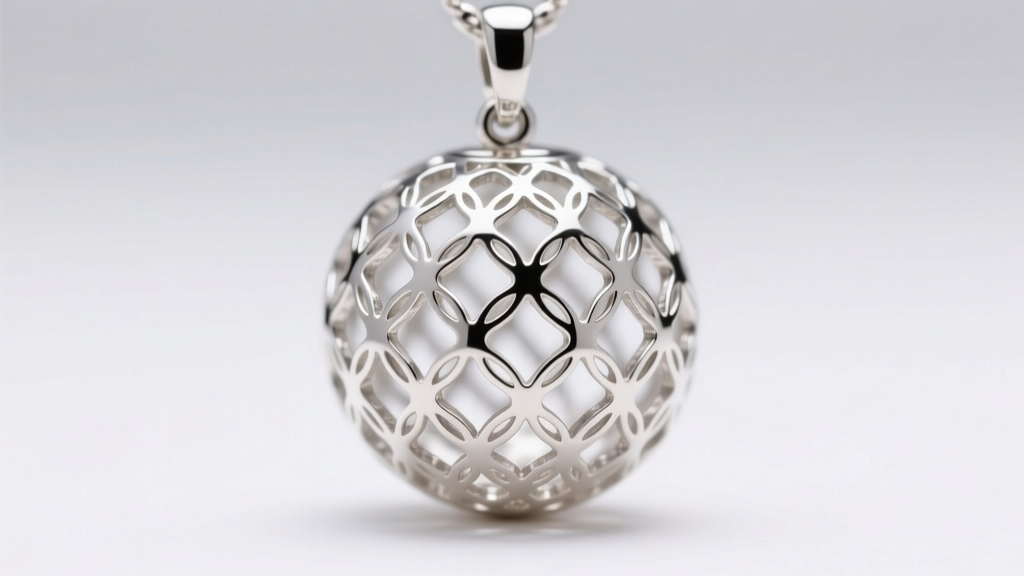
The Electroforming and Stamping Solution
To solve the weight issue, jewelers utilize hollow orb constructions. There are two primary methods:
- Stamped and Soldered Hemispheres: Two thin sheets of metal (usually 0.8mm to 1.2mm thick) are pressed into dome shapes and soldered together. This reduces the weight of a 20mm silver orb to a highly wearable 3 to 5 grams.
- Electroforming: A 3D-printed or wax sphere is coated in a conductive paint and submerged in an electrolyte bath. Metal (usually copper or silver) is deposited atom by atom, creating a seamless, ultra-lightweight hollow shell that can be as thin as 0.3mm.
| Metal Type | Construction | Approx. Weight | Tarnish Resistance | Best Chain Pairing |
|---|---|---|---|---|
| Sterling Silver (925) | Solid Cast | 43.8g | Low (Requires Polishing) | 4.0mm+ Curb Chain |
| Sterling Silver (925) | Hollow Stamped | 4.2g | Low (Requires Polishing) | 1.5mm Box Chain |
| 14k Yellow Gold | Solid Cast | 55.0g | High | 5.0mm+ Rope Chain |
| Grade 5 Titanium | Hollow / CNC | 2.8g | Absolute (Inert) | 1.2mm Cable Chain |
Gemstone Spheres: Hardness and Cleavage Planes
Gemstone orb necklaces offer unparalleled optical depth, but the spherical shape exacerbates the risk of chipping. When a faceted gemstone is struck, the force is distributed across its flat planes. When a sphere is struck, the impact concentrates on a single microscopic point, creating immense localized pressure.
Therefore, the Mohs Hardness Scale and a gem's "toughness" (resistance to breaking) are paramount. According to the Gemological Institute of America (GIA), hardness dictates scratch resistance, but toughness dictates impact survival.
Gemstones to Avoid for Orb Pendants
Avoid gemstones with perfect cleavage (a tendency to split along structural planes) or low hardness. Fluorite (Mohs 4) and Opal (Mohs 5.5) are notoriously fragile in spherical cuts. A fluorite orb necklace will accumulate micro-scratches within weeks of daily wear, turning a glossy sphere into a dull, frosted ball.
The Ideal Gemstone Orbs
- Rose Quartz & Amethyst (Mohs 7): Excellent scratch resistance and no true cleavage, making them highly durable for swinging pendants.
- Nephrite Jade (Mohs 6-6.5): While slightly softer on the Mohs scale, nephrite possesses exceptional toughness due to its interlocking fibrous crystal structure. It is practically shatterproof against everyday impacts.
- Obsidian (Mohs 5-5.5): Although technically a volcanic glass and relatively soft, obsidian lacks a crystalline structure, meaning it chips rather than shattering along cleavage planes. It takes a mirror polish that is highly striking in an orb format.
Glass, Resin, and Enamel: The Lightweight Alternatives
For those seeking large, statement-sized orb necklaces (30mm to 50mm) without the cervical strain of heavy metals or the high cost of large gemstones, glass and resin are the premier choices.
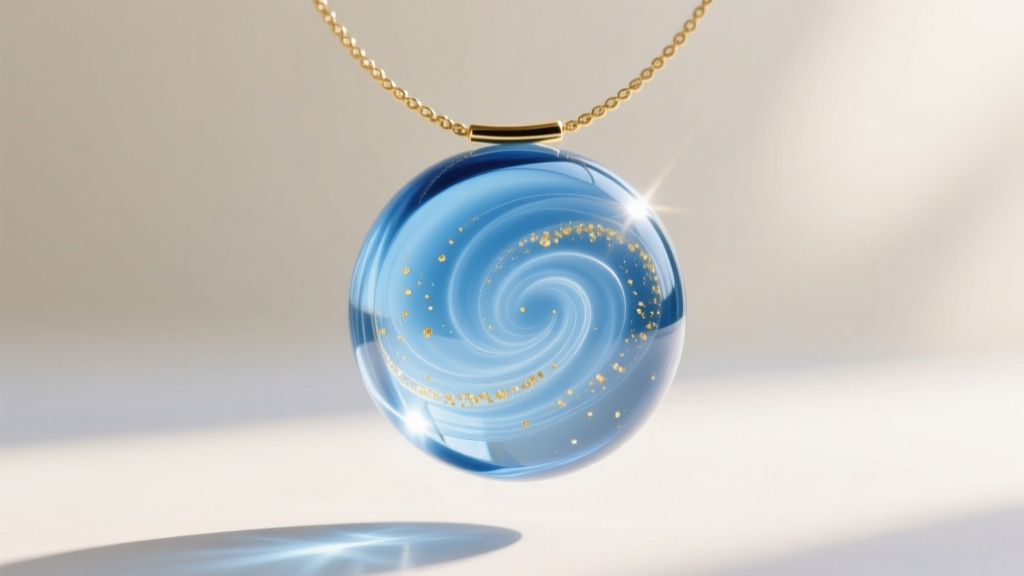
Borosilicate vs. Soda-Lime Glass
Not all glass orbs are created equal. Standard soda-lime glass (used in windows and bottles) is heavy and prone to thermal shock. High-end artisan orb necklaces utilize borosilicate glass (often known by the brand name Pyrex). Borosilicate glass contains boron trioxide, which makes it highly resistant to thermal expansion and significantly harder (Mohs 6.5) than standard glass. Lampwork artists use borosilicate rods to encase 24k gold leaf or silver fuming inside the orb, creating a deep, three-dimensional galaxy effect that will not scratch easily against clothing.
The UV Degradation of Resin Orbs
Epoxy and UV-cured resins allow for the suspension of dried flowers, pigments, and glitter within a crystal-clear sphere. However, resin has a critical failure mode: photo-oxidation. Unless the resin is formulated with high-grade HALS (Hindered Amine Light Stabilizers) and UV absorbers, a clear resin orb necklace will develop a yellow or amber tint within 6 to 12 months of exposure to sunlight. When purchasing a resin orb, always verify with the artisan that a UV-inhibitor was used in the casting process.
Chain Pairing and Bail Mechanics
The structural integrity of an orb necklace relies heavily on the bail (the loop connecting the orb to the chain) and the chain's gauge. Because orbs rotate freely, they create torsional stress on the bail.
Selecting the Right Bail
- Drilled Orbs: Many gemstone and glass orbs are drilled completely through the center and strung directly onto the chain or a flexible wire. This is the most secure method but limits the chain thickness to the drill hole (usually 1.0mm to 1.5mm).
- Soldered Cap Bails: For metal or undrilled stone orbs, a metal cap is glued or soldered to the top. Ensure the jump ring connecting the cap to the chain is soldered shut. An open jump ring will eventually twist open due to the rotational friction of the spherical pendant.
Chain Gauge Recommendations
As a strict rule of thumb, the chain's breaking strength must be at least five times the weight of the orb to account for dynamic shock (e.g., the pendant dropping suddenly against the end of the chain). A 10-gram orb requires a chain capable of withstanding 50 grams of tensile force. For orbs over 15 grams, abandon delicate cable chains in favor of interlocking box chains, curb chains, or rope chains with a minimum wire gauge of 2.0mm.
Maintenance and Care by Material
Maintaining the optical perfection of a spherical surface requires specific protocols based on the material:
- Metal Orbs: Use a high-quality silver polishing cloth for sterling silver. Avoid liquid dips, which can leave chemical residues in the microscopic pores of the metal, leading to accelerated re-tarnishing.
- Gemstone Orbs: Clean with warm water, a drop of mild dish soap, and a microfiber cloth. Never use ultrasonic cleaners on porous stones like Lapis Lazuli or Turquoise, as the high-frequency vibrations can cause internal fracturing.
- Glass and Resin: Wipe with a damp microfiber cloth. Avoid alcohol-based cleaners on resin orbs, as isopropyl alcohol can degrade the surface polish over time, causing a cloudy, frosted appearance.
Final Verdict
The perfect orb necklace is a triumph of material science over geometric vulnerability. For everyday, worry-free wear, a hollow sterling silver or Grade 5 titanium orb offers the best balance of metallic luster and featherlight comfort. For those drawn to organic depth, a nephrite jade or rose quartz sphere provides exceptional impact resistance. By respecting the specific gravity and hardness properties of your chosen material, you ensure your spherical pendant remains a flawless, swinging focal point for years to come.


