Authenticating a Vintage Rose Quartz Bead Necklace: Material Guide
Learn to authenticate a vintage rose quartz bead necklace by comparing material properties, inclusions, and hardness against glass and synthetic fakes.

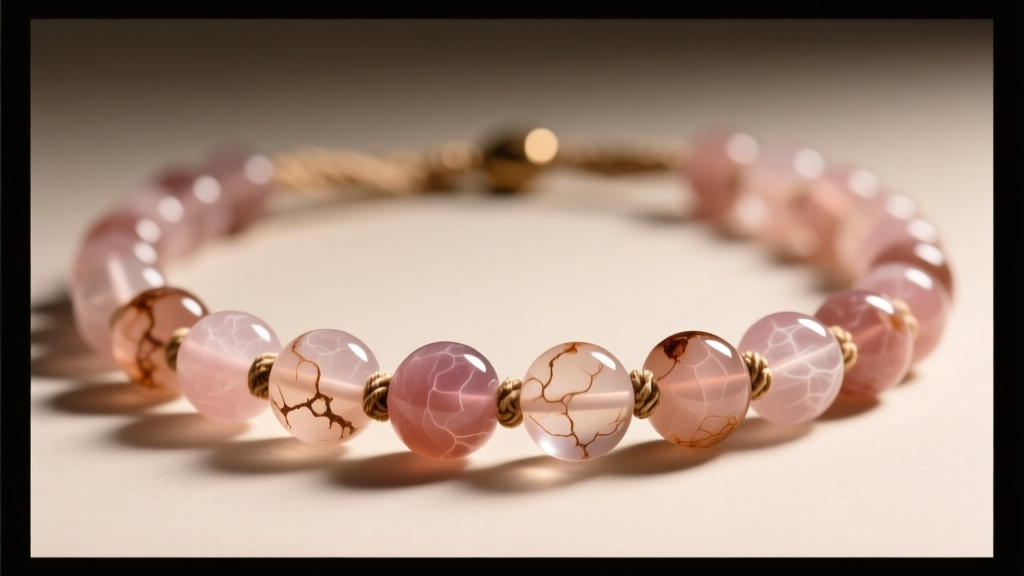
The secondary gem market is currently saturated with reproductions, making the authentication of a vintage rose quartz bead necklace a critical skill for collectors and jewelry historians. Unlike faceted diamonds or sapphires, rose quartz is rarely synthesized in laboratories for commercial bead production due to the low cost of natural rough. However, it is frequently imitated using glass, dyed lower-grade quartz, and molded resins. To accurately date and value vintage pieces from the mid-20th century, one must look beyond the pastel hue and examine the fundamental mineralogical properties, lapidary techniques, and structural wear patterns inherent to the material.
The Mineralogy of Rose Quartz: Gemological Baselines
Rose quartz is a macrocrystalline variety of silicon dioxide (SiO2). Unlike amethyst or citrine, which form in distinct geometric crystals, rose quartz typically occurs in massive, compact formations. According to the Gemological Institute of America (GIA), the material exhibits specific physical constants that serve as the foundation for authentication:
- Refractive Index (RI): 1.544 to 1.553 (Birefringence: 0.009)
- Specific Gravity (SG): 2.65 (+/- 0.02)
- Mohs Hardness: 7.0
- Crystal System: Trigonal (though massive specimens lack visible crystal faces)
The pink coloration in massive rose quartz was historically attributed to titanium, iron, or manganese impurities. However, modern gemological research, including data cataloged by Mindat.org, indicates that the color in many translucent to opaque specimens is actually caused by microscopic fibers of a borosilicate mineral related to dumortierite. These microscopic inclusions are a primary indicator of natural, untreated stone.
Genuine Vintage vs. Modern Imitations: A Material Breakdown
When evaluating a vintage rose quartz bead necklace, the first step is ruling out common simulants. The table below outlines the diagnostic properties used by gemologists to separate genuine quartz from its most frequent imitators.
| Material | Mohs Hardness | Specific Gravity | Refractive Index | Diagnostic Inclusions / Features |
|---|---|---|---|---|
| Genuine Rose Quartz | 7.0 | 2.65 | 1.544 - 1.553 | Cloudy translucency, dumortierite fibers, liquid inclusions, rutile needles. |
| Pink Glass | 5.0 - 5.5 | 2.20 - 2.80 | 1.47 - 1.70 | Spherical gas bubbles, swirl marks, conchoidal fracture, lacks birefringence. |
| Dyed Quartz | 7.0 | 2.65 | 1.544 - 1.553 | Color concentration in surface-reaching fractures, spiderweb dye patterns. |
| Molded Resin/Plastic | 2.0 - 3.0 | 1.05 - 1.30 | 1.50 - 1.60 | Extremely lightweight, thermal conductivity (warm to touch), mold lines. |
The Asterism Factor in Mid-Century Beads
Some of the most highly prized vintage rose quartz bead necklaces, particularly those originating from the 1950s and 1960s, feature beads that exhibit asterism. This optical phenomenon occurs when light reflects off microscopic, oriented rutile (titanium dioxide) needles within the quartz.
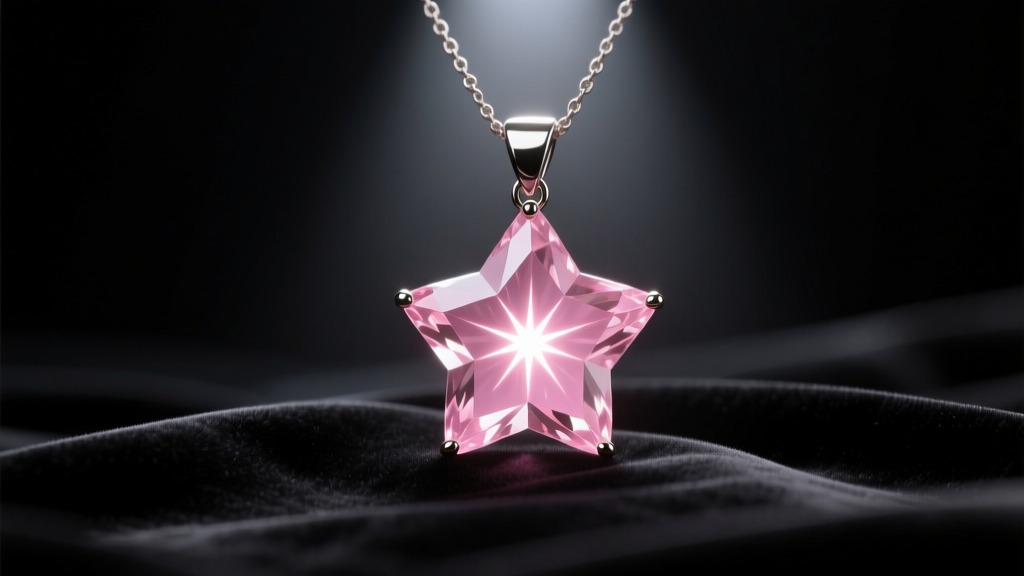
To properly display a star, the beads must be cut en cabochon rather than faceted or perfectly spherical. When authenticating a vintage star rose quartz necklace, use a single, direct light source (like a penlight or smartphone flash). A genuine star will display a sharp, six-rayed pattern that moves dynamically across the dome of the bead as the light source shifts. Glass imitations attempting to mimic this effect often use etched surfaces or embedded foil, which remain static and lack the depth of natural rutile reflection.
Lapidary Evidence: Analyzing the Drill Holes
One of the most definitive ways to date and authenticate a vintage rose quartz bead necklace is by examining the drill holes under 10x or 20x magnification. The technology used to drill hardstones has evolved significantly over the last century.
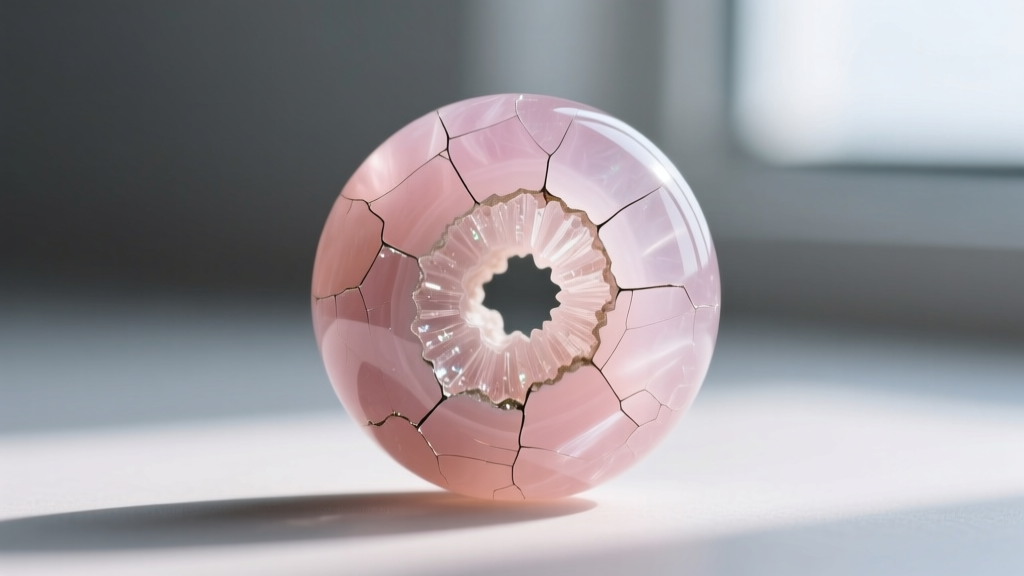
Vintage beads (pre-1980s) were typically drilled using diamond-tipped core bits or early ultrasonic drilling methods. Because rose quartz has a Mohs hardness of 7 and lacks cleavage, it fractures conchoidally (like glass) when subjected to mechanical stress. Under magnification, vintage drill holes often exhibit:
- Micro-chipping: Small, shell-like fractures around the entry and exit points of the hole.
- Asymmetrical Bores: Beads were often drilled from both sides to meet in the middle, resulting in a slight misalignment or "step" inside the channel.
- Matte Interior Walls: The inside of the hole is rarely polished, showing the raw, granular texture of crushed quartz.
In contrast, modern mass-produced beads utilize precision CNC drilling and laser-assisted techniques, resulting in perfectly cylindrical, smooth-walled holes with zero edge chipping. If a purported 1960s necklace features laser-perfect drill holes with polished interiors, it is highly likely a modern reproduction.
Stringing Material Degradation and Wear Patterns
The material holding the beads together provides crucial secondary evidence of a necklace's age and authenticity. Vintage rose quartz bead necklaces were traditionally strung on natural silk cord. Over decades, silk undergoes specific degradation processes that synthetics do not replicate.
Expert Insight: Authentic vintage silk stringing will show localized stretching between the heaviest beads (usually the center drop). Furthermore, natural silk will accumulate microscopic particulate matter, skin oils, and cosmetic residues deep within the fibers, turning the cord a dull, grayish-yellow near the clasp. Modern nylon or polyester threads remain uniformly bright and do not stretch in the same localized manner.
However, from a preservation standpoint, wearing a vintage piece on its original 60-year-old silk is a catastrophic risk. The tensile strength of degraded silk drops by over 70%. Collectors should have authentic vintage necklaces professionally re-strung using modern, high-tensile micro-cable wires or bonded nylon (such as Griffin Silk alternative or PowerPro), incorporating French wire (gimp) at the clasp to prevent the metal findings from cutting through the new thread.
Sourcing and Valuation: Pricing by Material Grade
The value of a vintage rose quartz bead necklace is not determined by age alone, but by the gemological grade of the rough material used. The market generally categorizes these pieces into three tiers:
1. Commercial Grade (Opaque / Heavily Included)
Beads are completely opaque, pale pink to almost white, with visible white quartz veining and heavy fracturing. Often dyed in the mid-century to enhance color. Valuation: $40 - $120 for a standard 18-inch strand.
2. Medium Grade (Translucent / Moderate Inclusions)
Beads allow light to pass through the edges, exhibiting a rich, saturated bubblegum pink color. Dumortierite inclusions may be visible as tiny dark specks. This is the most common grade for authentic 1970s bohemian jewelry. Valuation: $150 - $350.
3. Gem / AAA Grade (Semi-Transparent / Star Quartz)
Highly translucent beads with minimal cloudiness, often sourced from premium Brazilian or Madagascan deposits. Necklaces featuring matched, cabochon-cut star beads from the mid-century command the highest premiums. Valuation: $500 - $1,500+, depending on bead diameter (8mm vs. 14mm) and provenance.
Care Protocols for Vintage Specimens
Preserving the material integrity of a vintage rose quartz bead necklace requires strict adherence to gemological care standards. While quartz is relatively hard, it is highly sensitive to thermal shock and specific chemicals.
- Never use Ultrasonic Cleaners: The high-frequency vibrations can exacerbate existing micro-fractures, causing vintage beads to split entirely.
- Avoid Steam Cleaning: Sudden temperature changes can cause conchoidal fracturing.
- Chemical Sensitivity: Rose quartz can be dulled by prolonged exposure to harsh alkaline solutions or hydrofluoric acid (found in some heavy-duty rust removers and glass etchers). Clean only with warm water, a mild pH-neutral soap, and a microfiber cloth.
- Storage: Store the necklace flat in a lined jewelry box. Hanging a heavy, vintage stone necklace for long periods places uneven stress on the stringing material, leading to premature stretching and cord failure.
By understanding the precise mineralogical properties, historical lapidary techniques, and structural vulnerabilities of rose quartz, collectors can confidently navigate the secondary market, ensuring their acquisitions are genuine artifacts of mid-century jewelry design rather than modern simulants.


