Orca Whale Necklace: Metallurgy, Casting, and Chain Pairing
Discover the technical details behind a premium orca whale necklace. Learn about lost-wax casting, marine-safe alloys, and ideal chain pairings.

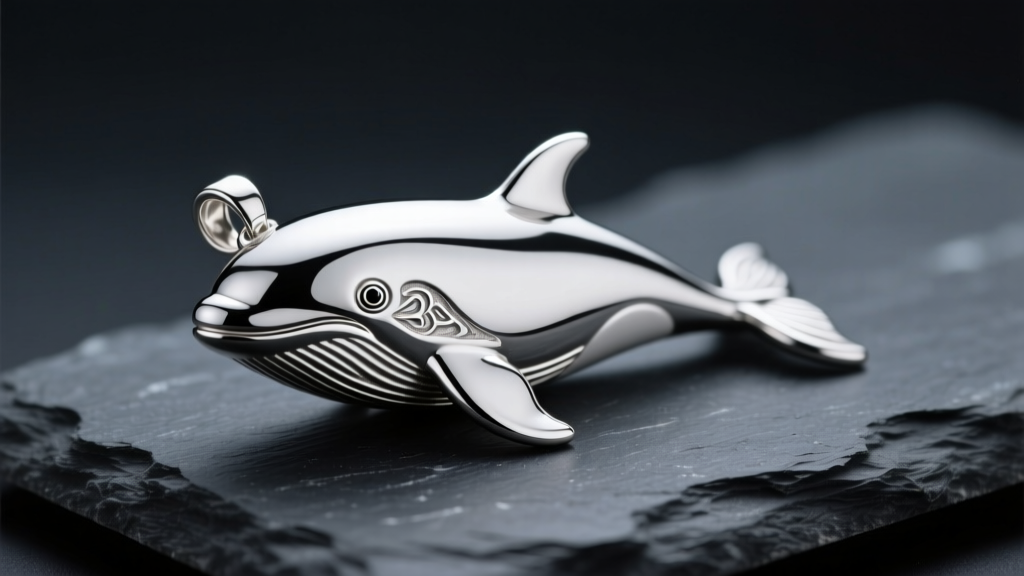
The Anatomy of a Premium Orca Whale Pendant
The appeal of marine-inspired jewelry has surged, but discerning collectors know that a mass-stamped trinket pales in comparison to an expertly engineered orca whale necklace. Crafting a pendant that captures the hydrodynamic grace of an orca (Orcinus orca) requires a mastery of both organic sculpting and precise metallurgy. Unlike geometric pendants, the sweeping curves of the dorsal fin, the bulbous melon (forehead), and the tapered flukes present unique challenges in metal casting and structural integrity.
As of 2026, the industry standard for high-end marine pendants begins with high-resolution CAD (Computer-Aided Design) modeling. Designers must account for the exact volume and center of gravity to ensure the orca rests flat against the sternum rather than flipping awkwardly. Once the digital model is finalized, it is printed using castable photopolymer resin, which burns out cleanly without leaving ash residue that could cause porosity in the final metal cast.
Dimensional Accuracy and Lost-Wax Casting
The transition from resin to metal relies on the ancient lost-wax casting method, modernized with vacuum-assisted centrifuges. The most critical technical hurdle in casting an orca whale pendant is 'spruing'—the placement of wax channels that allow molten metal to flow into the mold. Thin extremities, such as the tips of the pectoral flippers and the tail flukes, cool faster than the dense central body. If the sprues are placed incorrectly, the metal will freeze prematurely, resulting in incomplete fills or microscopic shrinkage porosity.
Expert jewelers compensate for alloy-specific shrinkage rates. For instance, sterling silver shrinks by approximately 1.5% to 2.5% during cooling. According to manufacturing guidelines detailed by Ganoksin, the master model must be scaled up in the CAD phase to ensure the final cast matches the precise dimensional tolerances required for a premium finish.
Metallurgy: Selecting Marine-Safe Alloys
An orca whale necklace is often worn by marine enthusiasts, sailors, and divers, meaning the metal must withstand high-salinity environments, sweat, and frequent moisture exposure. Standard sterling silver (92.5% silver, 7.5% copper) is highly susceptible to tarnishing when exposed to sulfur and chlorine, forming a dark layer of silver sulfide or silver chloride.
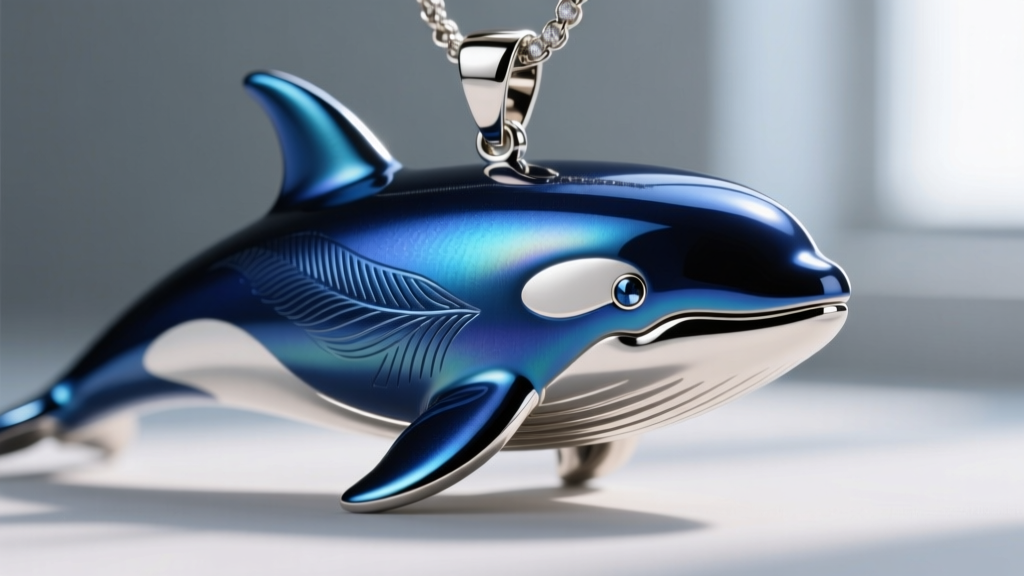
To combat this, modern metallurgists favor advanced alloys. Argentium silver, which replaces some of the copper with germanium, creates a transparent germanium dioxide layer on the surface that drastically slows tarnishing. For those requiring absolute saltwater immunity and hypoallergenic properties, aerospace-grade titanium is the premier choice.
Alloy Comparison for Marine Environments
| Material | Density (g/cm³) | Saltwater Resistance | Tensile Strength | Ideal Use Case |
|---|---|---|---|---|
| Sterling Silver (925) | 10.36 | Low (Requires Rhodium) | ~290 MPa | Occasional wear, formal settings |
| Argentium Silver (935) | 10.10 | Medium-High | ~310 MPa | Daily wear, low-maintenance polish |
| Grade 2 CP Titanium | 4.51 | Exceptional | ~345 MPa | Scuba diving, surfing, sensitive skin |
| Platinum (950/50 Ru) | 21.45 | Exceptional | ~500 MPa | Heirloom investment, luxury weight |
For a comprehensive look at how germanium alters the crystalline structure of silver to prevent fire-scale and tarnish, Rio Grande provides extensive metallurgical data sheets that inform modern bench jewelers.
Chain Engineering: Weight, Gauge, and Clasp Mechanics
A pendant is only as secure as the chain suspending it. A solid cast orca whale pendant typically weighs between 14 grams and 28 grams, depending on the scale and metal density. Suspending this weight requires careful attention to chain gauge, link geometry, and clasp tension.
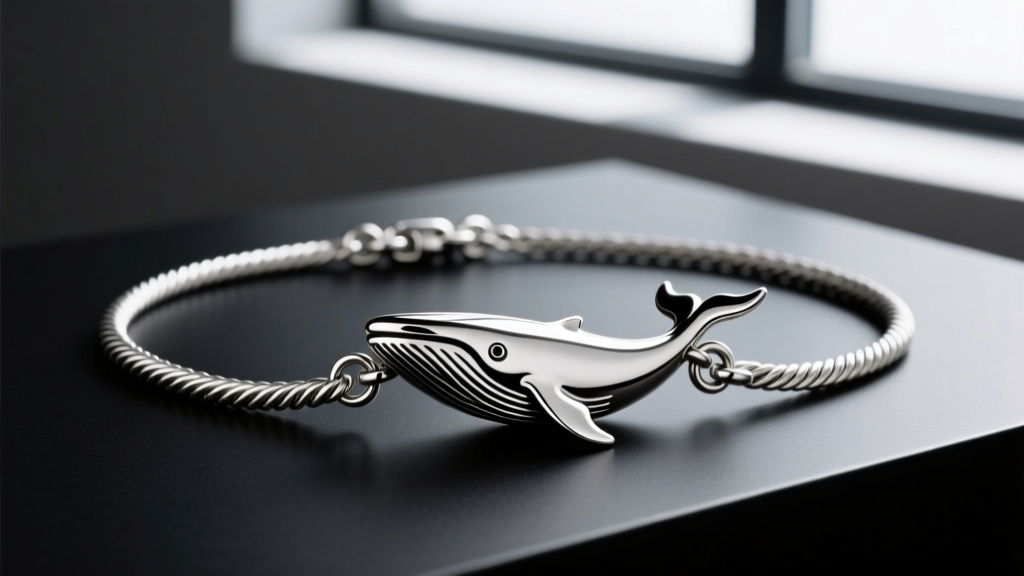
Matching the Bail and Chain Gauge
The bail—the loop connecting the pendant to the chain—must be engineered to prevent friction wear. If the inner diameter of the bail is too tight against the chain, the constant micro-movements will act like a saw, eventually cutting through the metal. For a 20-gram orca pendant, a chain thickness of 1.2mm to 1.6mm is optimal. This provides a tensile safety factor of at least 4:1 (meaning the chain can hold four times the static weight of the pendant before yielding).
- Rope Chains: Excellent for heavy pendants due to their intertwined link structure, which distributes lateral stress evenly.
- Cable Chains: Classic and durable, but ensure the links are soldered shut to prevent them from pulling apart under dynamic loads (e.g., jogging or swimming).
- Box Chains: Avoid for heavy, solid-cast pendants. The sharp inner edges of box links can cause accelerated wear on the bail over time.
Furthermore, the clasp must be proportionate. A standard 5mm spring ring is insufficient for a 25-gram pendant; the internal spring mechanism can fail under sudden kinetic shocks. A 10mm or 12mm lobster clasp with a reinforced lever is the mandatory standard for secure suspension.
Patina, Oxidation, and Maintenance Protocols
To highlight the intricate anatomical details of the orca—such as the eye patch, the teeth, and the gill rakers—jewelers often apply a chemical patina. Liver of sulfur (potassium sulfide) is commonly used to oxidize the recessed areas of silver, creating a stark contrast against the polished high points. However, this antiquing is vulnerable to improper cleaning.
Ultrasonic cleaners, while excellent for removing skin oils and dirt from diamond rings, will strip the oxidation from a detailed orca whale necklace in minutes. The high-frequency cavitation bubbles literally blast the soft silver sulfide layer out of the crevices. Instead, maintenance should involve a mild, phosphate-free dish soap and a soft-bristled baby toothbrush. If the silver begins to lose its luster on the high-polish surfaces, a microfiber polishing cloth impregnated with jeweler's rouge should be used, carefully avoiding the darkened recesses.
Understanding the chemical vulnerabilities of precious metals is crucial. The Gemological Institute of America (GIA) notes that environmental factors like humidity, wool, and even certain foods accelerate silver tarnish, making proper storage in anti-tarnish flannel bags essential when the necklace is not being worn.
Conclusion
Selecting or commissioning an orca whale necklace is an exercise in applied physics and materials science. From the precise spruing of the wax model to the selection of a marine-resistant alloy and the calculation of chain tensile strength, every variable dictates the longevity and aesthetic success of the piece. By prioritizing technical craftsmanship over mass-produced stamping, collectors can secure a wearable tribute to the ocean's apex predator that will endure both the elements and the test of time.


