2026 Trends: Styling A Pearl Necklace With Diamond Pendant
Discover 2026 trends for the pearl necklace with diamond pendant. Expert styling tips, pearl grading, and layering techniques for modern necklines.

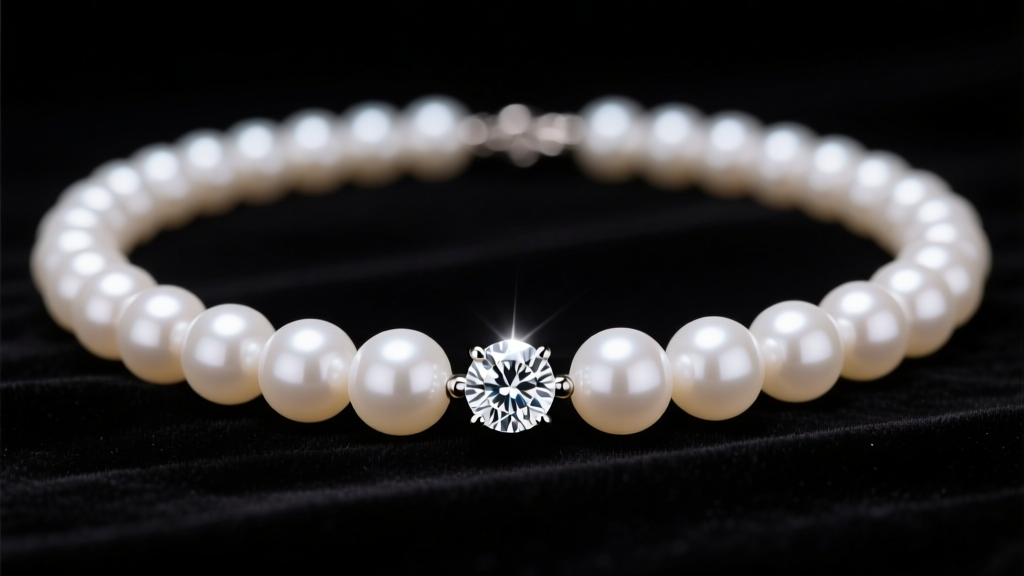
The 2026 Renaissance of the Pearl Necklace With Diamond Pendant
Once relegated to the realm of conservative heirlooms and traditional bridal wear, the pearl necklace with diamond pendant has undergone a radical stylistic metamorphosis. As we navigate the 2026 jewelry landscape, this hybrid silhouette has emerged as a cornerstone of the 'quiet luxury' and 'modern heritage' movements. No longer just a single strand of uniform beads, today's iterations play with asymmetrical drops, mixed-metal hardware, and deliberate contrasts in organic and geometric textures. The integration of a diamond pendant onto a pearl strand creates a focal point that bridges the soft, iridescent luster of nacre with the sharp, refractive brilliance of faceted carbon. This guide dissects the material anatomy, structural requirements, and advanced styling frameworks necessary to master this trend.
Material Anatomy: Grading Pearls and Diamond Accents
The success of a pearl necklace with diamond pendant hinges entirely on the interplay of its two primary materials. A mismatch in quality—for instance, pairing a high-clarity solitaire diamond with low-grade, blemished freshwater pearls—will immediately compromise the piece's visual integrity. Understanding the grading metrics for both elements is non-negotiable for serious collectors and stylists.
Pearl Varieties and Luster Grades
According to the Gemological Institute of America (GIA), pearl quality is evaluated on size, shape, color, luster, surface quality, and nacre thickness. For a pendant necklace, luster is the paramount metric. The sharpness of light reflected on the pearl's surface must complement the diamond's brilliance.
| Pearl Type | Size Range | Luster Profile | 2026 Market Price (18" Strand) |
|---|---|---|---|
| Akoya (Hanadama Certified) | 7.0mm - 8.5mm | Mirror-like, sharp reflections | $1,200 - $3,500 |
| White South Sea | 10.0mm - 14.0mm | Satiny, soft-glow luxury | $4,000 - $12,000+ |
| AAA Freshwater | 7.0mm - 9.0mm | High, slightly softer than Akoya | $300 - $800 |
| Tahitian (Peacock Overtone) | 9.0mm - 11.0mm | Metallic, dark with complex overtones | $1,500 - $4,500 |
For the quintessential 2026 aesthetic, gemologists recommend Hanadama-certified Akoya pearls. The 'Hanadama' designation guarantees a nacre thickness of at least 0.4mm and a mirror-like luster that can hold its own against a diamond's scintillation.
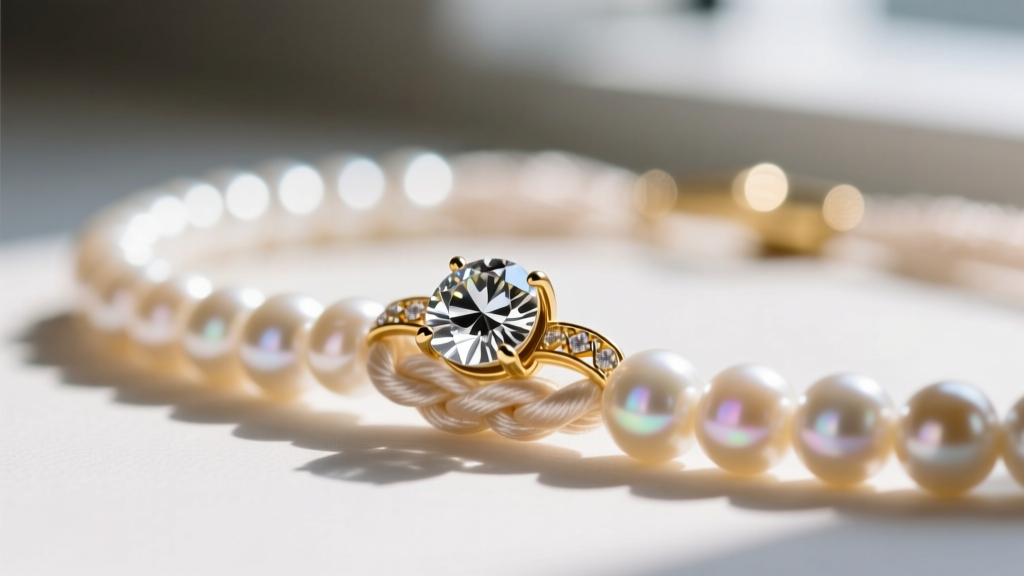
Diamond Pendant Specifications
When suspending a diamond from a pearl strand, the pendant acts as an anchor. The GIA Diamond Quality Factors dictate that while color and clarity are vital, the cut quality is what generates the light return necessary to contrast with the pearl's soft glow. For pendants ranging from 0.15ct to 0.50ct, a color grade of G or H is optimal. Because the diamond rests against the white or cream backdrop of the pearls, a near-colorless grade will face up completely white to the naked eye, allowing you to allocate more budget toward an Excellent or Ideal cut grade. Clarity can safely drop to VS2 or SI1, as inclusions in this carat range are invisible without 10x magnification, and the pendant's constant motion makes microscopic flaws irrelevant.
Structural Integrity: Silk, Wire, and Bail Mechanics
A pearl necklace with diamond pendant is a mixed-material engineering challenge. Pearls are organic and soft (2.5 on the Mohs scale), while diamonds are the hardest natural substance (10 on the Mohs scale). If the diamond pendant rubs against the pearls, it will literally drill into the nacre over time, causing irreversible pitting.
- The Bail Buffer: The pendant must be suspended via a specialized bail that features a built-in buffer. In high-end 2026 designs, the bail includes a microscopic silicone or Teflon sleeve where it meets the pearl strand, or the pendant is flanked by two 2mm gold spacer beads to prevent direct diamond-to-pearl contact.
- Stringing Material: Never accept a nylon or synthetic wire for a knotted pearl necklace. Authentic pieces use Size E or F Japanese silk thread. The silk provides a subtle elasticity that allows the necklace to drape fluidly rather than stiffly.
- Knotting Precision: Hand-knotting must occur between every single pearl. The knots should be tight against the pearl, measuring roughly 0.8mm in diameter. This not only prevents catastrophic loss if the strand breaks but also prevents the pearls from grinding against each other.
Strategic Layering and Neckline Pairings
The 2026 styling paradigm has moved away from wearing the pearl necklace with diamond pendant as a solitary, isolated piece. The current trend favors the 'Curated Collarbone' look, which involves precise layering to create depth.
The Rule of Thirds in Layering
To avoid a tangled, chaotic appearance, layering must adhere to strict length differentials. The human eye naturally seeks mathematical harmony, and a 2-inch variance between strands is the golden rule.
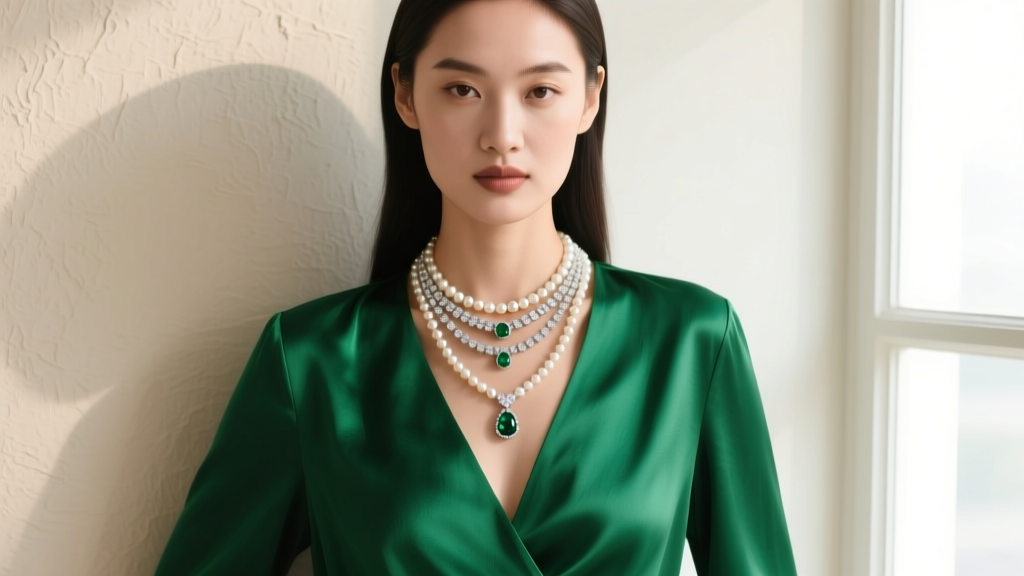
- The Base Layer (14" - 15"): A delicate 14k gold paperclip chain or a micro-pearl choker that sits high on the clavicle.
- The Focal Layer (17" - 18"): Your primary pearl necklace with diamond pendant. The 18-inch 'princess' length ensures the diamond drop rests exactly at the hollow of the throat or just above the sternum, depending on the wearer's torso.
- The Anchor Layer (20" - 22"): A longer, heavier chain featuring a matte gold geometric pendant or a single, large baroque pearl to draw the eye vertically.
Neckline Compatibility Matrix
The diamond pendant's shape must converse with the garment's neckline. A round brilliant diamond pendant pairs best with deep V-necks and scoop necks, as the circular geometry softens the sharp angles of the fabric. Conversely, a pear-shaped or marquise diamond drop demands a straight-across boat neck or a structured collared shirt, allowing the elongated diamond to create a vertical illusion that lengthens the neck.
Care and Maintenance for Mixed-Material Necklaces
Maintaining a pearl necklace with diamond pendant requires a bifurcated approach to cleaning, as standard jewelry cleaning methods will destroy the piece. Ultrasonic cleaners, which use high-frequency sound waves to dislodge dirt from diamond pavé, will shatter the nacre of a pearl and cause the silk thread to fray internally. Furthermore, steam cleaners will melt the adhesive inside the diamond's setting and permanently cloud the pearl's surface.
The correct maintenance protocol involves wiping the pearls with a damp, lint-free microfiber cloth after every wear to remove acidic skin oils. The diamond pendant should be cleaned separately using a soft baby toothbrush dipped in a solution of warm water and a single drop of mild dish soap, carefully avoiding the silk thread. Once a year, the necklace should be taken to a professional jeweler for 're-stringing'—a process where the old silk is cut away and replaced, ensuring the structural integrity of the knots.
Investment Tiers and Market Positioning
When acquiring a pearl necklace with diamond pendant, buyers generally navigate three distinct market tiers. The entry-level tier ($400 - $900) is dominated by AAA freshwater pearls paired with 0.05ct diamond chips in sterling silver or gold vermeil. While accessible, these pieces often lack the luster depth required for high-impact styling. The mid-tier ($1,500 - $4,000) features 18k gold hardware, Hanadama Akoya strands, and 0.15ct to 0.25ct solitaire diamonds in bezel or four-prong settings. This is the sweet spot for daily luxury wear. Finally, the haute joaillerie tier ($10,000+) utilizes flawless South Sea pearls and custom-cut diamond drops, often commissioned from heritage houses like Mikimoto or Tasaki, serving as both a wearable art piece and a tangible asset.


