Perfecting Necklace Hang: Chain Physics, Drape, and Pendant Balance
Master the physics of necklace hang. Learn how chain weave, metal density, and pendant weight affect drape, plus expert fixes for spinning clasps.

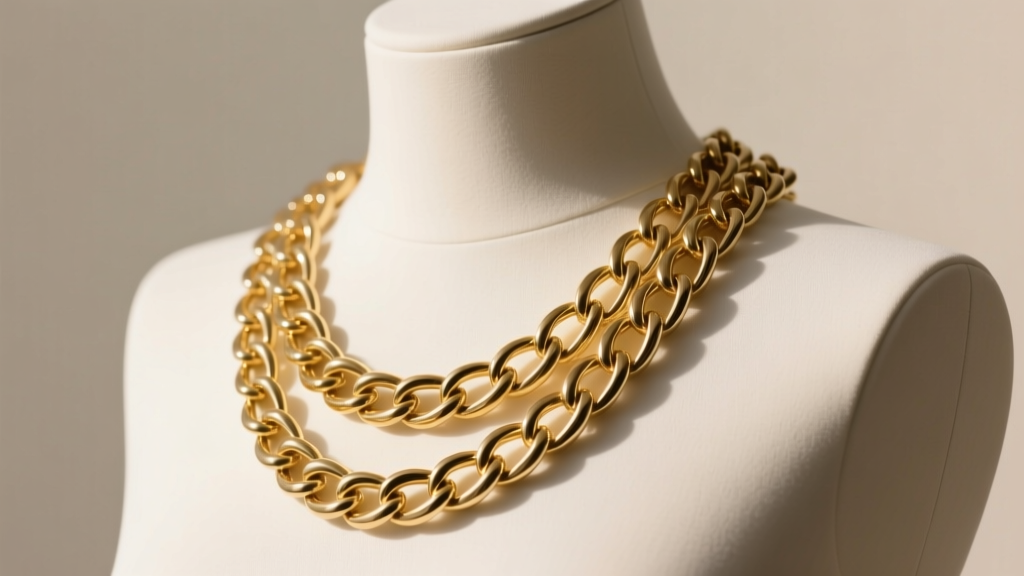
The Biomechanics of Drape: Why Your Necklace Hangs the Way It Does
The concept of necklace hang is rarely discussed outside of master bench jewelers and luxury manufacturing houses, yet it dictates whether a piece sits elegantly on the clavicle or constantly requires readjustment. A perfect necklace hang is not an accident; it is the result of applied physics, balancing gravitational vectors against the biomechanical slopes of the human neck and upper chest.
The average human clavicle sits at a 15 to 20-degree downward slope from the sternocleidomastoid muscle to the acromion process. When a 16-inch choker rests on this slope, the chain forms a shallow catenary curve. If the chain lacks lateral articulation, it will bridge across the hollow of the neck rather than draping into it. Conversely, an 18-inch princess length drops below the clavicle, resting on the sternum where the body's topography is relatively flat. Understanding this underlying anatomy is the first step in engineering a flawless drape.
According to manufacturing insights from Rio Grande's technical guides, the way a chain interacts with these anatomical landmarks is dictated entirely by its structural geometry and mass distribution. A poorly calculated hang results in the dreaded 'forward spin,' where the clasp migrates to the center of the chest, or a pendant that perpetually flips upside down.
Chain Weave Architecture and Articulation
To master necklace hang, you must understand Link Aspect Ratio (AR). AR is the mathematical relationship between a link's inner diameter and its wire gauge. A high AR (e.g., 5.0 or above) creates loose, highly articulated links that drape like liquid fabric. A low AR (e.g., 2.5) creates tight, rigid links that hold their shape but resist conforming to the neckline.
High-Articulation vs. Rigid Weaves
Cable and curb chains typically feature an AR between 3.5 and 4.0. This provides multi-axis articulation, allowing the chain to twist and fold smoothly around the cervical spine. However, if the wire gauge is too thick relative to the link size, the chain becomes stiff, causing it to kink rather than drape.
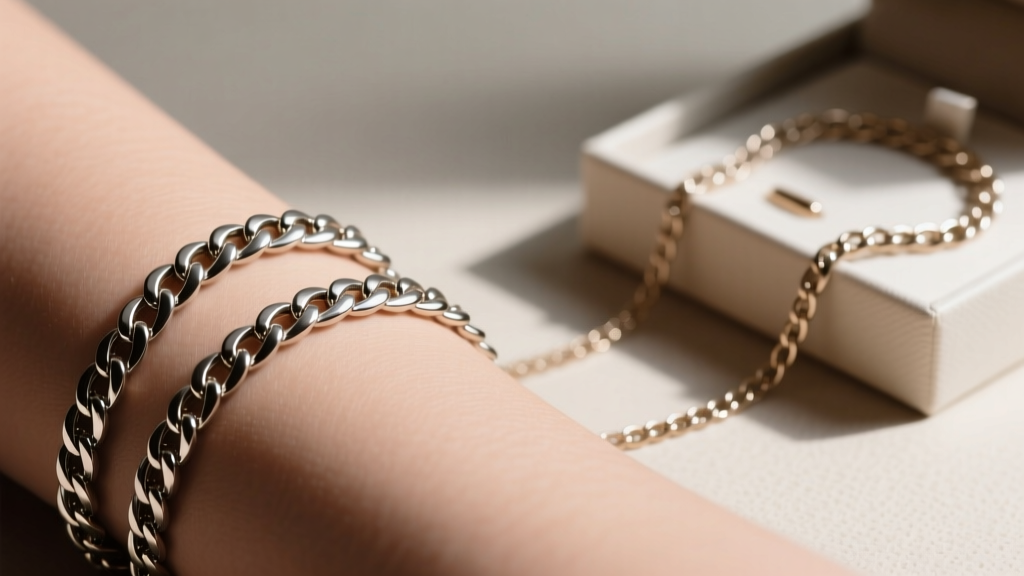
Herringbone and snake chains represent the opposite end of the spectrum. These weaves have an effective AR approaching zero, with links laid flush against one another. While they offer a stunning, mirror-like ribbon effect, they possess virtually zero lateral articulation. As noted by the Gemological Institute of America (GIA), the structural rigidity of these weaves means they hang heavily and are highly susceptible to permanent kinking if bent past their yield strength. They require a wider neckline to hang properly without buckling.
| Chain Weave | Approx. AR | Articulation Axis | Hang Profile | Ideal Pendant Weight |
|---|---|---|---|---|
| Standard Cable | 3.5 - 4.0 | Multi-axis | Soft, rounded catenary | Up to 3x chain weight |
| Curb / Figaro | 3.0 - 3.5 | Bi-axis (flattened) | Wide, structured drape | Heavy, wide bails |
| Box Chain | 2.0 - 2.5 | Multi-axis (hinged) | Geometric, stiff drop | Light to medium pendants |
| Herringbone | ~0 (Flush) | Longitudinal only | Liquid ribbon, heavy | None (worn standalone) |
| Rope Chain | 4.5+ | Omni-directional | Deep V, heavy pull | Heavy solitaire pendants |
Material Density: The Hidden Variable in Drape
Jewelry designers often overlook metal density when prototyping a necklace hang. Platinum has a density of 21.45 g/cm³, while 14k gold sits at roughly 13.5 g/cm³. This means an identical 18-inch, 2mm box chain will weigh nearly 60% more in platinum than in 14k gold.
This mass discrepancy drastically alters the hang. The heavier platinum chain will pull the neckline fabric downward, creating a deeper, tighter V-shape and sitting closer to the sternum. The lighter gold version will sit higher and looser. When designing bespoke pieces, bench jewelers must adjust the chain length by 0.25 to 0.5 inches depending on the chosen metal to achieve the exact same visual hang on the client's body.
The Center of Gravity: Pendant Bail Dynamics
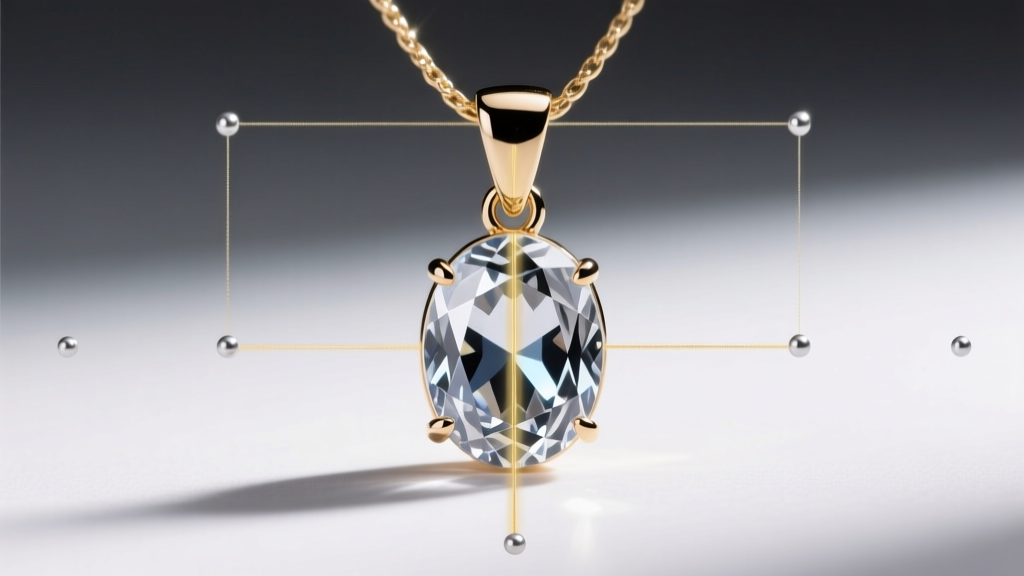
A pendant that constantly flips upside down is a failure of center of mass (CoM) calculation. For a pendant to hang face-forward, its CoM must rest distinctly below the pivot point of the bail.
Fixing the Flipping Pendant
This issue frequently occurs with top-drilled briolettes or elongated marquise stones. If the bail is soldered rigidly to the top of the stone, the pivot point (where the chain passes through) is often higher than the stone's CoM. Gravity forces the heaviest part of the stone to seek the lowest point, causing the pendant to invert.
The technical solution is to introduce a floating bail or a micro-jump ring connector. By adding a 3mm, 20-gauge jump ring between the fixed bail and the chain, you lower the effective pivot point below the stone's CoM. This guarantees the pendant will always self-correct to a face-forward orientation, regardless of how the chain moves.
Troubleshooting the Forward Spin: Clasp Migration
The most common complaint in fine jewelry is the clasp spinning to the front of the neck. This is purely a gravitational issue caused by mass imbalance. A standard cast 14k gold lobster clasp weighs approximately 1.2 grams. If it is attached to a delicate 1mm cable chain that weighs only 2.5 grams in total, the clasp represents nearly 50% of the necklace's total mass concentrated in a single node.
Because the neck slopes downward toward the front and back, gravity pulls the heaviest point of the chain down the slope. Since the front slope (the sternum) is often longer and less obstructed by hair than the back (the cervical spine), the heavy clasp migrates forward.
Expert Fixes for Clasp Migration:
- Downsize the Clasp: Replace the heavy lobster clasp with a lightweight 4mm or 5mm spring ring, which typically weighs under 0.3 grams.
- Add a Counterweight: Solder a small, 1-gram metal tag or a decorative bead 1 inch away from the clasp on the opposite side. This anchors the back of the neck, preventing forward migration.
- Use a Balancing Bead: Thread a small silicone or gold friction bead onto the chain near the clasp to create physical resistance against the skin.
Layering Geometry: Calculating the Drop Offset
When layering multiple necklaces, achieving a perfect hang requires calculating the drop offset to prevent tangling. Tangling occurs when two chains share the same catenary curve and their link sizes allow them to interlock.
The industry standard is the 2-inch drop rule: each subsequent chain should be exactly 2 inches longer than the one above it. However, this only works if the chains have different weave profiles. Pairing a 16-inch herringbone with an 18-inch snake chain will still result in tangling because both lack lateral articulation and will slide against each other, creating friction and knots. For a flawless layered hang, alternate highly articulated chains (like rope or cable) with rigid chains (like box or herringbone) to maintain distinct, separate drape trajectories.


