The Pink Diamond Heart Necklace: 2026 Trend Analysis & Styling Guide
Explore the 2026 market for the pink diamond heart necklace, analyzing natural vs. lab-grown origins, cut proportions, and styling tips.

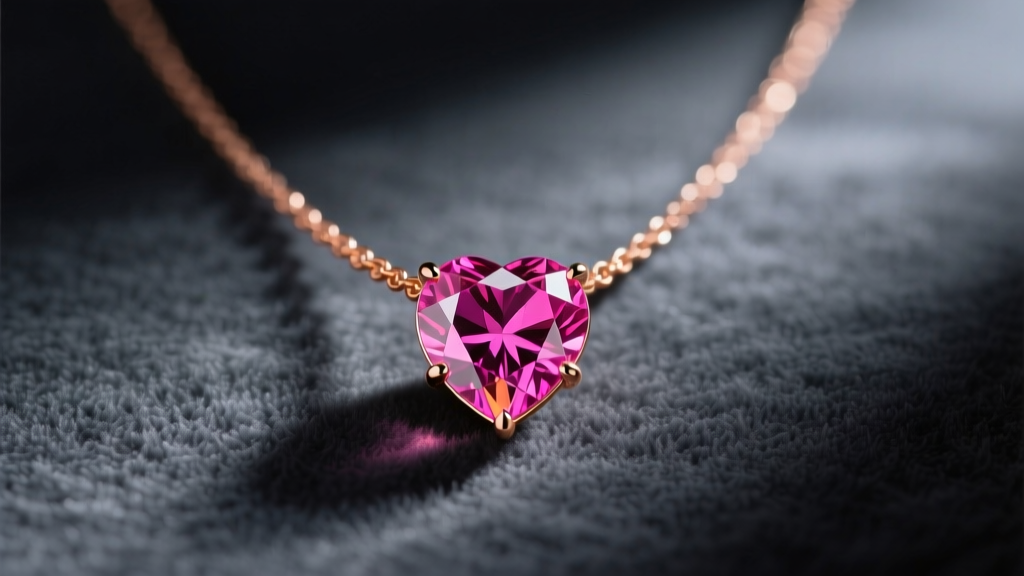
The Resurgence of Romantic Motifs in High Jewelry
As we navigate the 2026 jewelry landscape, the industry has witnessed a definitive pivot from the ultra-minimalist 'quiet luxury' movement toward what trend forecasters are calling 'romantic maximalism.' At the absolute apex of this shift is the pink diamond heart necklace. No longer relegated to juvenile charm bracelets or overly sentimental trinkets, the heart pendant has been reimagined through the lens of high jewelry and advanced gemology. Today, it serves as both a bold sartorial statement and, depending on its origin, a serious investment-grade asset. Understanding the nuances of this specific necklace requires a deep dive into crystal lattice deformations, precision cutting mechanics, and modern alloy pairings.
The Geology and Genesis: Natural vs. Lab-Grown Pink Diamonds
The most critical factor dictating the value and market positioning of a pink diamond heart necklace in 2026 is its origin. Natural pink diamonds are geological anomalies. Unlike yellow or blue diamonds, which derive their hues from trace elements like nitrogen or boron, natural pink diamonds owe their color to 'plastic deformation'—a phenomenon where extreme subterranean pressure distorts the diamond's crystal lattice, altering how it absorbs light. According to the Gemological Institute of America (GIA), less than 0.1% of all natural diamonds mined exhibit a predominantly pink hue.
With Rio Tinto's legendary Argyle mine in Western Australia—the source of over 90% of the world's natural pink diamonds—having permanently closed in 2020, the supply of natural stones has entirely ceased. As documented in the Rio Tinto Argyle Mine Archives, only one carat of pink diamond was found for every one million carats of rough diamond extracted. This absolute scarcity has pushed natural pink diamond heart pendants into the realm of ultra-high-net-worth investment pieces.
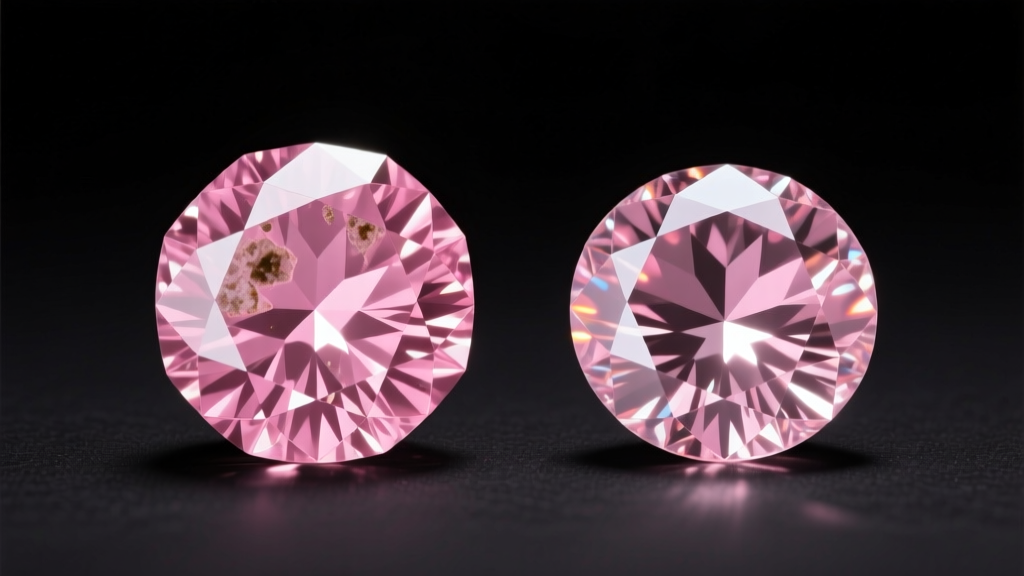
Conversely, the accessible luxury market in 2026 is dominated by lab-grown pink diamonds, primarily created via Chemical Vapor Deposition (CVD). These stones are initially grown as near-colorless or slightly brownish crystals. To achieve the coveted pink hue, they undergo a highly controlled post-growth process of irradiation and annealing. This treatment creates specific color centers within the synthetic lattice that absorb green and yellow light wavelengths, resulting in a vivid, stable pink that is chemically, physically, and optically identical to its natural counterpart, albeit at a fraction of the cost.
Mastering the Heart Modified Brilliant Cut
The heart shape is a 'modified brilliant' cut, meaning it utilizes the same faceting structure as a round brilliant but requires immense technical skill to execute symmetrically. When evaluating a pink diamond heart necklace, the cut quality dictates not just the sparkle, but the saturation of the pink color itself. A poorly proportioned heart will suffer from the 'bow-tie effect'—a dark shadow stretching across the center of the stone—and color windowing, where light leaks out the bottom, washing out the pink hue.
Ideal Proportions Matrix for Heart Cuts
| Proportion Metric | Ideal Range | Impact on Pink Saturation |
|---|---|---|
| Depth Percentage | 58% - 62% | Optimal light return; prevents color wash-out. |
| Table Percentage | 55% - 60% | Balances brilliance with scintillation. |
| Length-to-Width Ratio | 0.95 - 1.05 | Ensures a classic, symmetrical heart silhouette. |
| Cleft Depth | Distinct but shallow | Too deep creates structural weakness; too shallow looks like a pear cut. |
Furthermore, the setting mechanics are paramount. The pointed tip of the heart is the most vulnerable area for chipping. A high-quality pink diamond heart necklace will always utilize a specialized V-prong at the tip to encase the vulnerable point, while the two rounded lobes are secured with standard bezel or claw prongs to maximize light entry.
2026 Styling Frameworks: Necklines and Layering
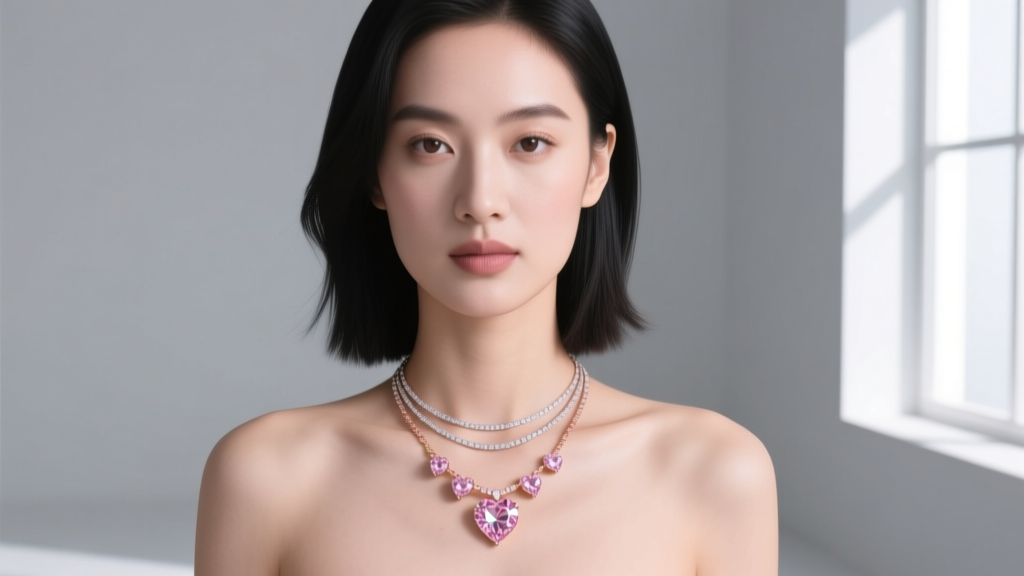
Styling a pink diamond heart necklace in 2026 moves beyond simply throwing it over a t-shirt. The interplay between the diamond's warm pink hue, the metal alloy, and the wearer's neckline requires deliberate curation.
The Metal Alloy Advantage
For pink diamonds, 18k rose gold is the undisputed champion of metal pairings. Composed of 75% pure gold, 22.25% copper, and 2.75% silver, the copper content gives the metal a warm, reddish-pink tone. Because diamonds are highly reflective, the rose gold setting bounces warm light back into the pavilion of the pink diamond, optically enhancing the stone's natural color saturation. Platinum or white gold, while excellent for colorless diamonds, can sometimes make lighter pink diamonds (Fancy Light) appear washed out or greyish by contrast.
Neckline Pairing Guide
- The 16-Inch Princess Length: The most versatile option. It sits perfectly on the collarbone and acts as a natural focal point for V-neck blouses, scoop necks, and open-collared silk shirts. It mimics the V-shape of the neckline, elongating the neck.
- The 14-Inch Choker Length: Ideal for boat necks, off-the-shoulder tops, and high-fashion square necklines. A 1.00ct to 1.50ct heart pendant on a 14-inch chain creates a striking, modern contrast against the horizontal lines of these garments.
- The 18-Inch Matinee Length: Best reserved for deep plunging necklines or layered over fine-knit turtlenecks in the autumn and winter months.
The 2026 Layering Protocol
Layering a pink diamond heart necklace requires a strict adherence to weight and texture contrast. The current trend dictates pairing the delicate heart pendant (typically on a 16-inch 1.2mm cable chain) with a heavier, textured 18-inch rope chain or a minimalist 14-inch platinum snake chain. This asymmetrical layering prevents the romantic heart motif from looking overly saccharine, grounding it with industrial or architectural chain elements.
Valuation and Investment: 2026 Pricing Matrix
The bifurcation of the market between natural and lab-grown pink diamonds has created two entirely distinct pricing tiers. Below is the current 2026 valuation matrix for a 1.00-carat, well-proportioned heart cut.
| Origin & Color Grade | Clarity Expectation | Estimated Retail Price (2026) | Market Position |
|---|---|---|---|
| Natural Fancy Intense Pink | VS1 - VS2 | $140,000 - $190,000 | Investment / Ultra-High Jewelry |
| Natural Fancy Vivid Pink | VVS2 - IF | $280,000+ | Auction / Museum Grade |
| Lab-Grown Fancy Intense Pink | VVS1 - VVS2 | $1,800 - $2,600 | Accessible Luxury / Everyday Wear |
| Lab-Grown Fancy Vivid Pink | IF (Internally Flawless) | $3,200 - $4,800 | Premium Accessible Luxury |
For everyday consumers, the lab-grown sector offers the opportunity to acquire a visually flawless, intensely saturated pink diamond heart necklace for the price of a standard colorless diamond solitaire. However, for collectors, the natural Argyle pinks remain a hedge against inflation, with values appreciating steadily year-over-year due to the hard cap on supply.
Certification and Provenance Standards
Never purchase a pink diamond heart necklace without rigorous third-party certification. For natural stones, the GIA is the absolute authority, providing a Natural Diamond Origin Report that details the color grading (from Faint to Fancy Vivid) and confirms the absence of artificial irradiation. For lab-grown stones, the International Gemological Institute (IGI) and the Gem Certification & Assurance Lab (GCAL) are the preferred entities in 2026. GCAL is particularly highly regarded for heart cuts, as their certificates include an optical symmetry analysis that explicitly maps the bow-tie effect, ensuring you are not purchasing a poorly cut stone that will look dark in the center.
Final Verdict
The pink diamond heart necklace in 2026 is a triumph of both geological rarity and modern scientific achievement. Whether you are acquiring a lab-grown Fancy Vivid piece in 18k rose gold for daily wear, or securing a rare natural Argyle stone for a high jewelry collection, the key lies in the precision of the cut and the intentionality of the styling. By respecting the proportions of the modified brilliant cut and leveraging the optical benefits of rose gold alloys, the heart pendant transcends its nostalgic roots, cementing itself as a sophisticated, enduring staple of modern luxury.


