Plunder Danielle Necklace Care: Cleaning & Maintenance Guide
Learn how to safely clean and maintain your Plunder Danielle necklace. Expert tips for preserving antique finishes and vintage patinas.

Understanding the Metallurgy of Plunder Design Jewelry
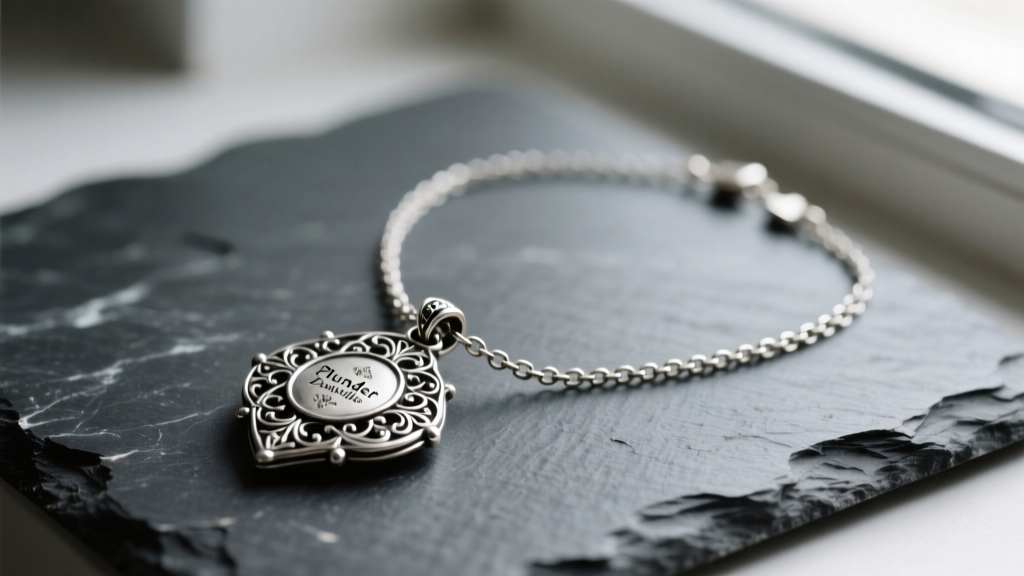
To properly care for your plunder danielle necklace, you must first understand the unique metallurgical profile of Plunder Design jewelry. Unlike fine jewelry crafted from solid 14k gold or sterling silver, Plunder pieces are celebrated for their vintage-inspired, antique-finish aesthetics. The Danielle necklace typically features a base metal core—often a high-quality pewter, brass, or zinc alloy—that is electroplated with a thin layer of silver-tone, gold-tone, or bronze-tone metal.
Crucially, the signature 'antique' look is achieved through a process called intentional oxidation or antiquing. After plating, a dark chemical wash (often containing liver of sulfur) is applied to the piece. This darkens the recessed areas of the pendant and chain links, creating a high-contrast, three-dimensional relief effect that mimics decades of natural wear. Finally, a delicate clear e-coating or micro-lacquer is sometimes applied to seal the finish. Because of this complex layered construction, treating the Danielle necklace like solid sterling silver will permanently strip its intentional patina and ruin the piece.
The 'Never-Do' List for Antique Finishes
The most common way collectors ruin vintage-style fashion jewelry is by applying cleaning methods meant for solid precious metals. When maintaining your necklace, strictly avoid the following:
- Ultrasonic Cleaners: The high-frequency cavitation bubbles and heat generated by ultrasonic machines will cause the delicate electroplating and e-coating to blister, peel, and flake off the base metal core.
- Silver Dips and Tarn-X: These liquid cleaners rely on thiourea-based chemicals and strong acids to instantly dissolve silver sulfide (tarnish). If used on the Danielle necklace, they will instantly strip the intentional dark oxidation from the crevices, leaving the piece looking flat, cheap, and unnaturally bright.
- Baking Soda and Foil Baths: This popular DIY hack creates a galvanic electrochemical reaction. While safe for solid silver, it will cause microscopic pitting and galvanic corrosion on multi-metal plated alloys.
- Commercial Jewelry Polishing Cloths: Cloths impregnated with jeweler's rouge or micro-abrasives will act like sandpaper on thin plating, wearing it down to the base metal within just a few uses.
The Safe Cleaning Protocol (Step-by-Step)
As of 2026, conservation-grade cleaning remains the gold standard for antique-finish fashion jewelry. This method relies on gentle mechanical action and neutral-pH surfactants rather than harsh chemical reactions.
Step 1: Dry Dusting
Before introducing any moisture, remove surface dust and skin cells. Use a clean, dry makeup blending brush or a can of compressed air (held at least 12 inches away) to dislodge debris from the intricate filigree and chain links. This prevents scratching during the wet wash phase.
Step 2: Prepare a Neutral Surfactant Solution
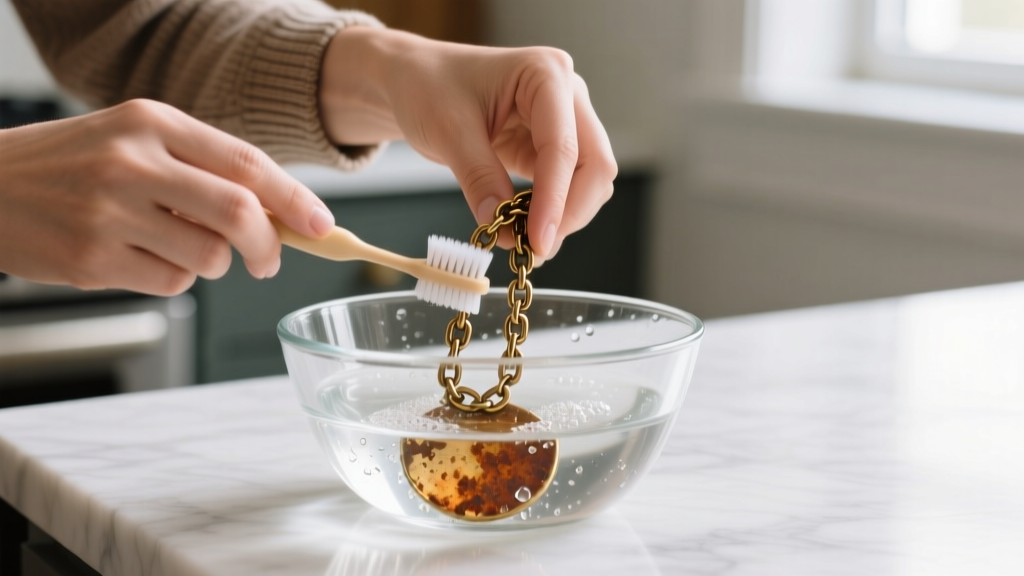
Fill a small glass bowl with lukewarm distilled water. Tap water contains chlorine and dissolved minerals that can leave hard water spots on the plating. Add exactly one drop of a mild, phosphate-free dish soap (such as original blue Dawn). The goal is to create a weak surfactant solution that breaks down skin oils without attacking the metal's clear coat.
Step 3: Targeted Agitation
Submerge the necklace for no more than 60 seconds. Using an extra-soft baby toothbrush (which features bristles roughly 0.12mm in diameter, compared to the 0.20mm bristles of standard soft brushes), gently sweep over the raised areas of the pendant. Do not scrub the recessed areas; you want to preserve the dark antiquing wash in the grooves.
Step 4: Rinsing and Drying
Rinse the piece briefly under a slow stream of distilled water. Immediately pat it dry with a clean, lint-free microfiber cloth. Do not rub aggressively. Allow the necklace to air-dry completely on a paper towel in a low-humidity room before storing it. Trapped moisture in the chain links or clasp mechanism is the primary catalyst for base-metal corrosion.
Environmental Threats and Storage Matrix
Proper storage is 90% of jewelry maintenance. The base metals and platings used in the Danielle necklace are highly susceptible to environmental degradation. Below is a structural framework for mitigating specific threats.
| Environmental Threat | Chemical / Physical Reaction | Mitigation Strategy |
|---|---|---|
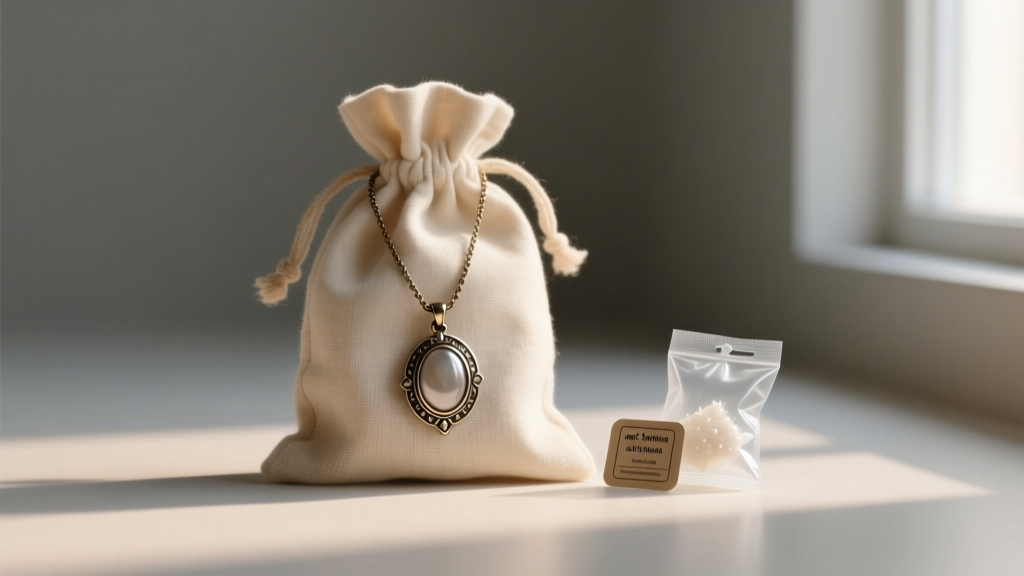
| Ambient Humidity (>60% RH) | Accelerates oxidation and causes base metal corrosion beneath the plating. | Store with desiccant silica gel packets; replace packets every 3 months. |
| Airborne Sulfur Compounds | Reacts with silver-tone plating to form black silver sulfide tarnish. | Use 3M Silver Shield anti-tarnish strips inside the storage container. |
| Polyethylene Plastic Bags | Traps moisture and off-gasses volatile organic compounds (VOCs). | Store in unbleached, acid-free cotton muslin pouches or tarnish-proof flannel. |
| Friction and Micro-abrasions | Wears away the thin electroplated layer and clear e-coating. | Hang the necklace individually or lay it flat; never tangle with other pieces. |
Troubleshooting Common Wear Issues
Even with meticulous care, mechanical components like the lobster clasp and jump rings on the Danielle necklace can experience wear. Here is how to address common issues without causing collateral damage to the finish.
Stiff or Sticky Clasps
If the spring mechanism in the lobster clasp becomes stiff, never use WD-40 or standard lubricants. These contain petroleum distillates that will degrade the jewelry's clear coat and attract abrasive dust. Instead, use a synthetic watch oil (like Moebius 9010). Apply a microscopic drop directly to the clasp hinge using a fine needle or toothpick. Work the clasp open and closed a few times, then wipe away any excess oil with a microfiber swab.
Chain Snagging and Kinking
Vintage-style chains often feature intricate, interlocking links that can catch on knitwear or hair. If a link kinks, do not pull it forcefully, as this will stress the soldered joints and cause the plating to crack. Lay the chain flat on a corkboard and use two fine-tipped, smooth-jawed jewelry pliers to gently manipulate the link back into its original geometry. Always ensure your pliers have nylon or smooth metal jaws; serrated teeth will permanently gouge the soft plating.
Plating Wear on High-Friction Zones
Over years of wear, the back of the pendant and the area of the chain that rests against the collarbone may show signs of the base metal bleeding through. While you cannot reverse this at home, you can slow it down by applying a micro-thin layer of museum-grade microcrystalline wax (such as Renaissance Wax) to these high-friction zones. This creates a sacrificial, invisible barrier against skin acidity and friction.
Expert Sources & Further Reading
The care protocols outlined above are adapted from conservation standards used for mixed-metal and plated historical artifacts. For further reading on the chemistry of metal tarnish and safe surfactant use in jewelry conservation, consult the Gemological Institute of America (GIA) Jewelry Care Guide. Additionally, the American Institute for Conservation (AIC) provides extensive, publicly available guidelines on the environmental storage parameters for non-precious metal alloys and electroplated objects.


