How to Keep Layered Necklaces From Tangling: Material Guide
Learn how to keep layered necklaces from tangling by understanding metal friction, chain weaves, gauge differentials, and material properties.

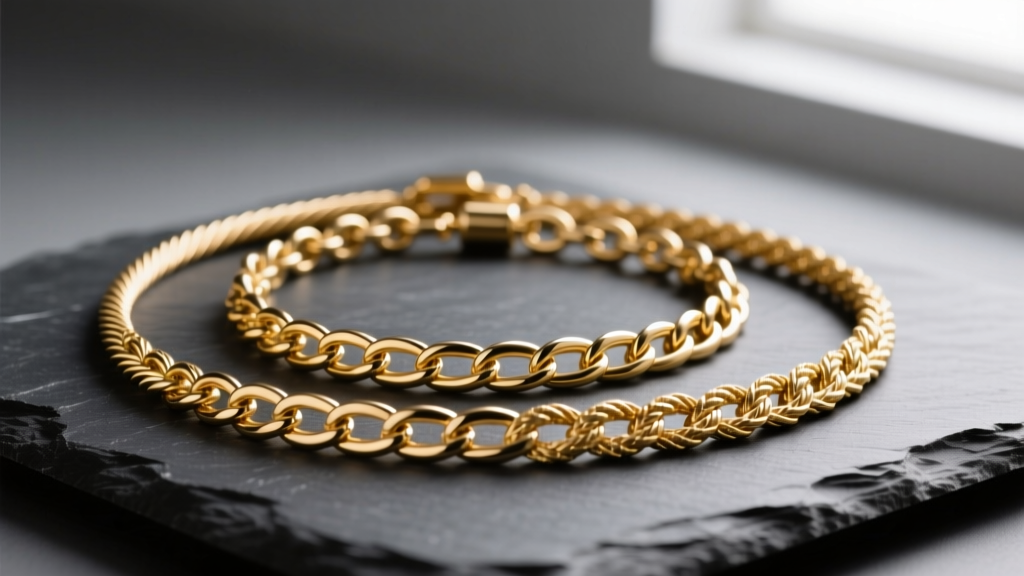
Layering necklaces is a cornerstone of modern jewelry styling, but the frustration of constantly untangling knotted chains can ruin the experience. While many stylists focus solely on length differentials, the true secret to a knot-free stack lies in metallurgy and chain geometry. If you are wondering how to keep layered necklaces from tangling, you must look beyond basic styling rules and examine the physical properties of the materials you are wearing. Surface friction, metal hardness, and link aspect ratios all dictate how chains interact when they slide against one another.
In this comprehensive material comparison guide, we break down the exact physics of chain entanglement. By understanding how different alloys and weaves behave, you can curate a layered stack that remains pristine from morning to night, eliminating the need for constant adjustments.
The Physics of Necklace Tangling: Friction and Surface Roughness
Tangling is fundamentally a problem of friction and mechanical interlocking. When two chains rest against the skin or clothing, they are subjected to kinetic movement. If the surface roughness (measured in Ra values) of a chain is high, it will catch on adjacent chains, hair, or textile fibers. Furthermore, environmental factors like dry skin and synthetic fabrics generate static electricity, which pulls lightweight chains together, forcing their links to interlock.
Different metals respond to wear and environmental exposure in unique ways. For instance, sterling silver is highly susceptible to oxidation. As silver tarnishes, it develops a microscopic layer of silver sulfide. This tarnish layer is not perfectly smooth; it increases the surface friction of the chain, making it significantly more prone to catching and knotting than a freshly polished piece. According to the Gemological Institute of America (GIA), maintaining the structural integrity and surface polish of precious metals is vital not just for aesthetics, but for the physical performance of the jewelry.
Conversely, high-karat gold (18k and 22k) is a relatively soft metal. While it resists tarnish, it is prone to micro-scratches from daily wear. These micro-abrasions create tiny burrs on the links that act like microscopic hooks, snagging finer chains in a layered stack. Platinum, despite being incredibly dense and durable, develops a 'patina' over time—a satin-like finish caused by microscopic surface displacement. While beautiful, this patina increases friction compared to a high-polish finish.
Material Friction Coefficients and Tangling Risk
To effectively layer necklaces, you must pair materials that either share similar friction profiles or use physical barriers (like pendants) to keep them separated. Below is a comparative analysis of common jewelry metals and their inherent tangling risks based on their material properties.
| Metal Alloy | Vickers Hardness (HV) | Surface Friction Profile | Tangling Propensity |
|---|---|---|---|
| Sterling Silver (925) | 60-70 HV | High (when tarnished), Low (when rhodium-plated) | High |
| 14k Yellow Gold | 130-150 HV | Moderate (resists micro-scratches well) | Moderate |
| 18k Yellow Gold | 110-125 HV | High (softer, prone to surface burrs) | High |
| Platinum (950) | 110-130 HV | Moderate to High (patina increases drag) | Moderate |
| Surgical Stainless Steel | 200-250 HV | Very Low (maintains high polish) | Very Low |
As the data illustrates, harder metals like surgical stainless steel or titanium maintain their mirror polish indefinitely, offering the lowest friction and the lowest risk of tangling. If you are committed to layering softer metals like 18k gold or untreated sterling silver, you must compensate with strategic chain weave selection.
Chain Weave Geometry: Which Links Interlock?
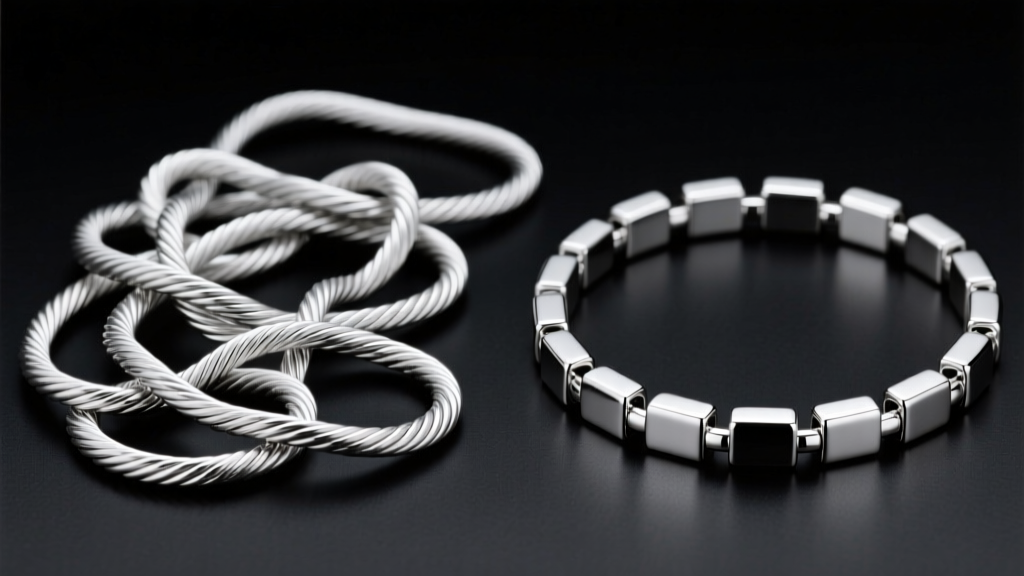
Material hardness is only half the equation; chain geometry is the other. The physical shape of the links determines whether a chain will lay flat or act as a series of interlocking gears. Jewelry suppliers like Rio Grande categorize chains by their link aspect ratios, which directly impact their tangling behavior.
High-Risk Weaves: Cable, Curb, and Figaro
Cable chains consist of uniform oval or round links. Because the open space inside the link is often larger than the wire gauge of an adjacent chain, cable links easily slip into one another. Curb and Figaro chains, while flattened, feature wide, open links that act as catch-points for finer chains. Layering two cable chains of similar gauges is a guaranteed recipe for severe knotting.
Low-Risk Weaves: Box, Snake, and Rope
If you want to know how to keep layered necklaces from tangling, transition to closed-surface weaves. Box chains feature square, tightly interlocked links that create a smooth, continuous surface with virtually no gaps for other chains to slip into. Snake chains are made of tightly joined wavy rings that form a flexible, solid tube, offering zero entry points for interlocking. Rope chains, while textured, have a twisted geometry that tends to deflect other chains rather than catch them.
Strategic Layering: The Gauge Differential Rule
When mixing materials and weaves, the thickness of the wire (gauge) is your primary defense against mechanical interlocking. The golden rule of layering is the 2mm Differential Rule. If your base chain is 1.0mm thick, your second chain must be at least 3.0mm thick, or feature a weave so dense that the 1.0mm links cannot physically fit inside the larger chain's gaps.
- The 0.8mm + 2.5mm Combo: Pair a delicate 0.8mm sterling silver cable chain with a chunky 2.5mm 14k gold curb chain. The silver links are too small to catch the thick gold wire, and the gold links are too thick to slip through the silver gaps.
- The Solid Tube Method: Layer a 1.5mm stainless steel snake chain with a 1.2mm gold box chain. Because neither chain has open gaps, they simply slide over one another regardless of their similar gauges.
- Pendant Anchoring: Adding a heavy pendant (minimum 5 grams) to the middle chain of a three-chain stack acts as a physical anchor. The weight pulls the chain taut, reducing the slack required for knots to form and keeping the chain physically separated from the layers above and below it.
Anti-Tangle Hardware and Clasp Modifications
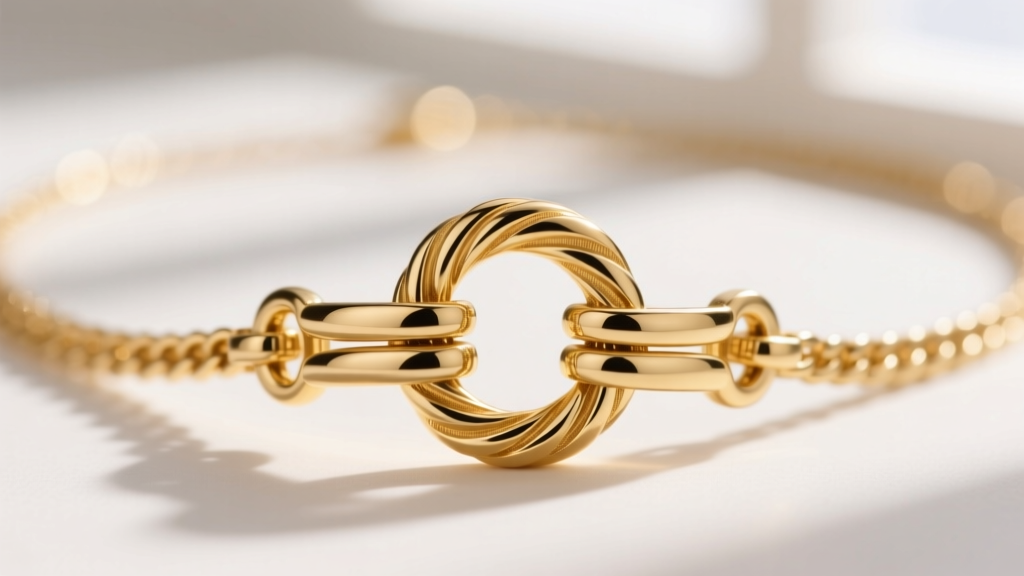
The hardware you use to secure your necklaces plays a hidden role in tangling. Standard spring-ring clasps are lightweight and prone to flipping around to the front of the neck, dragging the chain with them and creating twists that lead to knots. Upgrading your hardware is a crucial step in mastering how to keep layered necklaces from tangling.
Invest in multi-strand slide clasps or locking lobster clasps with integrated counterweights. A counterweighted clasp (often a small, heavy gold or platinum tube or sphere attached opposite the clasp mechanism) ensures the closure stays anchored at the nape of the neck. Furthermore, using a specialized 'tangle-free' connector ring—a small, polished O-ring that joins multiple chains at a single point before the clasp—forces the chains to lay parallel and prevents them from crossing over each other near the neck, which is where 80% of tangles originate.
Maintenance: Polishing and Static Reduction
Even the most carefully curated, geometrically perfect layered stack will tangle if the metals are poorly maintained. To minimize surface friction, you must implement a rigorous cleaning protocol. According to Jewelers of America, regular professional cleaning extends the life and performance of fine jewelry.
At home, use a high-quality microfiber polishing cloth infused with anti-tarnish compounds (such as Silverglow or Sunshine cloths) once a week. This removes the microscopic oxidation layer that increases friction. For gold and platinum, a quick bath in a mild, ammonia-free ultrasonic cleaning solution will dislodge skin oils and lotions that act as an adhesive between chains.
Finally, address the static issue. If you are wearing synthetic fabrics (like polyester or nylon) in dry, winter environments, static cling will pull lightweight chains together. Lightly misting your clothing with an anti-static spray, or rubbing a tiny, barely visible drop of jojoba oil onto the back of your neck and collarbone area, will neutralize the static charge and provide a lubricated surface for the chains to glide across, ensuring your layered stack remains flawless all day.


