Metallurgy & Mechanics: How to Prevent Necklaces From Tangling
Discover the physics of chain knotting and expert techniques on how to prevent necklaces from tangling using weave topology, clasp mods, and storage.

The Physics of Spontaneous Knotting
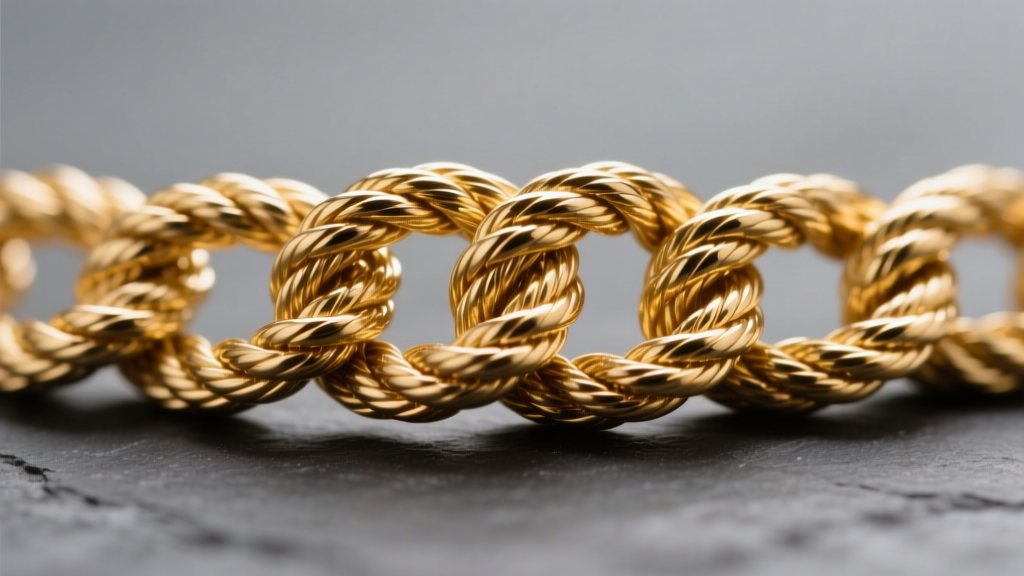
Every jewelry collector has experienced the frustration of pulling a delicate chain from a storage box only to find it bound in an impenetrable cluster of micro-knots. To understand how to prevent necklaces from tangling, we must first look at the physics of spontaneous knotting. In a landmark study published in the Proceedings of the National Academy of Sciences (PNAS), physicists Dorian Raymer and Douglas Smith proved that when a flexible string is agitated in a confined space, the ends of the string weave through the coils, creating complex knots in seconds.
The probability of knotting is dictated by three variables: chain length, flexibility (bending stiffness), and agitation. Necklaces between 18 and 24 inches fall into the mathematical 'danger zone' for spontaneous knotting. Furthermore, chains with high flexibility—such as fine cable or rope chains—have a lower bending stiffness, allowing them to fold sharply and loop through their own links. By manipulating these physical variables through chain topology, weight distribution, and storage engineering, we can effectively eliminate tangling.
Chain Weave Topologies: Tangling Susceptibility Index
Not all chains are created equal. The geometry of the links dictates the chain's degrees of freedom. A chain that can only bend on one axis is mathematically incapable of forming complex trefoil knots. Below is a technical breakdown of common chain weaves and their inherent tangling risks.
| Chain Weave | Link Geometry & Gauge | Flexibility Index | Tangling Risk | Best Use Case |
|---|---|---|---|---|
| Cable / Link | Uniform oval links, 20g-16g | High (Multi-axis) | Extreme | Pendant necklaces (requires careful storage) |
| Box | Square interlocking links, 18g-14g | Medium (Bi-axis) | Moderate | Everyday wear, medium-weight pendants |
| Rope | Twisted helical links, 18g-12g | High (Multi-axis) | High | Statement pieces, solo wear |
| Herringbone | Flat, flush-mounted links, 16g-10g | Low (Single-axis) | Low (but prone to kinking) | Collar necklaces, worn flat against skin |
| Omega | Interlocking metal plates over a mesh | Very Low (Rigid) | Negligible | Structured chokers, heavy slide pendants |
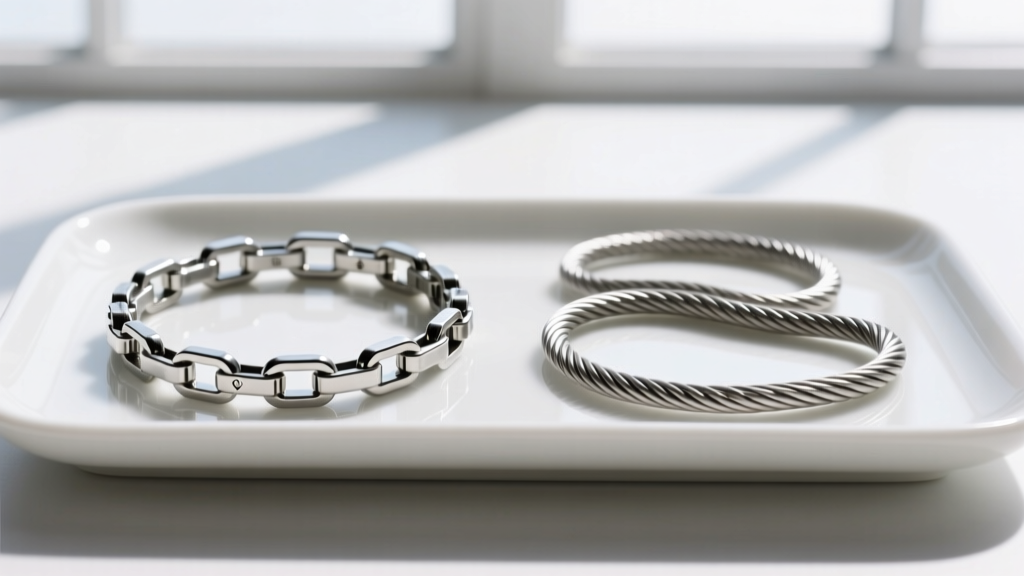
As the data illustrates, if your primary goal is to avoid tangles, rigid structures like Omega and Herringbone weaves are superior. However, if you prefer the drape of a flexible Box or Cable chain, you must rely on mechanical and storage interventions to prevent spontaneous knotting.
The Center-of-Gravity Problem: Clasp Migration
A common complaint among jewelers is the 'sliding clasp' phenomenon, where the clasp inevitably migrates to the front of the neck, twisting the chain and initiating a tangle at the nape. This is not a mystery; it is a simple center-of-gravity issue. The pendant or frontal focal point of the necklace is significantly heavier than the clasp and the thin jump ring at the back.
Gravity pulls the heavier frontal mass downward, while the lighter clasp is pulled upward by the tension of the chain sliding against the skin or clothing. This continuous micro-sliding introduces torsional stress and twists the chain links, creating the exact agitation required for spontaneous knotting.
Engineering Solutions for Clasp Migration
- Counterweight Clasps: Upgrade to a heavy lobster clasp or add a small 2mm-3mm gold or tungsten counterweight bead directly adjacent to the clasp. Matching the mass of the front and back of the necklace neutralizes the gravitational slide.
- Silicone Necklace Stays: These microscopic, medical-grade silicone tubes slide over the chain and grip the skin or clothing via high-friction coefficients, physically locking the clasp at the nape of the neck.
- Clasp-Forward Designs: For high-end bespoke pieces, jewelers are increasingly designing necklaces with decorative, magnetic clasps meant to be worn at the front or side, entirely eliminating the back-of-neck torsion.
Metallurgical Memory and Work Hardening
The material composition of your necklace heavily influences its tangling behavior. Precious metals exhibit 'work hardening'—a phenomenon where the metal becomes harder and more brittle as it is subjected to mechanical stress and bending. According to conservation guidelines from the Victoria and Albert Museum, repeated bending of fine metals alters their crystalline structure.
Sterling silver (925) has a Vickers hardness of approximately 65 HV in its annealed state, making it highly malleable. When a fine silver cable chain is crushed in a jewelry box, the links deform. This deformation creates permanent kinks. A kinked chain no longer lies flat; its altered topology creates protruding angles that act as hooks, catching on adjacent links and drastically increasing the probability of tangling. Conversely, 14k gold (approx. 120 HV) and platinum (approx. 130 HV) possess higher yield strengths and are more resistant to micro-deformations, making them inherently less prone to developing the 'hooks' that lead to severe tangles.
'A chain is only as stable as its weakest, most deformed link. Regularly inspecting your fine chains for micro-kinks and having a professional jeweler gently anneal or press them can restore their original topology and prevent future knotting.' — Master Bench Jeweler
Engineered Storage Protocols
Tossing necklaces into a communal, velvet-lined drawer is the fastest way to induce spontaneous knotting. To prevent agitation and confine the chain's degrees of freedom, implement the following storage protocols:
1. Tension-Bar Displays
For everyday wear pieces, use a countertop tension-bar display. By suspending the necklace vertically and applying slight downward tension, the chain is kept in a state of elongation. Knots cannot form in a taut string.
2. PTFE-Lined Individual Pouches
For travel and long-term storage, avoid standard cotton or velvet pouches, which generate static electricity and friction. Instead, use pouches lined with PTFE (Teflon) or anti-tarnish Pacific cloth. The ultra-low friction coefficient of PTFE allows the chain to slide freely without catching on the fabric, while individual isolation completely eliminates the agitation variable required for knotting.
3. The Straw Method for Travel
When packing for travel, thread one end of the chain through a rigid plastic or silicone straw, and clasp it. The straw acts as an exoskeleton, physically preventing the chain from bending beyond a 180-degree radius and making spontaneous knotting mathematically impossible.
Emergency Detangling: The Solvent and Pin Protocol
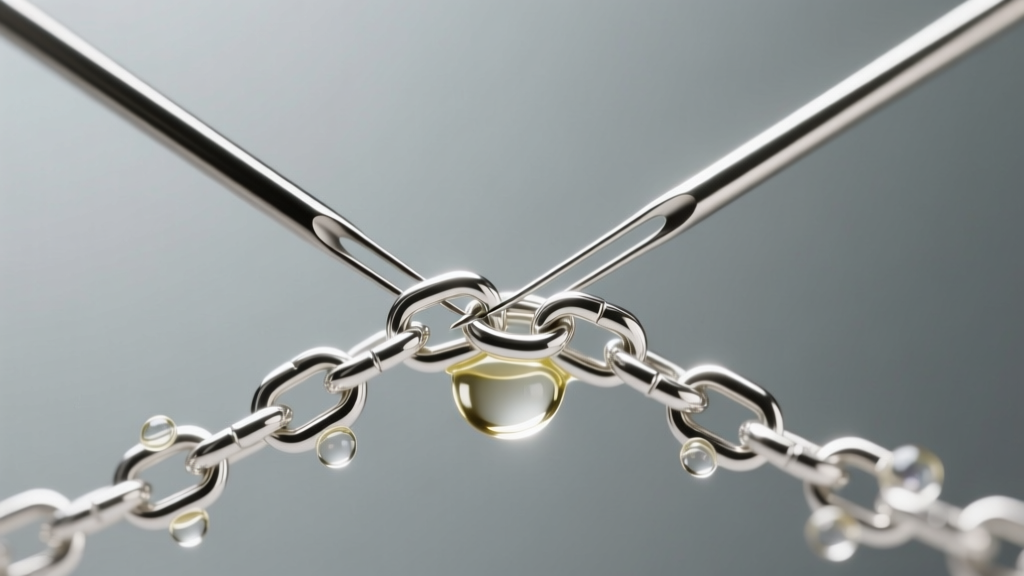
When a severe micro-knot does occur, pulling the chain will only tighten the links, causing work hardening and eventual structural failure (snapping). The Gemological Institute of America (GIA) recommends gentle, non-abrasive methods for jewelry maintenance. Follow this technical protocol to safely undo a knot without stressing the metal:
- Isolate the Knot: Lay the chain flat on a non-porous, well-lit surface like a glass or ceramic tray.
- Apply a Lubricating Solvent: Place a single drop of highly refined mineral oil or baby oil directly onto the center of the knot. Avoid water or soap, which can leave residues or promote oxidation in porous gemstones.
- Use Dual Micro-Probes: Take two fine steel sewing needles (size 9 or 10). Insert the tips into the center loop of the knot.
- Push, Do Not Pull: Gently push the needles outward in opposite directions to expand the center link. Never pull the ends of the chain. Once the center link is expanded, the surrounding loops will lose their tension and can be teased apart sequentially.
- Cleanse: Once detangled, clean the chain with a mild, phosphate-free dish soap and warm water to remove the mineral oil, then dry thoroughly with a microfiber cloth.
By understanding the physics of knotting, selecting the appropriate chain topology, and utilizing engineered storage, you can entirely eliminate the frustration of tangled jewelry, preserving both the structural integrity and the aesthetic beauty of your collection.


