Puka Shell Necklace Mens Trends 2026: Style & Fit Guide
Discover the 2026 puka shell necklace mens trend. Learn how to spot authentic cone shells, choose the right length, and style them with modern menswear.


The 2026 Resurgence: From Surf Cliché to Quiet Luxury
The puka shell necklace has officially completed its multi-decade rehabilitation. Once relegated to the realm of 1970s surf-dog stereotypes and early-2000s mall-kiosk impulse buys, the puka shell necklace mens market has been entirely reclaimed by high-end streetwear and quiet luxury aesthetics in 2026. Today, the modern iteration of this organic accessory is defined by meticulous sourcing, premium hardware, and deliberate styling. According to recent menswear trend analyses by GQ, the shift away from flashy metallic chains toward grounded, tactile, and nature-derived materials has placed authentic shell jewelry at the forefront of men's accessory rotation.
However, this surge in popularity has also flooded the market with synthetic imitations. Navigating the modern landscape requires a discerning eye for material authenticity, an understanding of precise sizing, and a grasp of how to integrate organic textures into contemporary wardrobes without looking like a time traveler. This guide breaks down the exact specifications, sourcing realities, and styling frameworks necessary to master the trend.
Authenticity Matrix: True Puka vs. Imitation Shells
The word "puka" translates to "hole" in Hawaiian, referring to the naturally occurring, smooth, concave holes found in the shells of the Conus miliaris (the millepoint cone snail). True puka shells are not manufactured; they are the result of ocean tumbling and natural biological decay, leaving behind the sturdy, calcified crown of the shell. As detailed in the organic gem material databases of the Gemological Institute of America (GIA), authentic shell structures possess unique microscopic growth lines and an asymmetrical, off-center hole.
Conversely, over 85% of the mass-market puka shell necklace mens products sold online are not shell at all. They are typically dyed howlite, magnesite, or injection-molded polyurethane. Below is a definitive breakdown to help you authenticate your pieces.
| Feature | Genuine Conus Puka | Dyed Howlite / Magnesite | Polyurethane / Plastic |
|---|---|---|---|
| Hole Placement | Off-center, naturally smooth edges | Perfectly centered, drill marks visible | Perfectly centered, seamless mold |
| Shape & Profile | Asymmetrical, convex top / concave bottom | Uniform thickness, perfectly round or square | Identical uniform stamping |
| Temperature Test | Cool to the touch, warms slowly | Cool to the touch (stone) | Room temperature, warms instantly |
| Weight | Lightweight but dense | Noticeably heavier (stone) | Feather-light, hollow feel |
| Price Range (18") | $120 - $600+ | $15 - $45 | $5 - $12 |
Stringing & Hardware: The Details That Separate Surf Trash from Quiet Luxury
The stringing material and clasp hardware are where the true value of a premium puka shell necklace mens piece is realized. Cheap elastic cords and base-metal crimp beads are the hallmarks of fast fashion. In 2026, luxury jewelers and specialized artisans are utilizing aerospace-grade wire and heritage textiles to ensure longevity and skin safety.
The Stringing Materials
- Waxed Irish Linen Cord: The gold standard for traditional knotting. Brands like Sajou produce waxed linen that resists water degradation and sweat acidity. It allows for adjustable macramé sliding knots, eliminating the need for metal clasps entirely.
- Titanium Grade 5 Wire: For necklaces that require structural rigidity and a modern, architectural drape, jewelers are stringing puka on 0.8mm Ti-6Al-4V wire. It is entirely hypoallergenic and will never snap under the weight of heavier shell crowns.
- Silk Mikado: Used primarily in high-end Japanese-American fusion brands, silk provides a luxurious, subtle sheen that contrasts beautifully with the matte, chalky texture of the shell.
The Hardware
If your necklace requires a clasp, avoid brass or gold-plated alloys, which will oxidize and turn your neck green when exposed to summer humidity and perspiration. Demand 14k or 18k solid gold lobster clasps or 316L surgical steel bayonet clasps. The integration of a small, textured gold bead or a single freshwater pearl as an accent piece among the puka shells has become a dominant micro-trend this year, adding a focal point that elevates the entire silhouette.
Sizing and Neckline Pairings for the Modern Man
The most common failure point in wearing organic jewelry is incorrect sizing. A puka shell necklace mens fit must be deliberate. Because puka shells are rigid and do not drape like a metal cable chain, the circumference must be matched precisely to your neck measurement and collar style.
The 17-Inch Choker & The Camp Collar
A 17-inch to 17.5-inch strand sits snugly at the base of the throat. This length is strictly reserved for open-necked garments. Pair it with a relaxed, short-sleeve camp collar shirt or a deep V-neck linen tunic. The rigid shells will frame the collarbones perfectly, mimicking the laid-back but tailored aesthetic popularized by mid-century Riviera style.
The 20-Inch Standard & The Heavyweight Tee
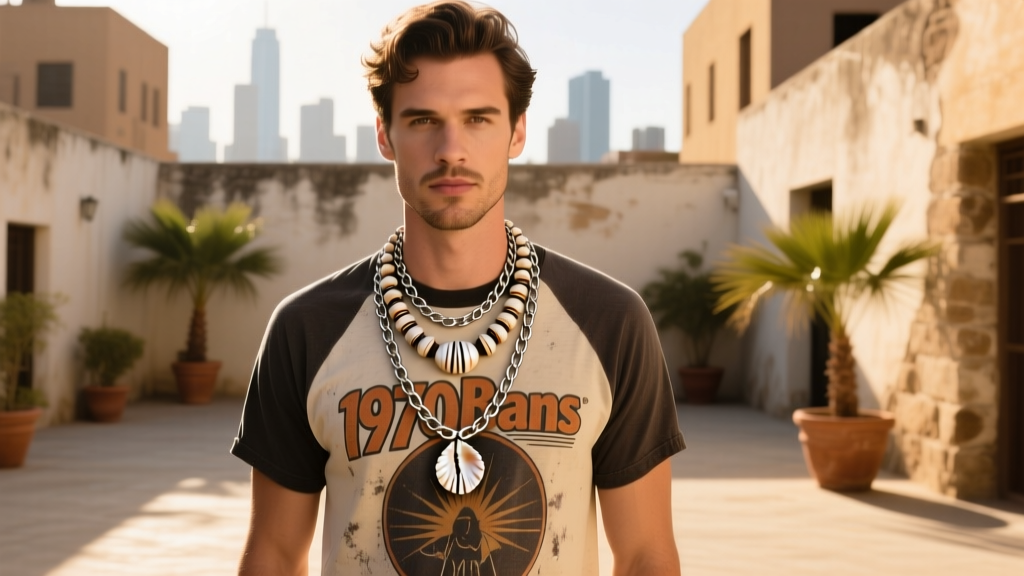
The 20-inch length rests just below the clavicle. This is the most versatile size for everyday wear. It pairs flawlessly with heavyweight, vintage-wash graphic tees or 280 GSM blank crewnecks. The matte texture of the shell plays exceptionally well against the rough, loopback cotton of a premium streetwear t-shirt.
The 24-Inch Drop & The Layering Framework
For a 24-inch to 26-inch drop, the puka strand should act as the foundational layer in a mixed-material stack. According to streetwear authorities at Hypebeast, mixing organic materials with precious metals is the defining jewelry trend of the mid-2020s. Layer a 24-inch puka strand with a 22-inch oxidized sterling silver Figaro chain and a 20-inch gold rope chain. The varying textures—chalky shell, darkened silver, and polished gold—create a rich, curated depth that looks inherently personal.
Care, Maintenance, and Degradation Risks
While Conus miliaris shells are incredibly durable, they are composed primarily of calcium carbonate. This makes them highly susceptible to acidic degradation. If you wear your puka shell necklace mens piece in the ocean, the saltwater will not harm the shell, but it will rapidly degrade cheap cotton cords and tarnish non-gold hardware. Rinse the piece with fresh water after ocean exposure.
Critical Warning: Never clean authentic puka shells in an ultrasonic jewelry cleaner. The high-frequency cavitation bubbles can cause microscopic fractures in the naturally tumbled shell, leading to sudden shattering. Instead, wipe the shells gently with a damp microfiber cloth and use a soft-bristle toothbrush to clear out any trapped skin oils or dirt from the concave undersides.
Market Pricing & Brand Tier Analysis
Understanding where your money goes is vital when investing in organic jewelry. Here is a breakdown of the current market tiers for authentic puka shell necklaces in 2026:
- Tier 1: Mass Market / Imitation ($10 - $40) - Found in fast-fashion retailers. Materials are almost exclusively dyed howlite or shell-heishi (which are uniform discs, not true puka). Stringing relies on cheap elastic.
- Tier 2: Artisanal & Surf Heritage ($120 - $280) - Sourced directly from Hawaiian or Indo-Pacific beachcombers. Features genuine, asymmetrical Conus shells, strung on hand-braided waxed linen with macramé closures.
- Tier 3: High-End Luxury & Designer ($450 - $1,200+) - Offered by luxury houses and specialized fine jewelers. Features hand-selected, color-matched true puka shells, interspersed with 18k gold spacer beads, finished with custom-machined precious metal clasps.
Final Verdict: Wearing It With Intention
The puka shell necklace mens trend in 2026 is no longer about adopting a costume; it is about integrating organic texture into a refined wardrobe. By insisting on genuine Conus miliaris shells, demanding premium stringing materials like waxed linen or titanium wire, and carefully matching the strand length to your specific neckline, you transform a nostalgic surf relic into a sophisticated, contemporary statement piece. Treat the shell with the same respect you would afford a turquoise or pearl pendant, and it will anchor your personal style for decades to come.


