What Does Purple on a Mood Necklace Mean? Technical Deep Dive
Discover the science behind purple on a mood necklace. We explore thermochromic liquid crystals, temperature thresholds, and material failure modes.

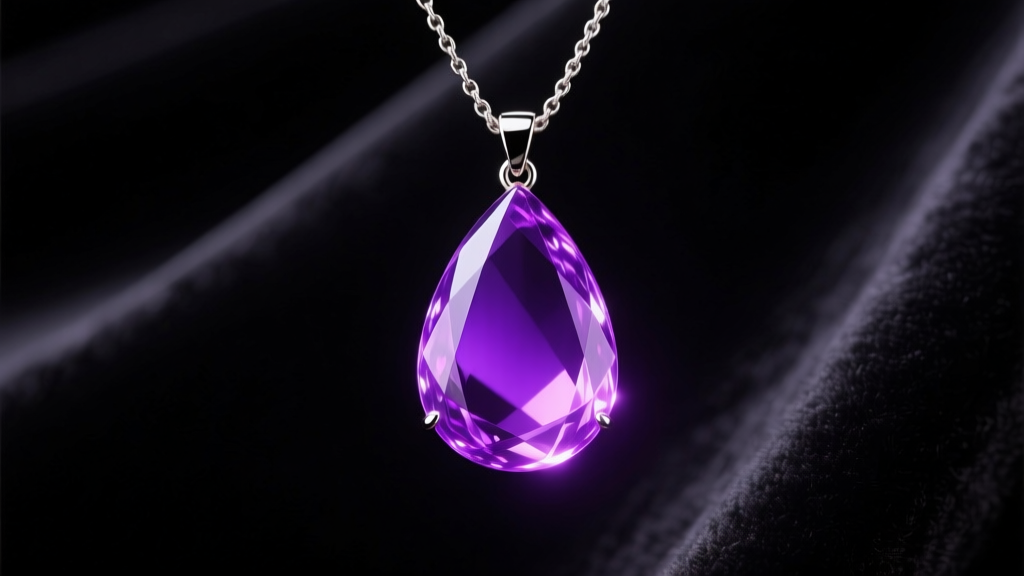
When you observe purple on a mood necklace, you are not witnessing magic, nor are you seeing a direct neurological readout of your emotional state. Instead, you are observing a highly calibrated thermodynamic reaction governed by the principles of materials science. While mood jewelry was popularized in the 1970s as a novelty, the underlying technology relies on complex cholesteric liquid crystals (CLCs) that respond to minute fluctuations in surface temperature. In this expert deep dive, we will deconstruct the exact physics, material composition, and failure modes of thermochromic pendants, specifically analyzing what the purple spectrum indicates on a molecular and physiological level.
The Physics of Cholesteric Liquid Crystals
To understand why a pendant shifts to purple, we must first examine the active layer of the jewelry. Mood necklaces utilize thermochromic materials, specifically chiral nematic liquid crystals. Unlike standard liquids, these molecules possess a rod-like structure that naturally aligns into a helical (twisted) formation. This helical structure acts as a natural diffraction grating for visible light.
When ambient light hits the pendant, the helical pitch—the distance it takes for the molecules to complete one full 360-degree twist—determines which wavelength of light is reflected back to the observer's eye, a phenomenon governed by Bragg's Law of diffraction. The rest of the light spectrum passes through the liquid crystal layer and is absorbed by a black backing material, ensuring high color contrast. As the temperature of the pendant changes, the kinetic energy of the molecules shifts. This thermal expansion or contraction alters the helical pitch, thereby changing the reflected wavelength. According to Britannica's comprehensive guide on liquid crystals, this phase transition is highly sensitive, capable of reflecting distinct colors across a narrow temperature bandwidth of just 2°C to 5°C.
Decoding Purple: Temperature Thresholds and Meanings
When your necklace displays purple, it is reflecting light in the short-wavelength spectrum, typically between 380 and 450 nanometers. For the thermochromic mixture used in standard mood jewelry, achieving this specific pitch requires the pendant's surface temperature to reach approximately 27°C to 29°C (80°F to 84°F).
Physiologically, human skin temperature at the extremities (like the neck and fingers) rests around 30°C to 32°C, but micro-fluctuations occur due to vasodilation and vasoconstriction. When you experience excitement, passion, or physical exertion, capillaries near the skin's surface dilate, increasing blood flow and marginally raising skin temperature. Therefore, the "romantic" or "passionate" mood associated with purple on a mood necklace is rooted in actual vascular responses to emotional stimuli.
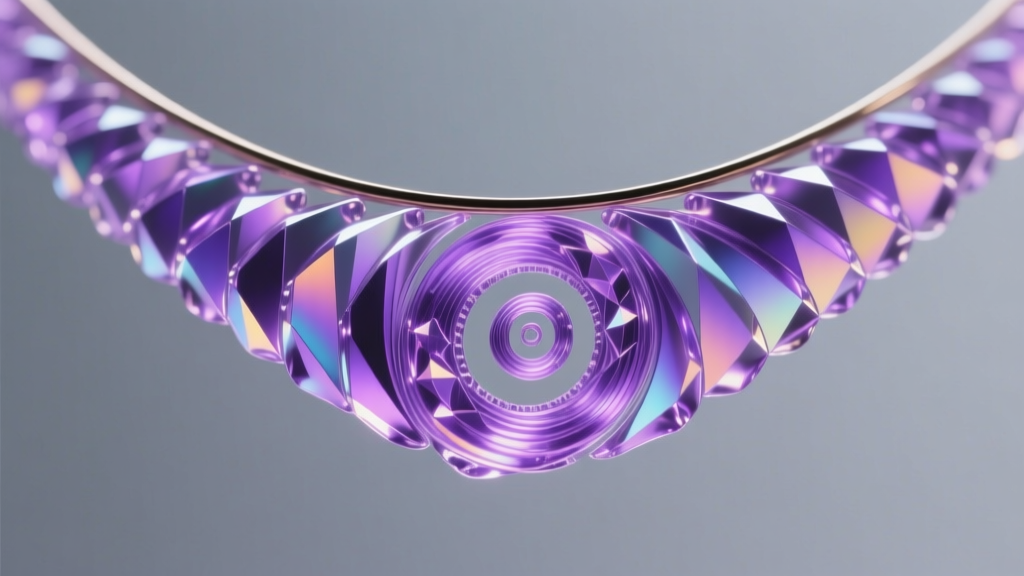
Thermochromic Color Calibration Chart
| Observed Color | Wavelength (nm) | Surface Temp (°C / °F) | Physiological State | Marketing "Mood" |
|---|---|---|---|---|
| Black / Brown | Absorbed (None) | < 22°C / < 72°F | Vasoconstriction, cold stress | Anxious, Cold, Stressed |
| Amber / Green | 520 - 580 nm | 24°C - 26°C / 75°F - 79°F | Baseline resting capillary flow | Relaxed, Calm, Normal |
| Blue / Cyan | 450 - 520 nm | 26°C - 28°C / 79°F - 82°F | Mild vasodilation, active state | Happy, Social, Active |
| Deep Purple / Violet | 380 - 450 nm | 28°C - 30°C / 82°F - 86°F | High vasodilation, elevated heart rate | Passionate, Romantic, Excited |
| Clear / White | Full spectrum scatter | > 32°C / > 90°F | Isotropic phase (matrix breakdown) | Overheated (Outside operating range) |
Encapsulation and Material Degradation
A common complaint among collectors and wearers is that their mood necklace becomes "stuck" on a single color—frequently purple or deep blue—or turns permanently black. To understand these failure modes, we must look at how the liquid crystals are encapsulated. Raw CLCs are highly volatile and easily destroyed by moisture and UV radiation. To protect them, manufacturers use a process called microencapsulation, suspending microscopic droplets of the liquid crystal mixture within a polyurethane or epoxy resin matrix.
This resin dome is then bonded to a dark, heat-absorbing base (often black nickel or a carbon-infused polymer) and capped with quartz or tempered glass. Despite this engineering, the materials are subject to specific degradation vectors:
- UV Photobleaching: Prolonged exposure to ultraviolet light breaks down the chiral dopants responsible for the helical twist. Once the dopants degrade, the crystals lose their ability to diffract light, usually resulting in a permanent yellowish-brown or black appearance.
- Moisture Ingress: If the glass or quartz dome suffers a micro-fracture, ambient humidity penetrates the resin. Water molecules disrupt the hydrogen bonding within the liquid crystal matrix, causing irreversible phase separation.
- Thermal Hysteresis: Repeatedly exposing the necklace to extreme heat (such as leaving it on a car dashboard in summer) forces the liquid crystals into an isotropic liquid phase. Upon cooling, the molecules may fail to realign into their chiral nematic structure, effectively "freezing" the pendant in a single color state.
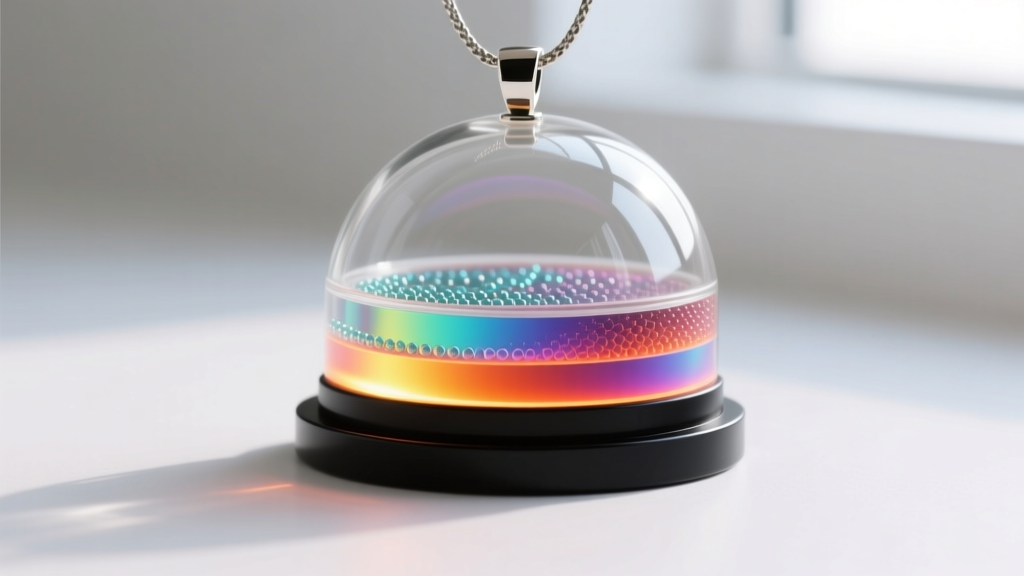
Troubleshooting: When Your Necklace Sticks on Purple
If your pendant is displaying a constant, unchanging purple, you must determine whether the necklace is accurately reading a consistently warm environment, or if the thermochromic matrix has suffered mechanical shear failure. You can perform a controlled calibration test to diagnose the issue.
The Thermal Calibration Test
- The Cold Shock: Place the pendant in a sealed plastic bag and submerge it in ice water (approx. 2°C / 35°F) for 60 seconds. A functional CLC matrix will immediately contract, shifting the color to black or dark brown.
- The Heat Shock: Remove the pendant and gently apply warm air from a hairdryer on a low setting, or hold it against a warm mug of tea (approx. 40°C / 104°F). The color should rapidly cycle through green, blue, and into a vibrant violet/purple.
- Diagnosis: If the pendant remains purple during the ice water submersion, the polyurethane encapsulation has likely suffered mechanical shear (often caused by dropping the pendant), locking the molecules in a rigid, expanded pitch. If it turns black in the cold but refuses to shift past green when heated, UV photobleaching has degraded the high-temperature chiral dopants.
Care and Calibration Maintenance
To maximize the operational lifespan of a thermochromic necklace and ensure accurate color transitions, specific care protocols are required. Avoid applying perfumes, lotions, or hairsprays directly onto the pendant, as the volatile organic compounds (VOCs) in these cosmetics can slowly dissolve the outer resin sealant over time. Furthermore, store the jewelry in a dark, climate-controlled environment when not in use to prevent cumulative UV damage. By understanding the exact science of cholesteric liquid crystals, you can appreciate the purple on a mood necklace not just as a retro novelty, but as a wearable marvel of soft-matter physics and thermal engineering.


