The Engineering of a Q Necklace: Typography & Durability
Discover the structural challenges of a Q necklace. Learn how typography, metal grades, and casting techniques dictate the durability of letter Q pendants.

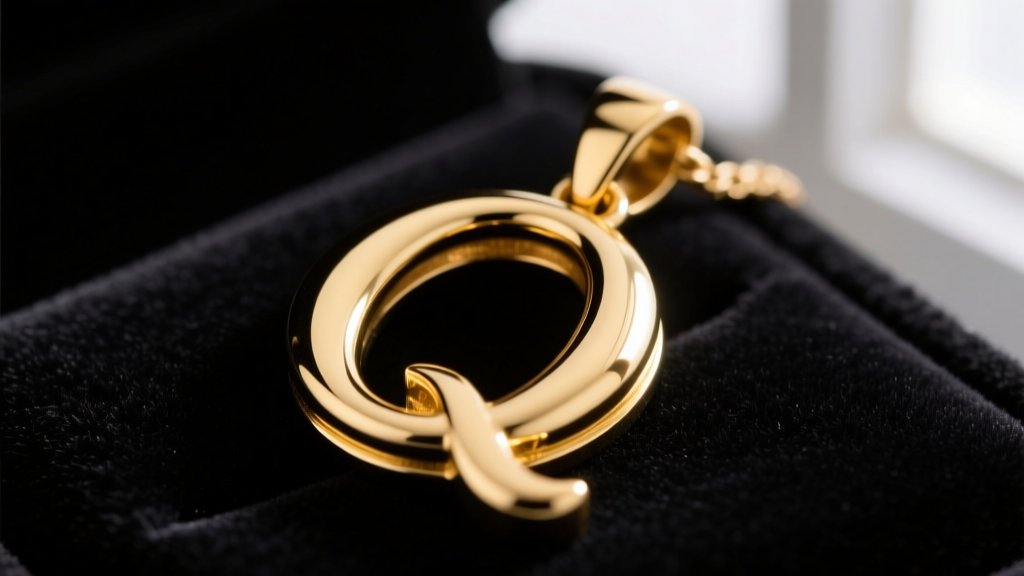
When consumers shop for initial jewelry, they rarely consider the structural engineering required to keep their chosen letter intact. However, for bench jewelers and CAD designers, the Q necklace represents one of the most notorious structural challenges in the alphabet. Unlike the continuous loops of an 'O' or the solid vertical pillars of an 'H', the letter Q features a primary bowl intersected by a descending tail. This tail creates an inherent vulnerability, acting as a lever that catches on clothing and concentrates kinetic stress at the exact junction where it meets the bowl.
In this expert deep dive, we explore the metallurgy, typography, and computer-aided design (CAD) parameters that separate a fragile, easily snapped Q pendant from an heirloom-quality piece built to survive daily wear in 2026 and beyond.
The Typography of Vulnerability: Serif vs. Sans-Serif
The survival rate of a Q necklace is directly dictated by its typographic roots. In traditional typography, the 'Q' is defined by its bowl and its tail (the descender stroke). When translating 2D fonts into 3D metal objects, the choice of typeface dictates the pendant's cross-sectional thickness.
The Danger of High-Contrast Serifs
High-contrast serif fonts, such as Bodoni or Didot, feature thick vertical strokes and razor-thin horizontal hairlines. If a Q necklace is cast using a traditional serif typeface, the tail often tapers to a dangerous sub-millimeter thickness. According to casting guidelines documented by the Ganoksin Project, any metal extremity thinner than 0.8mm is highly susceptible to micro-porosity during the investment casting process. The molten metal simply freezes before it can pack densely into the thin tip of the serif tail, leaving internal voids that guarantee a future snap.
The Structural Superiority of Sans-Serif and Slab Serifs
To engineer a durable Q necklace, expert designers gravitate toward uniform sans-serif fonts (like Helvetica or Futura) or heavy slab serifs (like Rockwell). These typefaces maintain a consistent stroke width, ensuring the tail retains a minimum cross-section of 1.2mm to 1.5mm. This uniform geometry allows for even cooling during the casting quench phase, resulting in a dense, crystalline metal structure free of shrinkage porosity.
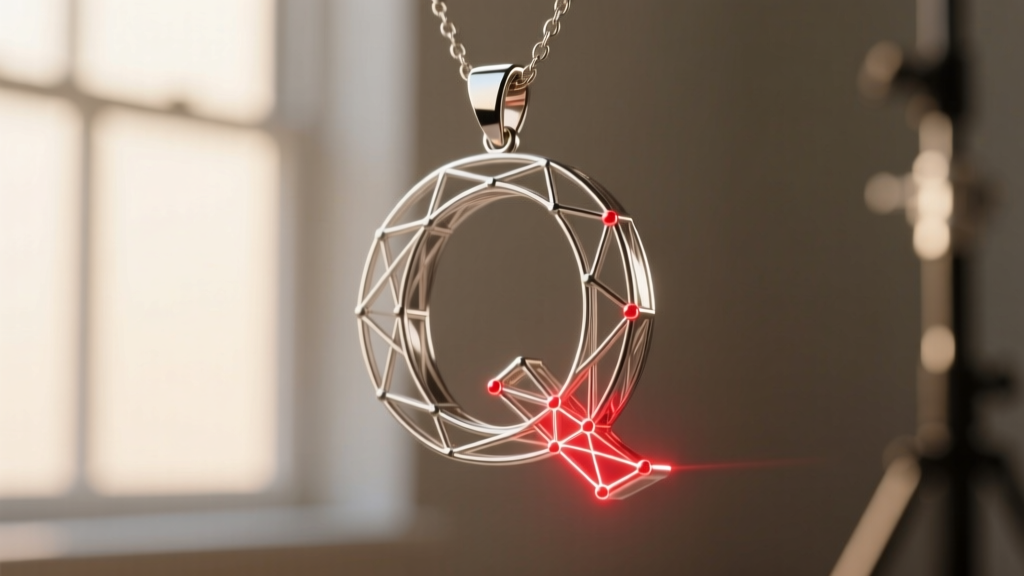
Metallurgical Realities: Hardness vs. Malleability
Not all precious metals behave identically when subjected to the leverage of a snagged Q tail. The Gemological Institute of America (GIA) and metallurgical standards emphasize the importance of the Vickers Hardness (HV) scale and tensile strength when evaluating jewelry alloys for high-stress designs.
Expert Insight: A platinum Q necklace will rarely snap outright. Because Platinum 950 is highly malleable and ductile, a snagged tail will bend or deform rather than fracture. Conversely, a high-karat gold tail will snap cleanly due to its crystalline rigidity.
Below is a technical comparison of standard jewelry alloys and their performance metrics specifically regarding the vulnerable Q tail:
| Metal Alloy | Vickers Hardness (HV) | Tensile Strength | Failure Mode on Snag |
|---|---|---|---|
| 14k Yellow Gold | 125 HV | 450 MPa | Clean fracture at the bowl junction |
| 14k White Gold (Nickel) | 140 HV | 550 MPa | High resistance; bends then snaps |
| 18k Yellow Gold | 115 HV | 380 MPa | High risk of immediate shearing |
| Platinum 950 / Ruthenium | 135 HV | 420 MPa | Severe bending; rarely fractures |
| Sterling Silver (925) | 105 HV | 300 MPa | Rapid deformation and eventual fatigue snap |
For a Q necklace intended for daily, unremoving wear, 14k white gold or ruthenium-alloyed platinum offers the highest structural integrity. The addition of ruthenium to platinum significantly increases its hardness, preventing the tail from bending out of shape when caught on a knit sweater.
CAD Engineering: The 0.3mm Fillet Rule
In modern jewelry manufacturing, a Q necklace begins its life as a 3D CAD model. The most critical juncture in this model is the internal corner where the tail intersects the outer edge of the bowl. In physics, sharp internal corners act as stress concentrators. If a CAD designer leaves a sharp 90-degree angle at this junction, any kinetic force applied to the tail will multiply at that exact vertex, initiating a micro-fissure.
To counteract this, master CAD engineers apply a strict 0.3mm fillet rule. By adding a subtle, rounded radius (a fillet) to the internal corner where the tail meets the bowl, the kinetic stress is dispersed across a wider surface area. This invisible geometric tweak increases the pendant's sheer resistance by up to 40% without altering the visual aesthetic of the typography.
Sprue Placement and Casting Shrinkage
During the lost-wax casting process, the wax model of the Q is attached to a central sprue base. If the sprue is attached directly to the thin tail of the Q to hide the cut-off mark, the tail becomes the primary conduit for molten metal. As the metal cools, it shrinks. A thin tail cannot feed enough molten metal back into the thicker bowl, resulting in a phenomenon known as 'suck-back' or shrinkage porosity right at the junction. Expert casters attach the sprue to the thickest part of the Q's bowl and accept the minor cleanup required on the back, ensuring the tail remains structurally sound.
Bail Placement and Chain Equilibrium
The letter Q is inherently asymmetrical and bottom-heavy due to the tail. A standard, mass-produced loop bail placed at the exact top-center of the bowl will result in a Q necklace that hangs crookedly, with the tail dragging the pendant to the right.
- Offset Bails: Custom jewelers will shift the bail 10 to 15 degrees to the left (counter-clockwise) to compensate for the lower-right weight of the tail.
- Hidden Horizontal Bails: For a sleek, modern look, a horizontal tube bail is drilled directly through the upper-left quadrant of the Q's bowl. This allows the chain to pass through the letter itself, perfectly balancing the pendant on the collarbone.
- Chain Gauge Pairing: Because the Q is a statement piece, it requires a chain that can handle the pendulum effect. A 1.5mm to 2.0mm cable or box chain in a matching alloy is recommended. Thinner chains (under 1.0mm) will suffer from accelerated link wear at the bail friction point.
Failure Modes and Advanced Repair Techniques
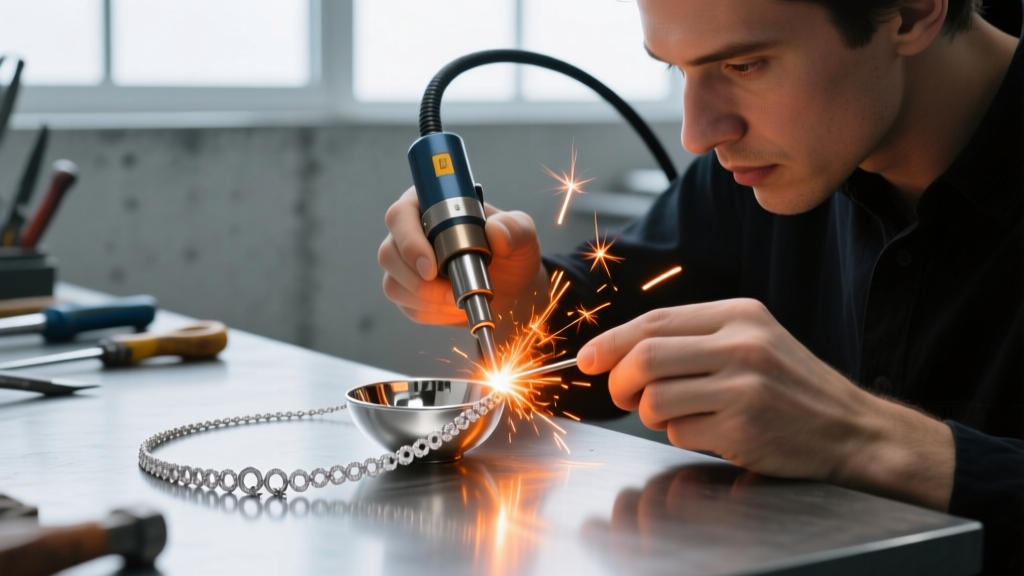
Even with optimal CAD design and superior alloys, a Q necklace can succumb to extreme trauma. When the tail snaps, traditional torch soldering is often a poor repair method. The intense, broad heat of a jeweler's torch can easily melt the delicate serif tips or alter the temper of the surrounding gold, leaving a visible seam and a weakened heat-affected zone.
Instead, the industry standard for repairing a fractured Q necklace is laser welding. Using a high-powered neodymium-doped yttrium aluminum garnet (Nd:YAG) laser, a bench jeweler can fuse a microscopic piece of filler wire directly into the fracture line. The laser's pinpoint accuracy confines the heat to a fraction of a millimeter, leaving the surrounding typography completely unaffected and restoring the tail to near-original tensile strength.
Preventative Maintenance for Initial Jewelry
To maximize the lifespan of your Q necklace, adopt a proactive maintenance routine. Every six months, inspect the tail junction under a 10x jeweler's loupe. Look for microscopic stress lines or a slight whitening of the metal (in white gold or platinum), which indicates metal fatigue. Catching a micro-fissure early allows a jeweler to laser-weld the joint preemptively, adding structural mass before a catastrophic snap occurs.
Ultimately, a well-engineered Q necklace is a triumph of metallurgy and design. By respecting the unique anatomical challenges of the letter Q—from the typography of the tail to the Vickers hardness of the alloy—you can select or design an initial pendant that is as structurally resilient as it is deeply personal.


