Queen Camilla Serpent Necklace: A Technical Deep Dive
An expert technical analysis of the Queen Camilla serpent necklace, exploring antique articulation, rose-cut settings, and royal provenance.

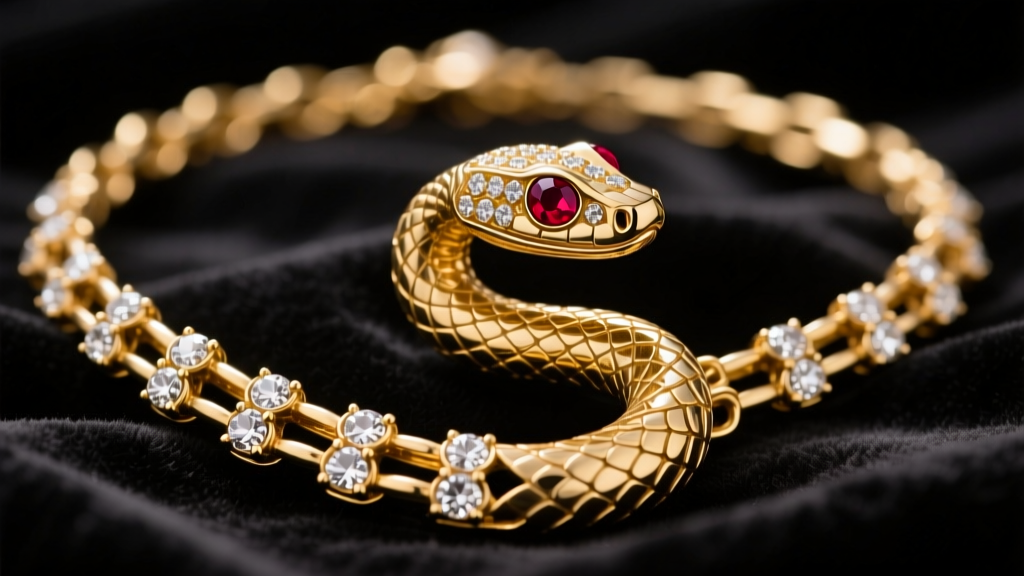
The Anatomy of Royal Serpent Articulation
The fascination with the Queen Camilla serpent necklace extends far beyond its royal provenance; it is a masterclass in 19th-century horological and goldsmithing engineering. When examining antique articulated serpent necklaces of this caliber—often drawn from the Royal Collection or Camilla’s private antique acquisitions—the primary technical marvel is the spine. Unlike modern snake chains that rely on simple interlocking cups, high-jewelry antique serpents utilize a complex, riveted vertebrae system.
Master goldsmiths of the Victorian and Edwardian eras constructed these pieces using a central armature, typically drawn from 14-gauge (1.6mm) or 16-gauge (1.3mm) high-carbon steel or hardened 18k gold wire. This internal spine provides the tensile strength required to support the heavy gold scales while allowing the necklace to coil fluidly against the clavicle. Each individual scale is hand-forged, usually from 18k yellow gold (75% Au, alloyed with copper and silver for a warm, rich hue), and connected via microscopic friction rivets. This technique, rarely seen in contemporary mass-market jewelry, ensures that the necklace moves with the fluidity of a living creature without suffering from metal fatigue at the joints.
Scale Overlap and Light Dynamics
The overlapping geometry of the scales is calculated to a precise tolerance of 0.2mm. This tight tolerance prevents the necklace from catching on delicate silk fabrics—a crucial consideration for royal state dinners—while maximizing the surface area available for light reflection. The scales are often slightly domed, a technique known as repoussé, which adds structural rigidity to the thin gold sheet (usually 0.8mm thick) without adding excessive gram weight.
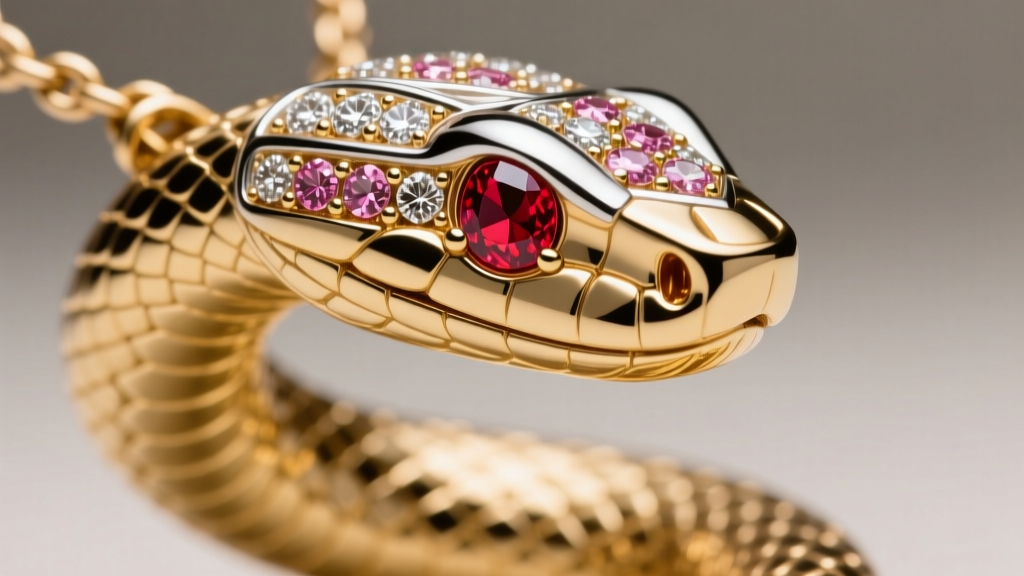
Gemological Breakdown: Silver-Topped Gold and Rose Cuts
A defining technical characteristic of the Queen Camilla serpent necklace and similar royal vault pieces is the use of silver-topped gold for the diamond-set sections, specifically the serpent’s head and the tapered tail. Before the widespread adoption of platinum and white gold in the early 20th century, jewelers faced a metallurgical challenge: yellow gold reflects a warm tint that compromises the perceived colorlessness of diamonds.
To solve this, artisans fused a thin layer of sterling silver to the surface of the 18k yellow gold base. The diamonds were then set into this silver layer using gypsy or millegrain bezel settings. Over decades, the silver naturally oxidizes, creating a dark, almost gunmetal patina in the crevices. Rather than being a flaw, this oxidation is highly prized by antique jewelry appraisers as it creates a stark contrast that makes the rose-cut diamonds appear significantly brighter and more prominent.
Rose Cut vs. Modern Brilliant: A Technical Comparison
The diamonds used in these antique serpent motifs are almost exclusively rose cuts. Understanding their optical mechanics is vital for anyone studying or attempting to replicate royal jewelry.
| Feature | Antique Rose Cut (Victorian Era) | Modern Round Brilliant (2026 Standard) |
|---|---|---|
| Facet Count | 3 to 24 facets (flat base, domed top) | 57 or 58 facets (conical pavilion) |
| Light Return | Soft, diffused, glassy luster | High-contrast scintillation and fire |
| Setting Depth | Requires minimal vertical depth (ideal for flush scale settings) | Requires deep pavilion clearance |
| Carat Weight Spread | Appears larger per carat due to shallow profile | Optimized for weight retention, smaller spread |
The flat base of the rose cut allows it to be set directly into the curved gold scales without requiring the deep, structural piercing that modern brilliants demand. The serpent’s eyes are traditionally set with cabochon Burmese rubies, selected for their high chromium content and lack of silk, providing a piercing, glassy red that contrasts with the metallic scales.
Provenance and the Royal Vault Connection
The serpent motif holds a deeply entrenched position in British royal jewelry history, popularized by Queen Victoria, whose engagement ring from Prince Albert was a serpent symbolizing eternal love. When analyzing the pieces accessible to Queen Camilla, we must look to the Royal Collection Trust, which houses numerous 19th-century snake motifs. While Camilla is frequently seen in the Greville Emerald Kokoshnik Tiara and the Delhi Durbar parure, her affinity for antique, nature-inspired motifs aligns perfectly with the Victorian serpent revival.
"The articulation of royal serpent necklaces represents a crossover between jewelry making and micro-engineering, requiring skills that are increasingly rare in the modern bench jeweler's repertoire." — Archival notes on Victorian Goldsmithing, Victoria and Albert Museum
Pieces worn by the Queen Consort are subjected to rigorous conservation protocols. Unlike modern jewelry, which can be aggressively polished, antique silver-topped gold requires specialized, non-abrasive cleaning to preserve the historical oxidation and the delicate millegrain edges surrounding the rose-cut diamonds.
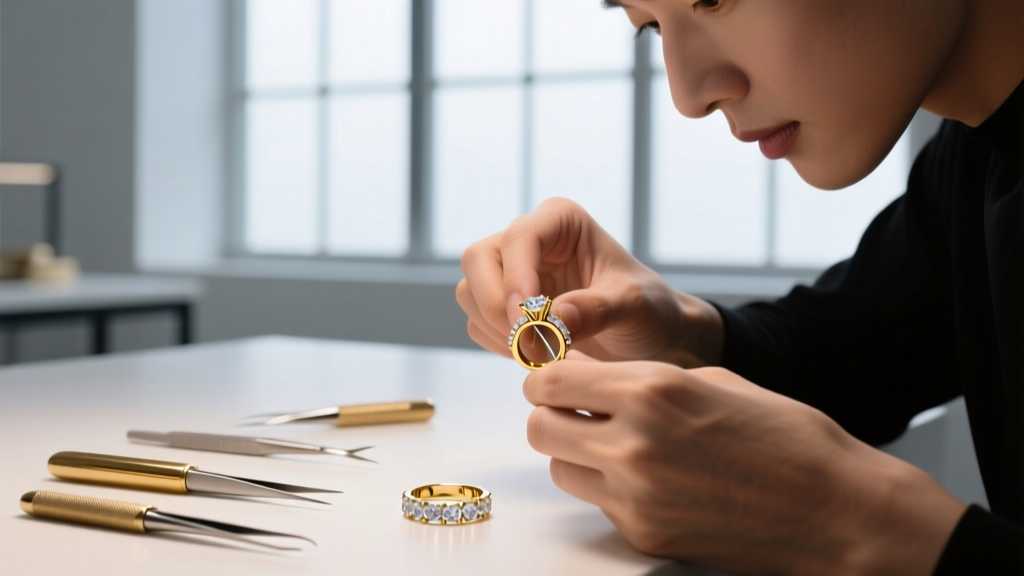
Technical Replication: Crafting a Serpent Necklace Today
For master jewelers in 2026 looking to replicate the technical brilliance of the Queen Camilla serpent necklace, the process demands a hybrid approach, merging CAD precision with traditional hand-finishing. According to gemological and historical standards outlined by the Gemological Institute of America (GIA), sourcing genuine antique rose cuts is paramount for achieving the correct visual weight and historical accuracy.
The 2026 Replication Workflow
- Spine Fabrication: Instead of hand-drawn wire, modern artisans use 3D-printed resin prototypes to cast the interlocking vertebrae in 18k gold, ensuring perfect tolerances of 0.05mm before assembling the internal Kevlar or titanium tension wire.
- Scale Milling: 5-axis CNC milling is used to carve the domed scales from wax blocks, guaranteeing uniform thickness (0.75mm) across all 150+ scales, which is then cast and hand-chased to add organic texture.
- Metallurgical Bonding: To replicate the silver-topped gold effect without the risk of future delamination, modern jewelers often use a rhodium plating process over white gold for the head and tail, though purists still fuse sterling silver using traditional torch-sweating techniques.
- Stone Setting: The rose-cut diamonds are secured using laser-welded bezels, eliminating the risk of thermal shock to the antique stones that traditional torch soldering might cause.
Maintenance and Conservation of Antique Snake Chains
Owning or conserving a piece of this magnitude requires strict adherence to antique jewelry maintenance. The most critical failure mode for articulated serpent necklaces is the degradation of the internal tension wire and the stretching of the friction rivets. If the necklace is stored hanging, gravity will slowly pull the rivets out of alignment, causing the scales to gape and the internal spine to snap.
Conservationists mandate that these pieces be stored coiled in a bespoke, acid-free silk-lined box, supporting the entire circumference of the necklace to relieve tension on the joints. Furthermore, ultrasonic cleaners are strictly forbidden. The high-frequency vibrations can easily shatter the fragile girdles of antique rose-cut diamonds and loosen the cabochon rubies, which are often secured with historically inaccurate, degraded shellac or early epoxy resins from mid-century repairs. Cleaning must be done manually using a soft sable brush, distilled water, and a mild, non-ionic surfactant, preserving both the metallurgical integrity and the historical soul of the piece.


