Queen's Necklace Materials: Platinum vs Gold & Stone Guide
Discover the best metals and gemstones for a modern queen's necklace. Compare platinum, gold, and titanium alloys for high-carat royal collars.


The Anatomy of a Modern Royal Collar
Historically, the term "queen's necklace" evokes the infamous 18th-century Affair of the Diamond Necklace, a lavish 2,800-carat piece that sparked a royal scandal. Today, the modern interpretation of a queen's necklace refers to an opulent, high-jewelry collar or multi-strand choker designed to sit flush against the collarbone, often carrying anywhere from 50 to over 200 carats of gemstones. Crafting a piece of this magnitude is not merely an exercise in aesthetics; it is a rigorous test of material science and structural engineering. When a necklace weighs upwards of 150 grams, the choice of metal alloy and gemstone specific gravity dictates whether the piece will drape elegantly or cause severe neck strain and structural failure.
In this comprehensive material guide, we deconstruct the metallurgical and gemological properties required to engineer a flawless queen's necklace. We will compare precious metal alloys, analyze gemstone physics, and explore the hidden armatures that make high-carat royal collars wearable.
Metallurgical Showdown: Precious Alloys for Heavy Carat Loads
The foundation of any queen's necklace must withstand immense tensile stress. A multi-tiered diamond collar exerts continuous downward and lateral force on its clasps, links, and settings. Selecting the wrong alloy can lead to stretched links, worn pavé prongs, and catastrophic clasp failure. Below, we compare the three primary metals used in high-jewelry royal collars.
Platinum 950: Ruthenium vs. Iridium
Platinum is the undisputed king of high jewelry, but not all Pt950 alloys are created equal. The 5% alloying metal drastically changes the working properties and wear resistance of the necklace.
- Pt950/Ruthenium (Ru): With a Vickers hardness of approximately 135 HV, this alloy is the industry standard for delicate pavé work. Its superior hardness means that 0.8mm prongs will resist bending and wear over decades of use, making it ideal for the intricate micro-settings often found in the bib of a queen's necklace.
- Pt950/Iridium (Ir): Softer and more malleable (around 80 HV), this alloy is preferred for casting heavy, solid bezels or articulated hinges. However, it is less suitable for high-wear pavé areas, as the prongs will burnish and wear down faster over time.
18k White Gold: The Rhodium Conundrum
18k White Gold (typically alloyed with palladium or nickel to achieve a white color) offers a Vickers hardness of around 120 HV, making it structurally sound. However, its natural color is a faint yellowish-gray. To achieve the bright white finish expected in a royal collar, it must be electroplated with rhodium. For a queen's necklace, which is often an heirloom piece, the inevitable wear of rhodium plating on the back of the collar and around the clasps requires costly and risky re-plating. Consequently, top-tier maisons reserve 18k white gold for pieces where the metal is entirely hidden by gemstones.
Grade 5 Titanium: The Hidden Armature
While rarely used for the visible exterior of a traditional royal collar, Grade 5 Titanium (Ti-6Al-4V) has revolutionized the internal engineering of heavy necklaces. With a Vickers hardness exceeding 350 HV and a density nearly half that of platinum, titanium is used to mill the internal mesh and structural armatures of a queen's necklace. This reduces the overall weight of the piece by up to 30%, drastically improving comfort without sacrificing structural integrity.
Material Property Comparison Matrix
To understand how these materials perform under the stress of a 100+ carat collar, review the comparative data below, sourced from metallurgical standards and Platinum Guild International specifications.
| Metal Alloy | Vickers Hardness (HV) | Density (g/cm³) | Yield Strength | Best Application in Royal Collars |
|---|---|---|---|---|
| Pt950 / Ruthenium | 135 | 21.06 | High | Intricate pavé, micro-prong settings |
| Pt950 / Iridium | 80 | 21.60 | Medium | Heavy cast bezels, articulation hinges |
| 18k White Gold (Pd) | 120 | 15.20 | Medium-High | Hidden structural links, backing plates |
| Grade 5 Titanium | 350 | 4.43 | Extremely High | Internal armatures, tension clasps |
Gemstone Physics: Refractive Index and Specific Gravity
The visual impact of a queen's necklace relies on the interplay of light and stone density. When selecting the primary gemstones for a multi-tiered collar, jewelers must balance optical performance with the physical weight of the stones. According to the Gemological Institute of America (GIA), the physical properties of diamonds and their simulants present distinct engineering challenges.
Natural vs. CVD Lab-Grown Diamonds
From a purely physical standpoint, natural earth-mined diamonds and Chemical Vapor Deposition (CVD) lab-grown diamonds are identical. Both possess a Mohs hardness of 10, a Refractive Index (RI) of 2.417, and a Specific Gravity (SG) of 3.52. In a queen's necklace featuring 150 carats of diamonds, the total weight of the stones alone will be approximately 30 grams. CVD diamonds have become increasingly prevalent in high-jewelry replicas and modern avant-garde royal collars, allowing for massive carat weights without the exponential price scaling of natural stones. However, for investment-grade heirloom collars, natural Type IIa diamonds remain the standard due to their documented geological provenance.
The Moissanite Alternative: Dispersion vs. Weight
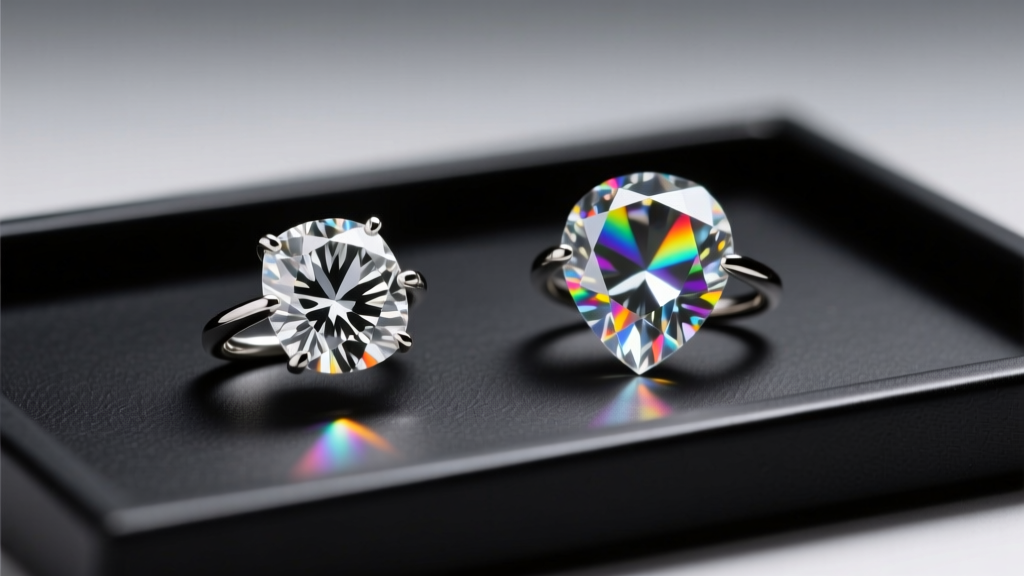
Moissanite (Silicon Carbide) is occasionally used in fashion-forward or theatrical interpretations of the queen's necklace. It boasts a higher dispersion (0.104) compared to diamond (0.044), resulting in a more aggressive "fire" or rainbow flash. However, its Specific Gravity is 3.21, meaning it is roughly 10% lighter than diamond. While this slightly reduces neck strain in a massive collar, its lower Mohs hardness (9.25) makes it more susceptible to facet abrasion over decades of wear, particularly where stones rub against each other in articulated fringe drops.
Structural Engineering: Articulation and Drape
A rigid metal collar will not sit correctly on the human body; the neck is a dynamic, curved surface. A masterfully crafted queen's necklace relies on advanced articulation to achieve its signature "liquid" drape. This is where material properties intersect with mechanical engineering.
The Hinge and Mesh System
To allow the necklace to conform to the clavicle, the back and sides of the collar are typically constructed using a series of micro-hinges or a woven precious metal mesh. If Pt950/Iridium is used for the hinges, the jeweler must ensure the hinge pins are made of a harder material, such as steel or titanium, to prevent the pin from shearing under the lateral tension of the heavy front bib. In modern 2026 high-jewelry manufacturing, laser welding is utilized to seal these micro-hinges without exposing the surrounding pavé diamonds to thermal shock, which could cause internal fracturing.
Clasp Mechanics for Heavy Loads
Standard lobster clasps are entirely inadequate for a royal collar. The sheer weight of the piece will warp the clasp lever over time, leading to accidental unfastening. Instead, a queen's necklace requires a custom-milled box clasp with a dual-safety figure-eight catch. The tongue of the box clasp must be forged from a high-yield-strength alloy, often incorporating a titanium core encased in platinum, ensuring that the locking mechanism cannot be bent out of shape even if the necklace is snagged on heavy fabric.
Maintenance and Longevity of Royal Collars
Owning a piece of this scale requires a rigorous maintenance protocol. The combination of skin oils, cosmetics, and environmental dust will quickly dull the brilliance of a multi-tiered pavé setting. Furthermore, the constant friction of metal against metal at the articulation points will generate microscopic wear debris.
- Ultrasonic Risks: While ultrasonic cleaners are standard for diamond rings, they are highly dangerous for a queen's necklace. The high-frequency vibrations can loosen the hundreds of micro-prongs holding the pavé stones, or worse, shatter fracture-filled diamonds often used in vintage collars.
- Steam Cleaning: High-pressure steam is the preferred method for cleaning royal collars, provided the stones are verified as untreated. Steam effectively blasts away sebum from the culets (bottoms) of the diamonds, restoring light return.
- Annual Prong Audits: Due to the immense value and weight of the piece, a master jeweler should inspect the prongs under 10x magnification annually. Any prong showing a wear depth of more than 15% must be re-tipped using laser welding to avoid thermal damage to adjacent stones.
Final Verdict: Engineering Your Heirloom
Creating or purchasing a modern queen's necklace is a masterclass in material compromise and optimization. For the ultimate heirloom piece, a Pt950/Ruthenium exterior provides the necessary hardness for secure pavé settings, while a Grade 5 Titanium internal armature ensures the piece remains wearable for hours at a gala. Whether set with natural Type IIa diamonds or precision-cut CVD stones, the success of the necklace relies entirely on respecting the specific gravity, tensile strength, and optical physics of the materials chosen. By prioritizing metallurgical integrity over mere carat weight, you ensure that the collar remains a breathtaking, structurally sound masterpiece for generations.


