Authentic Rankins Cross Necklace: Metals, Casting & Chain Guide
Explore the technical details of the authentic Rankins cross necklace. Learn about silver alloys, lost-wax casting, bail engineering, and chain pairings.

The Geometry and Heritage of the Rankins Cross
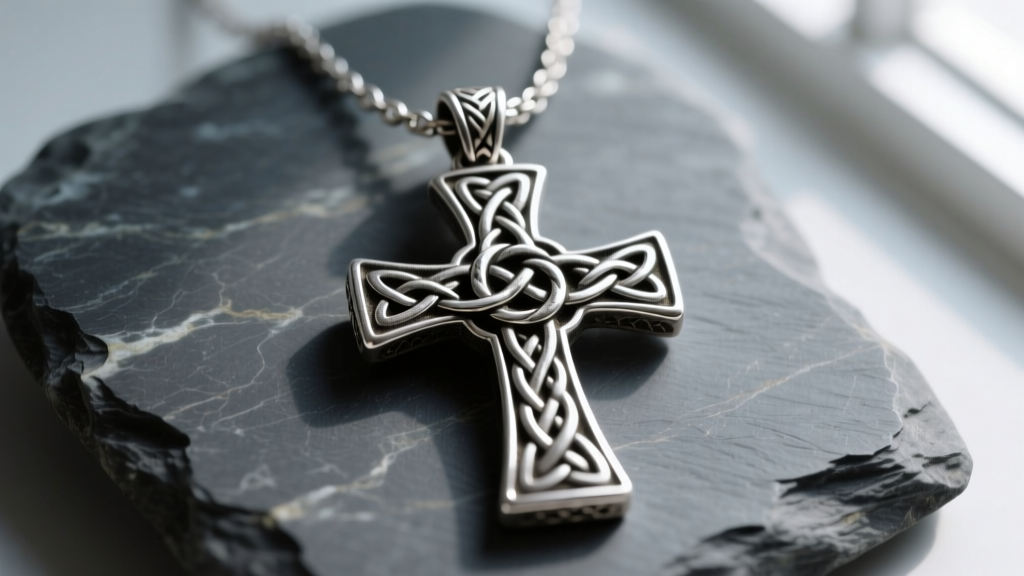
The Rankins cross necklace is more than a simple religious or decorative pendant; it is a masterclass in topological design and Scottish heritage jewelry. Originating from the broader tradition of Celtic high crosses, the specific Rankins variant is characterized by an elongated lower shaft and a highly complex, continuous-line interlaced knotwork within the nimbus (the circular ring). Unlike simpler Latin crosses, the geometry of a true Rankins cross requires the artisan to weave over-and-under patterns that never break, symbolizing eternity and the interconnectedness of life.
From a technical jewelry design perspective, this intricate knotwork presents unique manufacturing challenges. The deep undercuts and varying metal thicknesses mean that traditional die-striking is entirely impossible. Instead, authentic Rankins cross pendants rely on advanced lost-wax casting techniques to capture the precise 3D topology of the weave. When evaluating a piece, the first indicator of quality is the crispness of these intersections. Poorly finished castings will show rounded edges or 'melted' looking nodes where the metal failed to flow completely into the mold's deepest crevices.
Metallurgical Specifications: Beyond Basic Sterling
While the majority of heritage Scottish jewelry is produced in 925 sterling silver, the specific alloy chosen drastically impacts the longevity, tarnish resistance, and structural integrity of a heavy Rankins cross. Because these pendants often feature deep crevices that trap sulfur and moisture, standard sterling silver can develop severe, hard-to-remove black tarnish (silver sulfide) within the knotwork.
Alloy Comparison Chart for Heritage Crosses
| Alloy Grade | Composition | Vickers Hardness (HV) | Tarnish Resistance | Estimated Price Range (USD) |
|---|---|---|---|---|
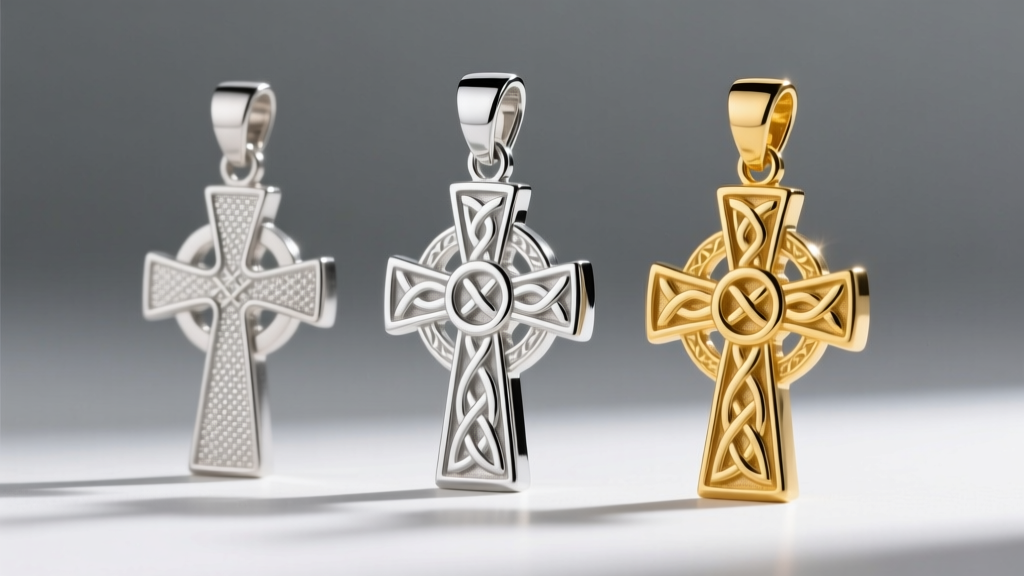
| 925 Sterling Silver | 92.5% Ag, 7.5% Cu | 65 (Annealed) / 120 (Work-Hardened) | Low (Prone to sulfide tarnish) | $85 - $180 |
| Argentium 960 Silver | 96% Ag, Germanium, Copper | 105 - 130 | High (Germanium oxide barrier) | $140 - $260 |
| 14k Yellow Gold | 58.5% Au, Cu, Ag, Zn | 135 - 150 | Excellent (Highly corrosion resistant) | $650 - $1,200+ |
For collectors seeking the highest durability without the premium of gold, Argentium silver is the superior technical choice. The addition of germanium creates a transparent oxide layer that dramatically slows tarnishing, keeping the deep Rankins knotwork bright with minimal polishing. Furthermore, authentic Scottish silver pieces should bear the hallmark of the Edinburgh Assay Office, identifiable by the three-towered castle stamp, guaranteeing the metal's purity and origin.
Lost-Wax Casting vs. Die-Striking: Manufacturing Deep Dive
As mentioned, the Rankins cross cannot be die-struck. The manufacturing process relies exclusively on investment casting (lost-wax). A master model is 3D printed in high-resolution castable resin or hand-carved from jeweler's wax. This model is encased in a plaster-like investment material and placed in a kiln.
The burnout cycle is critical. The flask must be heated to approximately 730°C to completely vaporize the wax, leaving a negative cavity. If the burnout is rushed, carbon residue remains in the narrow knotwork channels, causing 'incomplete fill' defects where the molten silver or gold cannot penetrate. Once cast—usually via centrifugal force or vacuum assist—the metal must cool at a controlled rate to prevent shrinkage porosity. This defect occurs when the outer layers of the metal solidify faster than the core, leaving microscopic voids inside the thickest parts of the cross, typically near the central intersection or the bail. These voids compromise structural integrity and can cause the pendant to crack under stress.
Bail Engineering and Structural Failure Points
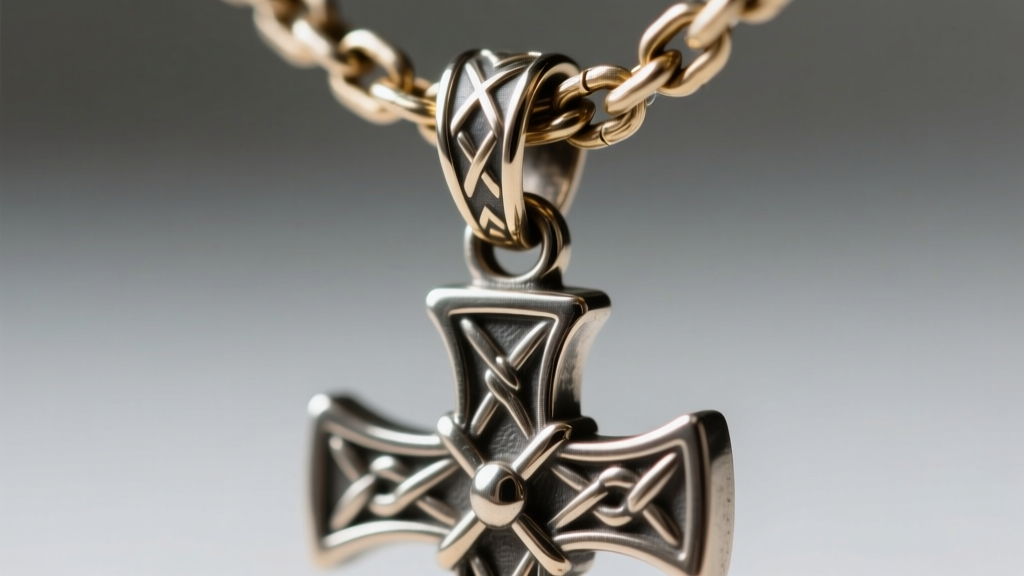
The bail—the loop that connects the pendant to the chain—is the most common point of catastrophic failure in heavy heritage jewelry. A solid cast Rankins cross typically weighs between 15 and 30 grams. When worn, dynamic movements (walking, bending, snagging on clothing) multiply this static weight, exerting significant shear stress on the bail.
- Integrated Cast Bails: Formed as part of the original wax model. While visually seamless, they are prone to porosity at the base where the loop meets the nimbus. They also suffer from work-hardening and eventual stress fracturing if bent.
- Soldered Sheet Bails: A separate loop formed from heavy-gauge sheet metal (minimum 1.2mm thick) and sweat-soldered to the back of the cross. This is the engineering gold standard for heavy pendants, as the solder joint distributes stress across a wider surface area.
When inspecting a Rankins cross necklace, check the inner diameter of the bail. It must be at least 4.5mm to accommodate a structurally sound chain without causing abrasive wear on the chain's links.
Chain Mechanics and Tensile Strength
Pairing the correct chain with a heavy Rankins cross is a matter of physics, not just aesthetics. The general horological and jewelry engineering rule of thumb is that the chain's breaking strength should be at least five times the static weight of the pendant. Therefore, a 20-gram cross requires a chain rated to withstand a minimum of 100 grams (approx. 1 Newton) of tensile force before yielding.
Expert Sizing Framework: Avoid hollow-curb or lightweight box chains. The sharp inner edges of the Rankins bail will act like a saw blade against thin, hollow links, eventually slicing through them. Opt for solid 2.5mm to 3.5mm Wheat (Spiga) chains or solid Rope chains. The multi-directional weave of a Wheat chain distributes the pendant's weight evenly and resists kinking.
For the clasp, abandon the standard spring-ring clasp immediately. The internal spring mechanism is a known failure point under dynamic loading. Upgrade to a heavy-duty lobster claw clasp with a reinforced lever, or a secure box clasp with a figure-eight safety catch if using a thicker chain.
Patina Preservation and Ultrasonic Risks
Many authentic Rankins crosses feature an applied oxidized patina (antiquing) to highlight the depth of the Celtic knotwork. This is achieved by submerging the silver in a potassium sulfide solution, deliberately creating a layer of silver sulfide in the recesses.
Critical Warning: Never place an antiqued Rankins cross in an ultrasonic cleaner. The high-frequency cavitation bubbles will aggressively strip the deliberate patina from the deep crevices, leaving the piece looking flat and washed out. Furthermore, if the cross features traditional Scottish pebble inlays (such as banded agate or jasper, which rank around 6.5 to 7 on the Mohs hardness scale), ultrasonic vibrations can shatter the stones or compromise the bezel settings.
Instead, clean the piece using a mild, phosphate-free surfactant and warm water. Use a soft boar-bristle detailing brush to gently agitate the dirt from the undercuts without scratching the high-polished ridges of the silver. Dry thoroughly with compressed air to prevent water spots from forming in the deep knotwork channels. For long-term storage, keep the necklace in an airtight anti-tarnish bag with a 3M silica gel desiccant packet to control ambient humidity.
Final Verdict: Sourcing Authentic Pieces
Investing in a Rankins cross necklace requires looking past the initial visual appeal and scrutinizing the metallurgical and structural realities of the piece. Demand Argentium silver or properly hallmarked Edinburgh sterling. Inspect the bail for soldered reinforcement rather than relying on fragile cast loops, and pair it with a solid wheat chain that respects the pendant's mass. According to the Gemological Institute of America (GIA), understanding the physical properties of precious metals and their manufacturing limitations is the key to acquiring heritage jewelry that will survive for generations. By applying these technical filters, you ensure your Rankins cross is not just a beautiful symbol of Scottish heritage, but a masterfully engineered artifact.


