Razor Necklace Meaning: Troubleshooting Style and Stigma
Discover the true razor necklace meaning, troubleshoot rusting pendants, prevent chain snapping, and learn how to style this edgy piece safely.

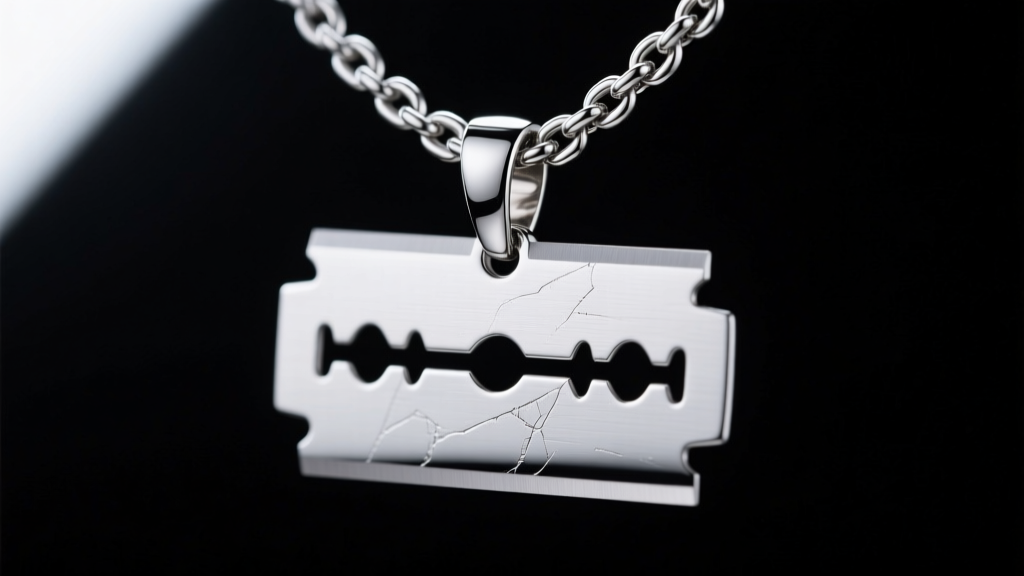
The razor blade pendant is one of the most polarizing and historically charged accessories in modern jewelry. While it has experienced massive revivals in alternative, grunge, and high-fashion circles, wearing one often invites unwanted questions, material failures, and styling dilemmas. When people search for the razor necklace meaning, they are usually confronted with two vastly different narratives: the rich, anti-establishment history of 1970s punk subculture, and the modern, often inaccurate misconceptions linking it to self-harm or gang affiliation.
As a domain expert in alternative jewelry styling and metallurgy, I see wearers struggle with three main problems: social stigma, rapid material degradation (rusting), and mechanical chain failures. This comprehensive troubleshooting guide will decode the history, solve your material headaches, and provide actionable frameworks for wearing a razor pendant with confidence and safety.
Decoding the Razor Necklace Meaning: Subculture vs. Misconception
To troubleshoot the social stigma associated with this piece, we must first establish its factual origins. The razor necklace meaning is deeply rooted in the 1970s London punk movement. Pioneers like Vivienne Westwood and Malcolm McLaren famously repurposed everyday, utilitarian, and dangerous objects—safety pins, dog collars, and razor blades—and transformed them into wearable art. According to the Victoria and Albert Museum's archives on punk fashion, this was a deliberate act of bricolage: taking mass-produced, disposable items and weaponizing them as a visual middle finger to the polished, conservative aesthetics of the British establishment.
The core meaning was anti-consumerism, rebellion, and DIY empowerment. It was never originally a symbol of self-harm or violence. However, as punk aesthetics were commercialized and diluted over the decades, the mainstream media occasionally mischaracterized the razor blade as a symbol of danger or illicit activity.
Troubleshooting the 'HR Problem': If you work in a conservative corporate environment and face questions about your jewelry, reframe the narrative. Explain that the piece is a nod to 1970s British punk history and DIY fashion upcycling, much like wearing a safety-pin lapel badge. Contextualizing it as a historical fashion artifact neutralizes modern misconceptions instantly.
For a deeper dive into the socio-political drivers of the punk aesthetic, Britannica's overview of the punk subculture highlights how shock value was used as a tool for working-class youth to demand visibility in a stratified society. Understanding this history empowers you to wear the piece with intellectual backing, rather than just edgy aesthetics.
The Rust Problem: Troubleshooting Carbon Steel vs. Surgical Steel
The most common technical complaint I receive from readers is: 'Why is my razor necklace leaving a black and orange stain on my chest, and why is the pendant pitting?'
The problem lies in the metallurgy. Many cheap, mass-market razor pendants are stamped from high-carbon steel or low-grade 304 stainless steel. Human sweat is highly corrosive, containing water, salt (sodium chloride), and lactic acid. Carbon steel has virtually no corrosion resistance; when exposed to sweat, it undergoes rapid oxidation, resulting in rust that stains the skin and degrades the sharp edges of the pendant.
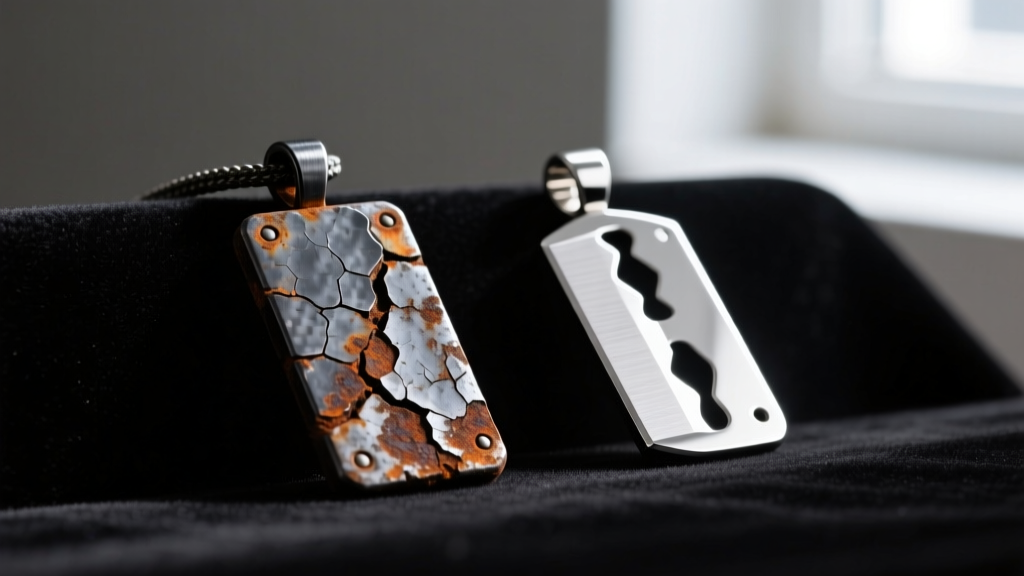
Material Troubleshooting Chart
To solve the rust problem, you must verify the material grade before purchasing. Here is a breakdown of what to look for and what to avoid:
| Material Grade | Composition | Rust/Sweat Resistance | Average Price | Skin Safety |
|---|---|---|---|---|
| High Carbon Steel | Iron + 0.6-1.0% Carbon | Poor (Rusts rapidly) | $10 - $25 | High irritation risk |
| 304 Stainless Steel | 18% Chromium, 8% Nickel | Moderate (Pits over time) | $25 - $45 | Moderate (Nickel allergy risk) |
| 316L Surgical Steel | 16-18% Cr, 10-14% Ni, 2-3% Mo | Excellent (Chloride resistant) | $40 - $80 | Hypoallergenic |
| 925 Sterling Silver | 92.5% Silver, 7.5% Copper | Tarnishes (No rust) | $75 - $150+ | Generally safe |
The Solution: Always opt for 316L Surgical Stainless Steel. The addition of molybdenum (Mo) in 316L steel specifically prevents chloride corrosion, meaning it will not rust when exposed to sweat or swimming pool water. If you prefer precious metals, 925 Sterling Silver is an excellent alternative, though it will require occasional polishing with a jeweler's cloth to remove sulfur-induced tarnish.
Mechanical Failures: Why Your Chain Keeps Snapping
A razor blade pendant is essentially a heavy, sharp-edged piece of metal. The second major troubleshooting issue is mechanical failure—specifically, the pendant slicing through the chain or the jump ring pulling apart.
Standard fashion jewelry often uses 1.2mm to 1.5mm cable chains. These chains have a low tensile strength (often under 8 lbs) and feature thin, soft wire links. The inner hole of a stamped razor pendant often has micro-burrs or sharp 90-degree edges left over from the manufacturing stamping process. As you walk, the pendant swings, and those sharp edges act like a guillotine, slowly sawing through the soft links of a cheap cable chain until it snaps.
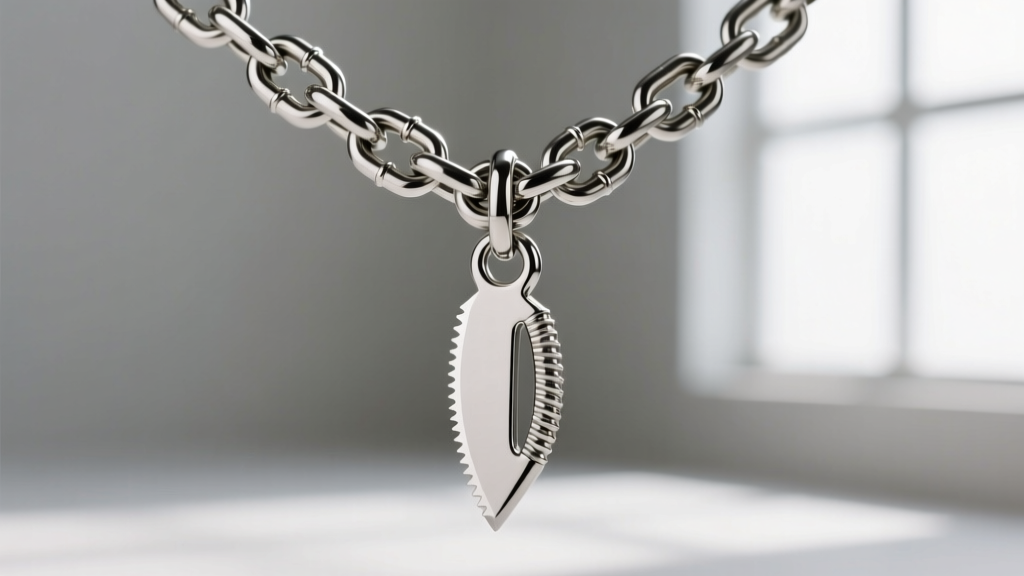
How to Bulletproof Your Chain Setup
To prevent losing your pendant, you must upgrade the suspension system. Follow these exact specifications:
- Chain Gauge and Style: Ditch the delicate cable chains. Upgrade to a 3.5mm to 5mm flat curb chain or a heavy rolo chain. These styles feature interlocking, flattened links that distribute weight evenly and have a tensile strength exceeding 40 lbs.
- The Bail Protector Hack: If your razor pendant has a sharp, unpolished hole, thread a tiny silicone O-ring (available at any hardware store for pennies) through the hole before attaching the jump ring. This creates a soft, frictionless barrier that prevents the steel pendant from grinding against the steel chain.
- Soldered Jump Rings: Never use an open, unsoldered jump ring to connect a heavy, swinging pendant. The lateral torque will pull the gap open. Ensure your jeweler uses a soldered jump ring or a heavy-duty lobster clasp directly through the bail.
Wardrobe Troubleshooting: Styling for the Workplace and Beyond
Beyond material and mechanical fixes, the final hurdle is styling. How do you integrate a piece with such an aggressive silhouette into a mature, modern wardrobe without looking like you are wearing a Halloween costume?
1. The High-Low Contrast Technique
The most effective way to neutralize the aggressive 'stigma' of a razor necklace is through high-low contrast. Pair the harsh, industrial lines of a 316L steel razor pendant with ultra-soft, luxurious fabrics. A heavy steel razor pendant layered over a cream-colored silk blouse, a cashmere turtleneck, or a tailored wool blazer creates a striking visual tension. The softness of the fabric elevates the jewelry from 'punk costume' to 'avant-garde high fashion'.
2. Strategic Layering
Wearing a razor pendant alone on a bare chest can sometimes lean too heavily into aggressive subculture tropes. To troubleshoot this, integrate it into a curated layering stack.
Try pairing a 20-inch silver razor pendant with a delicate 16-inch freshwater pearl choker and an 18-inch matte onyx beaded necklace. The pearls introduce organic, classic elegance, while the onyx bridges the gap to the dark, industrial aesthetic of the razor. This tri-layer approach signals to the observer that the piece is part of a deliberate, thoughtful styling choice rather than a reactionary statement.
3. Proportional Scaling
Many mass-market razor pendants are scaled to exact 1:1 replicas of real shaving blades, which can look overly literal and costumey. When shopping, look for stylized or scaled-down interpretations—perhaps a pendant that is 70% the size of a real blade, or one featuring geometric cutouts. A slightly abstracted silhouette reads as a sophisticated design motif rather than a literal hardware store replica.
Final Verdict: Maintenance and Care
The razor necklace meaning remains a powerful testament to DIY rebellion, anti-establishment art, and the reclamation of industrial objects. However, wearing it in the modern era requires a strategic approach to materials and styling. By insisting on 316L surgical steel to eliminate rust, upgrading to a 4mm curb chain to prevent mechanical snapping, and utilizing high-low fabric contrast to navigate social stigma, you can transform this historically charged accessory into a sophisticated, lifelong wardrobe staple. Treat the metal with respect, understand the history you are wearing, and let the styling speak for itself.


