Best Metals for a Necklace with Rectangular Pendant
Compare metals for a necklace with rectangular pendant. Discover durability, engraving suitability, and tarnish resistance for bar shapes.

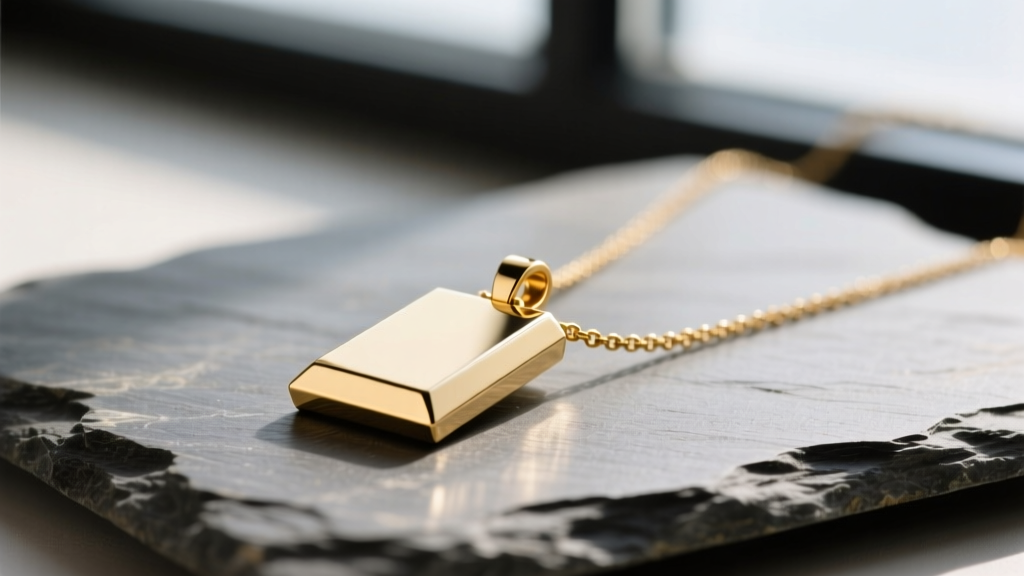
The Geometry Factor: Why Shape Dictates Material Choice
When shopping for fine jewelry, most buyers focus on chain gauge, clasp security, or gemstone clarity. However, the physical geometry of the pendant itself dictates which metals will actually survive daily wear. A necklace with rectangular pendant presents a unique set of metallurgical challenges compared to circular, oval, or organic shapes. Flat, expansive planes act as unforgiving mirrors for micro-scratches, while sharp 90-degree corners are prime targets for impact deformation and edge wear.
Choosing the right metal for a rectangular bar or block pendant requires understanding how different alloys handle surface abrasion, corner denting, and structural integrity over time. Whether you are looking for a minimalist titanium bar, an engraved gold coordinate necklace, or an indestructible stainless steel block, the material you choose will drastically alter the lifespan and aesthetic evolution of the piece.
Comprehensive Material Comparison Chart
Before diving into the specific properties of each alloy, it is crucial to understand how the most common jewelry metals perform when shaped into rigid, flat rectangles. The table below outlines the Vickers Hardness (HV) scale ratings, corner impact resistance, and ideal use cases for each material.
| Material | Hardness (HV) | Corner Durability | Surface Scratch Visibility | Best Engraving Method | Avg. Price Range |
|---|---|---|---|---|---|
| 316L Stainless Steel | 150 - 200 | Excellent | Low (if brushed) | Fiber Laser | $25 - $80 |
| 14k Solid Gold | 130 - 150 | Good | Moderate | Rotary / Laser | $250 - $600 |
| 18k Solid Gold | 110 - 130 | Fair (Prone to denting) | High (Shows patina) | Rotary Diamond Drag | $450 - $1,200+ |
| Grade 5 Titanium | 330 - 350 | Exceptional | Very Low | Laser Etching | $80 - $200 |
| 925 Sterling Silver | 60 - 75 | Poor (Corners round off) | Very High | Rotary / Hand Engraving | $40 - $150 |
316L Stainless Steel: The Indestructible Bar
If your priority is maintaining razor-sharp 90-degree corners and a flawless flat surface, 316L stainless steel is the undisputed champion. Unlike standard 304 steel, 316L contains 2-3% molybdenum, which drastically increases its resistance to chlorides and industrial solvents. This means a stainless steel rectangular pendant will not tarnish when exposed to sweat, swimming pools, or ocean water.
With a Vickers hardness rating hovering around 180 HV, 316L steel is hard enough to resist the micro-dents that plague softer precious metals. When dropped face-down on a tile floor, a steel bar pendant will likely bounce without its corners suffering any visible deformation. However, this extreme hardness makes traditional hand engraving nearly impossible. If you want text or coordinates on a steel rectangular pendant, it must be done using a fiber laser, which anneals the surface to create a permanent, dark mark without removing material.
14k vs. 18k Solid Gold: The Engraver's Canvas
Gold remains the most popular choice for fine jewelry, but the karat weight drastically changes how a rectangular pendant behaves. According to the Gemological Institute of America (GIA), pure 24k gold is far too soft for daily wear jewelry, necessitating the addition of alloy metals like copper, silver, and zinc.
14k Gold (58.5% pure gold) offers the ideal compromise for a necklace with rectangular pendant. The higher percentage of alloy metals increases the structural rigidity, allowing the pendant to maintain its geometric integrity. A 14k gold bar pendant can withstand the minor bumps of daily office work without its corners flattening out. Furthermore, 14k gold responds beautifully to both rotary diamond drag engraving and modern laser etching, making it the premier choice for personalized barcode or coordinate pendants.
18k Gold (75% pure gold) offers a richer, deeper yellow hue (or a more vibrant rose tone), but it is significantly softer. If you choose an 18k gold rectangular pendant, expect the sharp corners to slowly round off over years of wear. The flat planes will also develop a soft, matte patina from micro-scratches much faster than 14k gold. While this patina is beloved by vintage jewelry collectors, it is a detriment if you prefer a perpetual high-polish mirror finish.
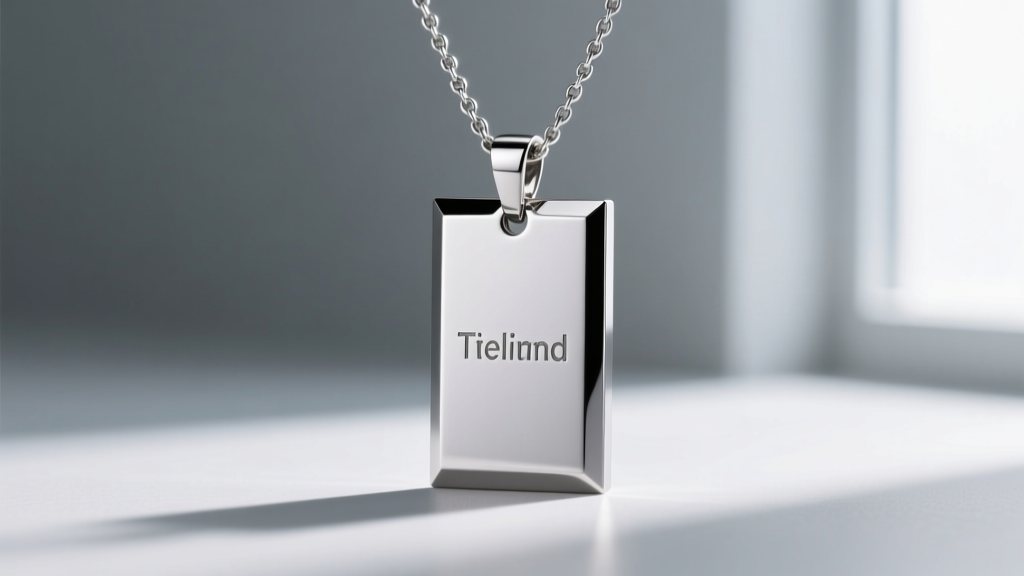
Grade 5 Titanium: Featherweight Modernism
For oversized, chunky rectangular pendants, weight becomes a major comfort factor. A solid steel or gold block measuring 40mm x 15mm can weigh upwards of 25 grams, which will constantly pull on the cervical spine and stretch the chain. Enter Grade 5 Titanium (Ti-6Al-4V), an aerospace-grade alloy that is roughly 45% lighter than steel but boasts a staggering hardness of 340 HV.
Titanium rectangular pendants are virtually immune to corner denting and surface scratching. The metal naturally forms a microscopic oxide layer that protects it from all forms of corrosion. The primary drawback of titanium is its reparability. If a titanium pendant does suffer a deep, catastrophic gouge, it cannot be easily polished out by a traditional jeweler due to the metal's extreme hardness and low thermal conductivity. Additionally, because titanium cannot be soldered with standard jewelry torches, integrating complex gemstone settings into a titanium bar is highly restricted.
925 Sterling Silver: The High-Maintenance Classic
Sterling silver (92.5% pure silver, 7.5% copper) is a staple in jewelry, but it is arguably the worst material for a sharp-cornered rectangular pendant. With a hardness of just 65 HV, silver is incredibly malleable. The sharp corners of a silver bar pendant will dent, flatten, and round off within the first few months of active wear.
Furthermore, the copper content in sterling silver reacts with sulfur in the air and the acids in human sweat, leading to rapid tarnishing. On a flat, polished rectangular surface, this tarnish is highly visible and requires frequent polishing with a jeweler's cloth. To mitigate this, many manufacturers apply a thin layer of rhodium plating over the silver. While this delays tarnishing, the plating will eventually wear off on the high-friction corners, leading to a two-toned, patchy appearance. As noted by the Birmingham Assay Office, proper hallmarking and understanding of alloy compositions are vital when purchasing silver to ensure you are getting genuine 925 and not a lower-grade base metal disguised with plating.
Corner Vulnerability and Edge Finishing Techniques
The most critical point of failure on any necklace with rectangular pendant is the corner. How the jeweler finishes these edges dictates the pendant's longevity and feel against the skin.
- Crisp 90-Degree Edges: Offers a striking, modern, architectural look. However, these edges act as stress concentrators. If dropped, the kinetic energy focuses entirely on the sharp corner, leading to immediate denting in soft metals like silver or 18k gold. Best reserved for 316L steel or Grade 5 titanium.
- Chamfered (Beveled) Edges: The jeweler cuts a 45-degree angle along the perimeter of the rectangle. This removes the fragile 90-degree point, replacing it with a sloped edge that deflects impact. This is the most durable finishing technique for gold and silver bar pendants.
- Soft-Rounded (Coin) Edges: The corners are sanded into a smooth curve. While highly comfortable against the collarbone, this technique destroys the strict geometric aesthetic that draws people to rectangular pendants in the first place.
Engraving and Surface Treatments on Flat Planes
Rectangular pendants are the industry standard for custom engraving because their flat, uninterrupted planes provide a perfect canvas. However, the chosen metal dictates the engraving method.
Pro-Tip for Engraved Bars: If you are engraving a minimalist font or a complex QR code onto a gold or silver rectangular pendant, always request a satin or brushed finish for the background metal. A high-polish background will reflect light and make dark, laser-etched text incredibly difficult to read from a distance.
For deep, traditional engravings (like cursive names or thick lines), a rotary diamond drag tool is required. This physically cuts into the metal, displacing it to create depth. This method works beautifully on 14k gold, 18k gold, and sterling silver, but will destroy the cutting bit if attempted on hardened steel or titanium. For those harder metals, a MOPA fiber laser is mandatory. Lasers do not cut into the metal; instead, they use intense heat to oxidize the surface layer, creating a permanent, high-contrast black mark that sits perfectly flush with the flat plane of the pendant.
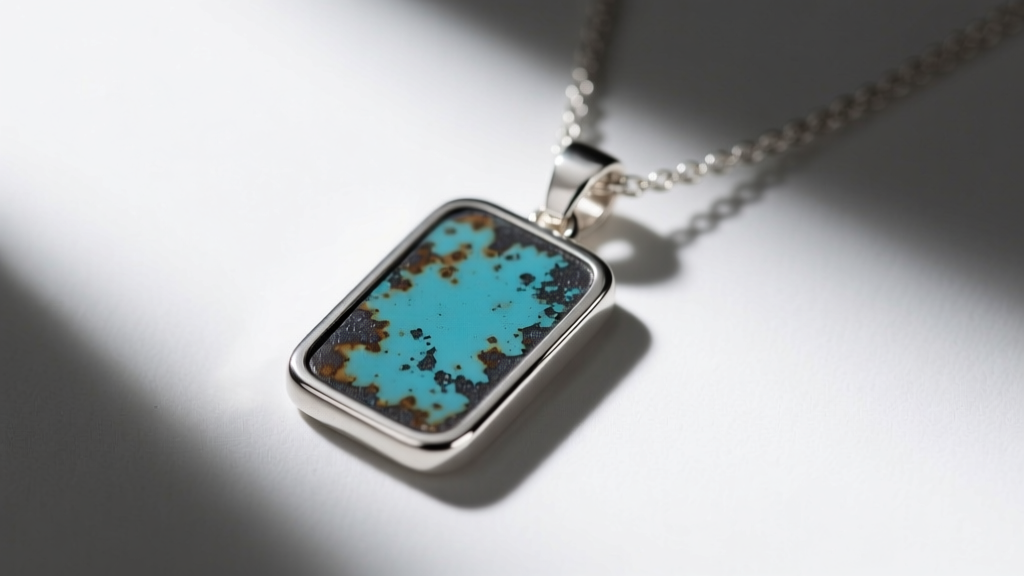
Final Verdict: Matching Metal to Lifestyle
Selecting the right material for your necklace with rectangular pendant ultimately comes down to your tolerance for maintenance and your aesthetic preferences. If you demand a lightweight, indestructible piece with razor-sharp corners that will look identical in ten years as it does today, Grade 5 Titanium or 316L Stainless Steel are your only viable options.
If you desire the prestige, intrinsic value, and deep engraving capabilities of precious metals, 14k Solid Gold offers the perfect balance of luxury and structural integrity. Opt for a chamfered edge design to protect the corners from impact, and choose a brushed surface finish to hide the inevitable micro-scratches that plague all flat, polished metals. Avoid 18k gold and sterling silver for strict geometric shapes unless you actively embrace the softening, rounding, and patina that comes with their inherent metallurgical softness.


