Red Agate Necklace Guide: Natural vs. Dyed Gemstone Properties
Discover the material properties of a red agate necklace. Learn how to compare natural vs. dyed stones, Mohs hardness, and care tips for longevity.

The Mineralogy of Red Agate: Quartz Family Properties
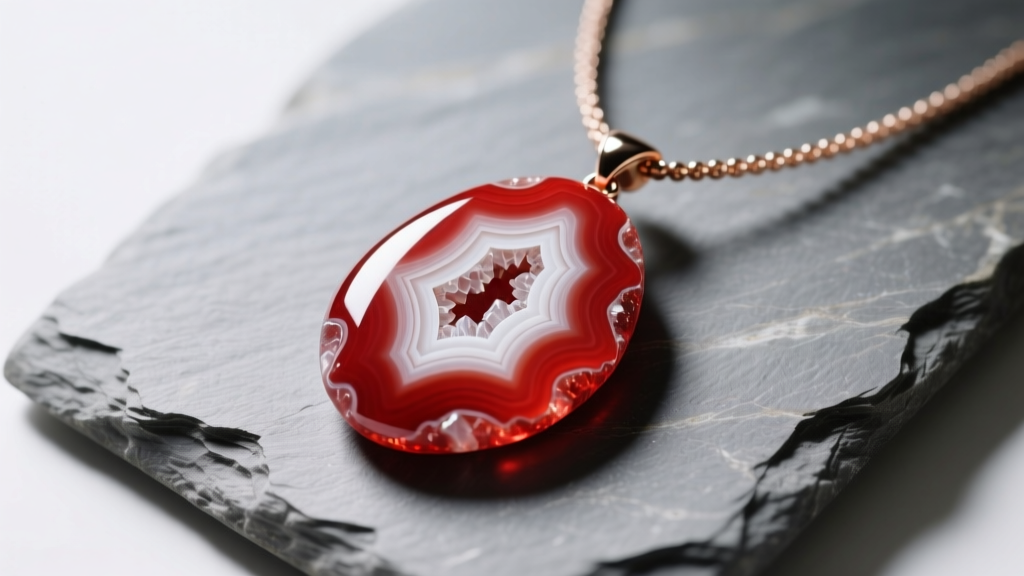
When evaluating a red agate necklace, understanding the underlying mineralogy is critical for assessing both durability and value. Agate is a cryptocrystalline variety of chalcedony, which itself is a microcrystalline form of quartz. According to the Gemological Institute of America (GIA), chalcedony possesses a Mohs hardness of 6.5 to 7, making it highly resistant to everyday scratching and suitable for frequent wear in necklace pendants and bead strands.
The specific gravity of agate ranges from 2.58 to 2.64, meaning a standard 16-inch strand of 8mm red agate beads will weigh approximately 28 to 32 grams. This substantial heft is a key tactile indicator of authenticity; glass or resin imitations will feel noticeably lighter. Furthermore, agate exhibits a refractive index (RI) of 1.530 to 1.540 and a vitreous to waxy luster when polished. The defining characteristic of true agate, as opposed to other chalcedony varieties, is its concentric or parallel banding, formed by the rhythmic deposition of silica-rich fluids in volcanic cavities over millions of years.
Natural vs. Dyed Red Agate: A Gemological Comparison
The most pervasive issue in the gemstone market regarding a red agate necklace is the prevalence of dye treatments. Naturally occurring red agate is exceptionally rare. Most commercial red agate is actually gray or white agate that has been chemically altered. The traditional dyeing process involves soaking the porous chalcedony in a sugar solution, followed by immersion in concentrated sulfuric acid. The acid carbonizes the sugar, leaving a permanent black or dark brown residue in the stone's microscopic pores. To achieve red hues, manufacturers use iron nitrate solutions, which are then heated to oxidize the iron, producing a permanent brick-red or crimson color.
Below is a structural comparison to help you identify the material properties of your necklace:
| Material Property | Natural Untreated Red Agate | Chemically Dyed Red Agate |
|---|---|---|
| Color Distribution | Subtle, often uneven banding with natural inclusions | Hyper-uniform, unnaturally vivid, pools in surface fractures |
| Reaction to Heat | Stable up to 400°C before structural dehydration | Dyes may degrade or shift color under prolonged high heat |
| Chelsea Filter Test | Inert (no color change) | May appear dull red or pink depending on iron salts used |
| Market Value (16-inch strand) | $80 - $250+ depending on banding contrast | $12 - $35 for commercial-grade bead strands |
Carnelian vs. Red Agate: Clearing Up the Confusion
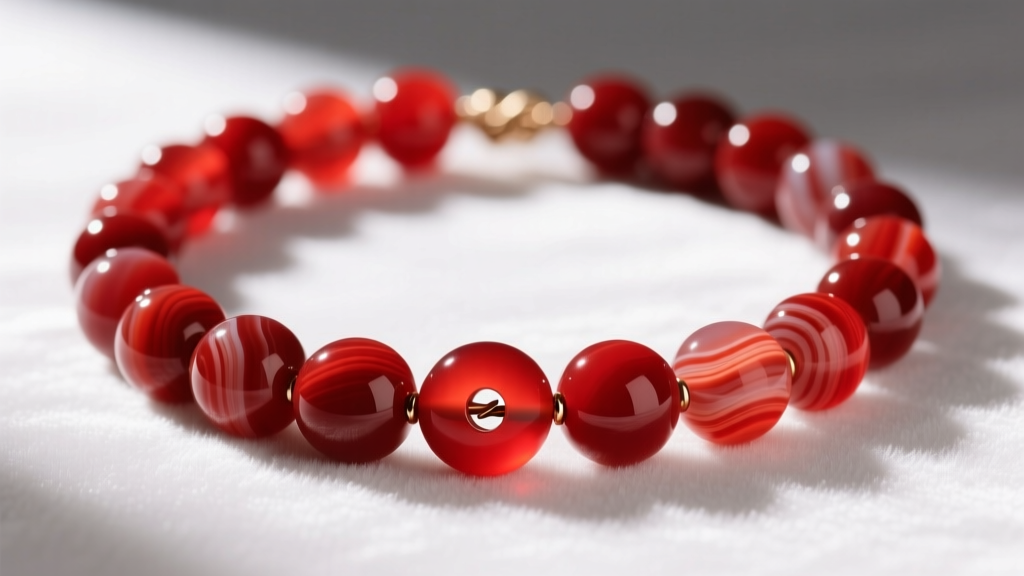
Jewelers and consumers frequently conflate carnelian with red agate. While both are chalcedony, their material properties and visual markers differ significantly. Carnelian is colored by naturally occurring iron oxide (hematite) impurities and typically presents as a solid, translucent orange-red to brownish-red without distinct banding. Red agate, by definition, must display banding.
If you are examining a red agate necklace pendant that is entirely uniform in color with no visible striations or concentric rings under a 10x jeweler's loupe, you are likely looking at carnelian—or a dyed piece of clear chalcedony. True natural red agate will always exhibit some form of structural zoning. The International Gem Society notes that 'carnelian agate' is a valid trade term for stones that exhibit both the solid red body color of carnelian and the distinct banding of agate, but these are rare and command premium prices.
Gemological Testing for Authenticity
For high-value red agate necklace pieces, non-destructive gemological testing is the only definitive way to confirm natural origin. A standard refractometer will confirm the RI of 1.53, verifying the stone is chalcedony, but it cannot detect dye. To detect iron-based red dyes, gemologists use a spectroscope. Natural red agate shows a broad absorption band in the blue-green region due to natural iron, while synthetic dyes often reveal sharp, unnatural absorption lines in the yellow-green spectrum.
Additionally, examining the drill holes of a bead necklace under darkfield illumination is highly revealing. In dyed beads, the dyeing agent penetrates the stone through the path of least resistance—the drill hole. You will often see a dark red 'halo' or concentrated rim of color immediately surrounding the drill channel, while the core of the bead remains pale or grayish.
Structural Integrity: Stringing and Hardware for Agate
Because agate is relatively dense and heavy, the structural hardware of a red agate necklace must be engineered to support the load without failing. Elastic cords (like Stretch Magic) are generally unsuitable for heavy 8mm to 12mm agate beads, as the abrasive edges of the drill holes will eventually fray and snap the elastomer.
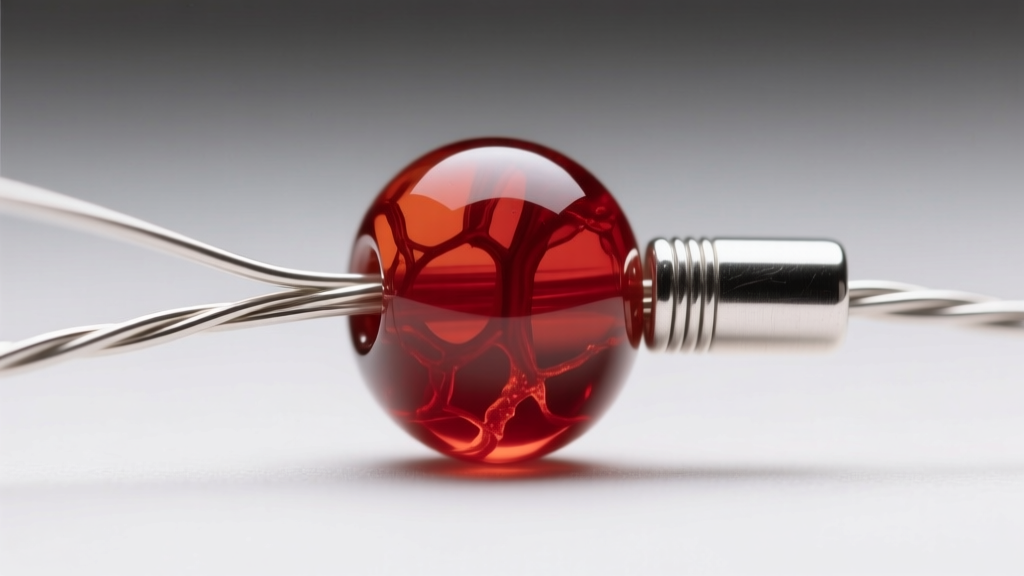
Professional jewelers recommend using a multi-strand stainless steel beading wire, specifically in a 0.019-inch or 0.024-inch gauge (such as SoftFlex or Beadalon). The 0.024-inch gauge provides a breaking strength of over 30 pounds, easily supporting the 35-gram weight of a heavy agate strand. Furthermore, the wire should be finished with sterling silver or gold-filled crimp tubes (2x2mm size), flattened with a crimping tool to create a secure, rounded fold that prevents the wire from slipping through the clasp jump ring. Always ensure the clasp itself is a sturdy lobster claw or a magnetic neodymium clasp rated for heavy beadwork.
Care, Cleaning, and Thermal Shock Prevention
While a Mohs hardness of 7 makes your red agate necklace resistant to dust and daily abrasion, chalcedony is susceptible to thermal shock and chemical degradation. Agate contains trace amounts of water within its cryptocrystalline structure. Sudden temperature changes—such as wearing the necklace in a sauna or washing it in scalding water—can cause the stone to fracture internally, a phenomenon known as 'crazing'.
- Ultrasonic Cleaners: Avoid using ultrasonic cleaners. The high-frequency vibrations can exacerbate microscopic internal fractures, especially in dyed stones where the acid treatment may have weakened the crystal lattice.
- Chemical Exposure: Remove the necklace before swimming in chlorinated pools or using household bleach. Chlorine can react with the iron oxides (both natural and dyed), causing the vibrant red color to fade or turn muddy brown over time.
- Routine Cleaning: Use a soft microfiber cloth and lukewarm water with a drop of mild, phosphate-free dish soap. Dry thoroughly with a lint-free towel before storing.
Market Pricing and Value Assessment
When shopping for a red agate necklace, price is a strong indicator of material treatment. Mass-market fashion jewelry brands typically sell dyed red agate bead strands for $15 to $30. These stones are heavily processed, and while they are permanent and safe to wear, they hold no intrinsic gemological value. Conversely, a necklace featuring natural, untreated banded red agate—often sourced from specific deposits in Brazil or Uruguay—will typically range from $100 to $300 for a well-matched bead strand, and significantly more for custom-carved pendants with high-contrast scenic banding. Always request a certificate of authenticity or a gemological lab report for any red agate necklace priced above $150 to ensure you are paying for natural geological formation rather than laboratory chemistry.