The Gemology of a Red Amber Necklace: Authentication and Grading
Explore the gemological properties of a red amber necklace. Learn to identify natural cherry amber, detect heat treatments, and grade inclusions.

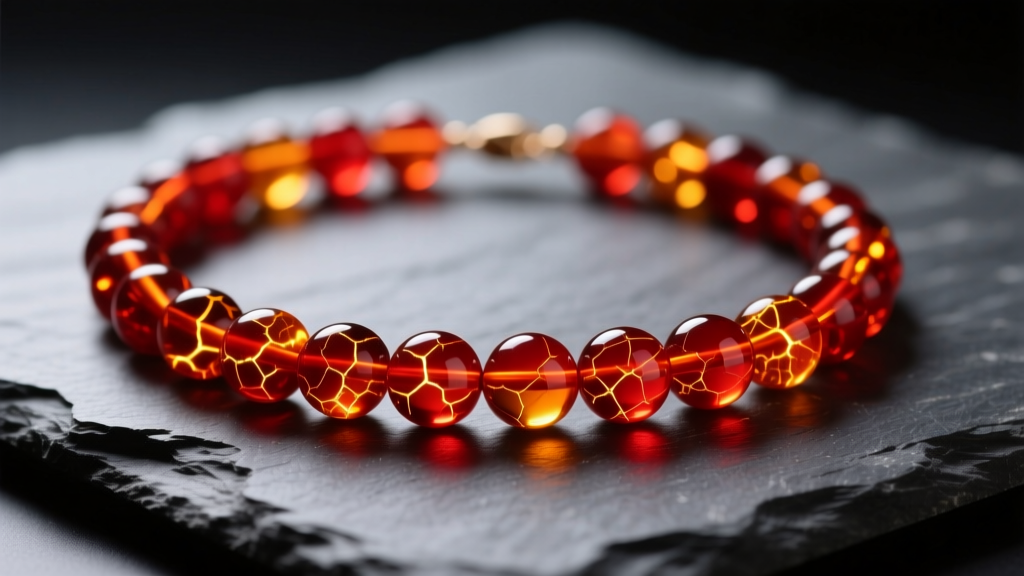
When collectors and gemologists evaluate a red amber necklace, they are navigating a complex intersection of paleobotany, organic chemistry, and modern lapidary treatments. Often marketed as "cherry amber," true red amber is a rarity in nature. The vast majority of red amber on the contemporary market is the result of controlled oxidation, heat treatment, or specific geological conditions unique to certain deposits. For the serious collector or jewelry professional, distinguishing between naturally occurring Burmese red amber (Burmite), oxidized Baltic succinite, and artificially dyed copal requires a rigorous understanding of gemological testing protocols.
The Chemistry and Physics of Red Amber
Amber is not a mineral; it is a fossilized tree resin. Its physical properties dictate how it must be handled, tested, and strung. According to the Gemological Institute of America (GIA), amber possesses a refractive index (RI) of approximately 1.54 and a specific gravity (SG) ranging from 1.05 to 1.10. This low density is a critical diagnostic feature, as it allows genuine amber to float in a saturated saltwater solution.
The red coloration in amber stems from two primary pathways:
- Natural Oxidation (Burmite): Burmese amber, dating back to the Cretaceous period (approximately 99 million years ago), often exhibits deep reddish-brown to cherry red hues. This is due to a higher concentration of specific terpenes and prolonged exposure to iron-rich sedimentary environments, which catalyze natural oxidation.
- Surface Weathering (Baltic Succinite): Baltic amber (Eocene epoch, ~44 million years old) is naturally yellow or honey-colored. However, the outer "crust" of raw Baltic nodules often turns deep red due to millions of years of atmospheric oxidation. Lapidaries will sometimes carve beads to retain this oxidized red crust.
Identifying Autoclave Treatments and Sun Spangles
Because natural red amber is scarce and commands premium pricing, the jewelry industry relies heavily on thermal treatments to meet consumer demand for cherry amber necklaces. The most common method involves placing Baltic amber in an autoclave—a pressurized chamber filled with an inert gas like nitrogen—and heating it to temperatures between 150°C and 250°C.
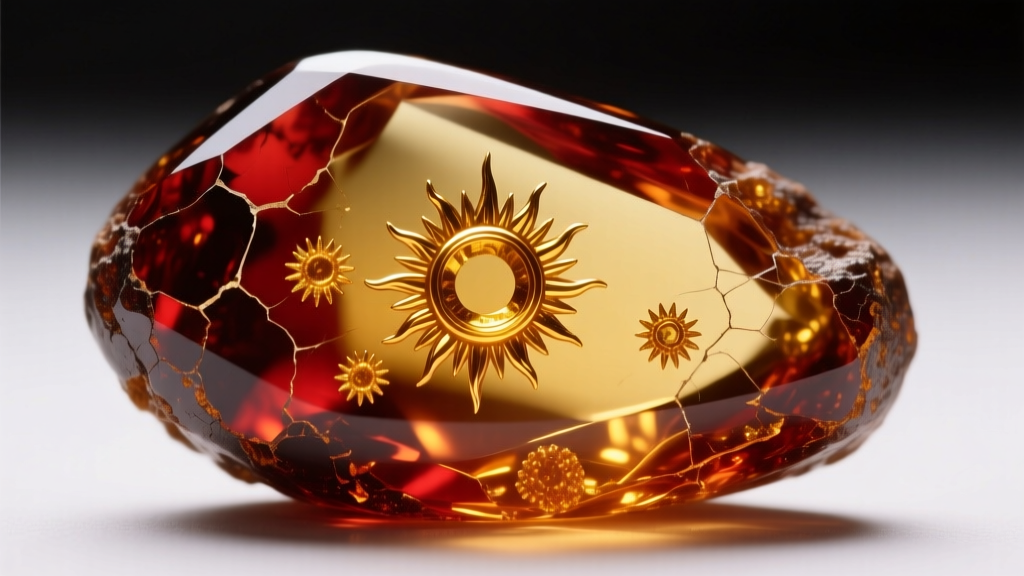
The Mechanics of Sun Spangles
This autoclave process serves two purposes. First, it accelerates oxidation, turning the amber a uniform, rich cherry red. Second, it clarifies the amber by dissolving microscopic gas bubbles. However, rapid cooling or internal stress during this process causes microscopic discoid fractures known as "sun spangles." While some consumers find these glittering internal fractures desirable, their presence is an immediate indicator to a gemologist that the amber has been thermally altered. Natural, untreated amber will rarely display these perfect, reflective stress fractures.
Gemological Testing Protocols
Authenticating a red amber necklace requires a multi-tiered testing approach. The International Gem Society (IGS) recommends combining non-destructive optical tests with careful physical examinations. Below is a diagnostic matrix used by professionals to separate amber from copal (young, semi-fossilized resin) and modern plastics.
| Test Method | Genuine Amber (Succinite/Burmite) | Copal (Sub-Fossil Resin) | Plastics / Glass Imitations |
|---|---|---|---|
| Specific Gravity (1:4 Salt:Water) | Floats (SG 1.05 - 1.10) | Floats (SG 1.03 - 1.08) | Sinks (Usually SG > 1.20) |
| UV Fluorescence (SWUV) | Pale blue, yellow, or milky green | Bright chalky white | Inert or unnatural bright colors |
| Acetone Swab Test | No reaction; surface remains hard | Becomes tacky/sticky | No reaction (or melts if polystyrene) |
| Hot Needle Test (Destructive) | Smells like pine resin / incense | Smells acidic, sweet, or like sap | Smells like burning plastic / chemicals |
Expert Note: The hot needle test should only be performed on an inconspicuous area, such as the edge of a drill hole, as it leaves a permanent burn mark. Furthermore, heavily oxidized red crusts may smell slightly burnt rather than purely resinous due to the carbonized outer layer.
Evaluating Inclusions and Market Valuation
The valuation of a red amber necklace fluctuates wildly based on its origin, treatment status, and the presence of biological inclusions. While clarified, autoclaved cherry amber is beautiful and widely used in commercial jewelry, it holds minimal value for serious collectors.
Pricing Tiers by Amber Type
- Commercial Autoclaved Baltic Cherry Amber: Typically ranges from $2 to $8 per gram. These beads are usually perfectly round, highly transparent, and heavily spangled.
- Natural Red Crust Baltic Amber: Ranges from $10 to $25 per gram. Valued for its rustic, unheated aesthetic, often featuring a gradient from opaque red on the outside to honey-yellow in the center.
- Natural Burmese Red Amber (Burmite): Ranges from $30 to over $150 per gram. Burmite is highly prized for its extreme age and the presence of Cretaceous-era biological inclusions.
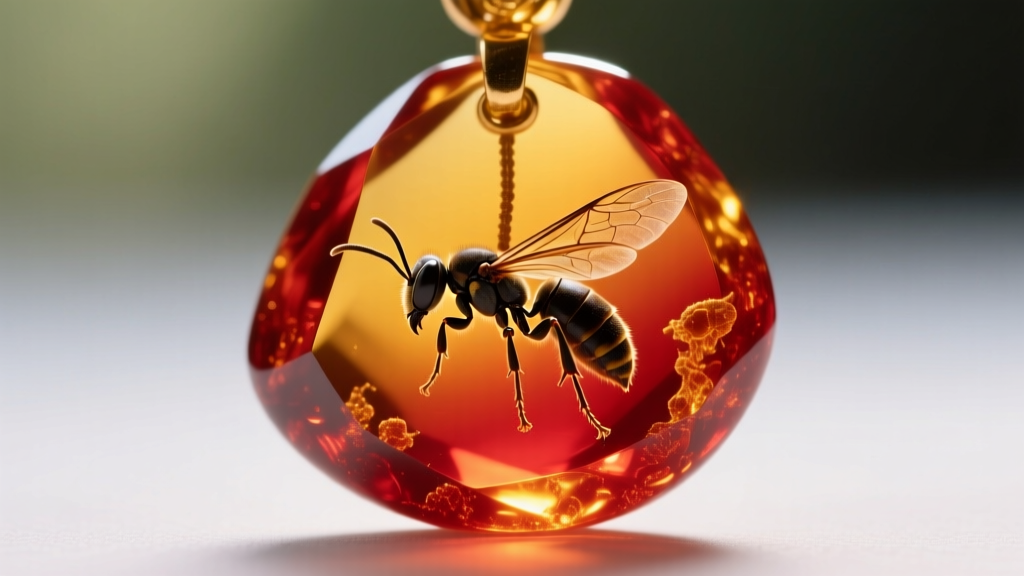
When evaluating inclusions in red Burmite, gemologists look for three-dimensional preservation. Because Burmese resin flowed in a tropical, high-humidity environment, it often trapped arthropods, fungal spores, and botanical debris. A red amber necklace featuring genuine, identifiable hymenopteran (wasp/ant) inclusions will command a massive premium, provided the inclusions have not been artificially carved or injected.
Drilling Morphology and Stringing Specifications
Because amber is exceptionally soft—ranking only 2 to 2.5 on the Mohs hardness scale—the mechanical construction of a red amber necklace requires specialized lapidary and stringing techniques to ensure longevity.
Analyzing Drill Holes
The morphology of the drill holes can help date a vintage amber necklace. Pre-20th-century amber beads were often drilled from both sides using a bow drill, resulting in a bi-conical hole that is wider at the edges and narrow in the center. Modern commercial necklaces feature perfectly straight, laser-guided cylindrical drill holes. If you are evaluating an estate piece marketed as "antique cherry amber," but it features perfectly uniform, straight drill holes and uniform autoclave spangles, it is likely a modern reproduction.
Stringing Requirements for Soft Organics
Never string an amber necklace on rigid wire or unknotted synthetic cord. Amber is susceptible to abrasion; bead-on-bead friction will slowly widen the drill holes over decades, eventually causing the beads to crack or split. Professional stringers must use:
- Material: 100% silk thread or high-grade bonded nylon (e.g., Griffin Silk).
- Technique: Hand-knotting between every single bead. The knots must be sized appropriately to the drill hole (usually 0.6mm to 0.8mm thread for standard 8mm-10mm beads) to prevent the amber from rubbing against adjacent beads.
- End Finishing: Use a gimp (French wire) or a soft silicone protector tube where the silk passes through the metal clasp ring to prevent the metal from sawing through the organic thread over time.
Archival Storage Warning: Red amber, particularly pieces that have been thermally treated to achieve their cherry hue, can be sensitive to prolonged UV exposure and extreme dryness. Store your necklace in a soft, acid-free cloth pouch away from direct sunlight to prevent the surface from crazing (developing a network of fine, microscopic cracks) and to preserve the integrity of the oxidized red color.


