Red Rosary Necklace Guide: Anatomy and Material Specs
Discover the technical anatomy of a red rosary necklace. Compare carnelian, garnet, and glass beads, wire gauges, and construction methods for lasting wear.

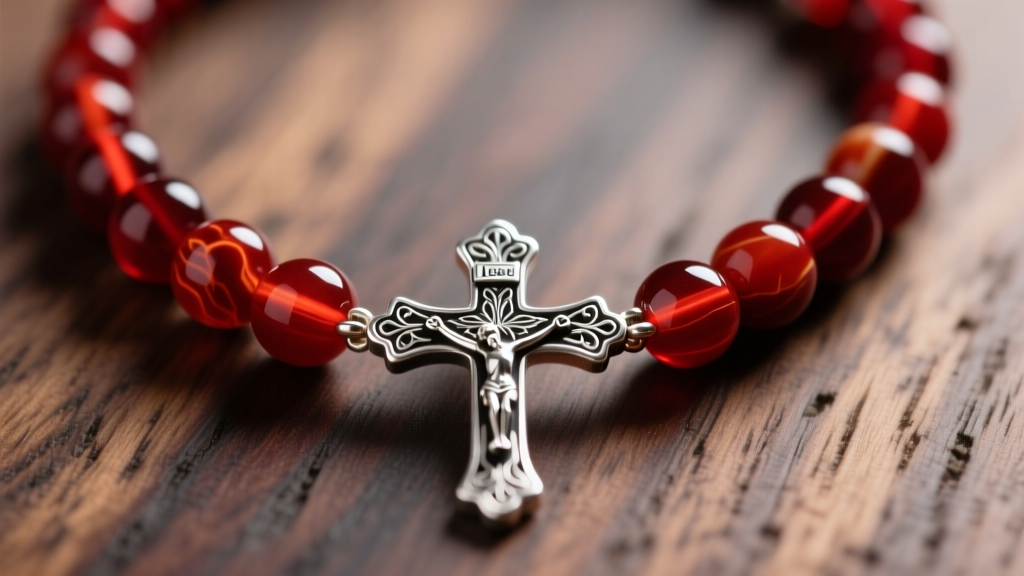
The red rosary necklace occupies a unique intersection between sacred liturgical function and fine jewelry craftsmanship. Historically, red beads symbolize the Precious Blood, the fire of the Holy Spirit, or the martyrdom of saints. Today, beyond its devotional use, the red rosary necklace is appreciated by collectors and jewelry enthusiasts for its striking visual contrast and intricate structural engineering. However, not all rosaries are built to withstand the mechanical stress of daily handling. This expert deep dive explores the precise anatomy, material science, and metallurgical construction techniques required to craft or evaluate a high-quality red rosary necklace.
The Anatomy and Proportions of a Standard Rosary
Before evaluating materials, one must understand the strict structural geometry of a traditional five-decade rosary. A standard Dominican-style rosary contains exactly 59 beads, divided into two distinct structural zones: the loop (or corpus) and the tail (or introit).
- The Loop: Contains 50 'Hail Mary' (Ave Maria) beads and 5 'Our Father' (Pater Noster) beads, separated by chain links or wire-wrapped spacers.
- The Tail: Drops from the centerpiece and includes 1 'Apostles Creed' medal or bead, 1 'Our Father' bead, 3 'Hail Mary' beads, and 1 'Glory Be' bead, terminating at the crucifix.
From a technical standpoint, the proportion between the Hail Mary beads (typically 6mm to 8mm) and the Our Father beads (typically 8mm to 10mm) is critical for tactile navigation. If the size differential is less than 2mm, the user loses the tactile feedback required for prayer without visual confirmation.
Material Science: Selecting the Ideal Red Gemstone or Glass
The longevity and aesthetic depth of a red rosary necklace depend entirely on the bead material. Red beads must withstand constant friction, skin oils, and occasional impacts. Below is an analysis of the most common red materials used in premium rosary construction.
Carnelian vs. Garnet: The Natural Stone Debate
Carnelian (a variety of chalcedony) and Garnet (specifically Pyrope or Almandine) are the premier choices for natural red rosaries. According to the Gemological Institute of America (GIA), carnelian ranks 6.5 to 7 on the Mohs hardness scale, making it highly resistant to scratching from dust (which contains quartz, hardness 7). However, carnelian is micro-porous and can absorb skin oils, potentially darkening over decades of use.
Garnet, ranking 6.5 to 7.5 on the Mohs scale, offers a higher refractive index, resulting in a deeper, more vitreous luster. As noted in the GIA Garnet Guide, almandine garnet is exceptionally durable but heavier than carnelian, which increases the tensile stress on the wire links.
The Coral Controversy and Glass Alternatives
Historically, precious red coral (Corallium rubrum) was the ultimate status symbol for rosaries. However, due to severe overharvesting and CITES restrictions, natural coral is ethically problematic and structurally fragile (Mohs 3.5). Modern master craftsmen have largely pivoted to high-end Czech fire-polished glass or Swarovski crystal (lead-free advanced glass), which offer uniform sizing, zero porosity, and a Mohs hardness of roughly 5.5 to 6.
| Material | Mohs Hardness | Avg. Cost (per bead) | Structural Durability | Best Stringing Method |
|---|---|---|---|---|
| Almandine Garnet | 7.0 - 7.5 | $0.80 - $1.50 | Excellent (High Impact) | Wire-Wrapped (22g) |
| Carnelian | 6.5 - 7.0 | $0.30 - $0.60 | Very Good (Porous) | Wire-Wrapped (22g) |
| Czech Fire-Polished Glass | 5.5 - 6.0 | $0.10 - $0.25 | Good (Brittle) | Wire or Tiger Tail |
| Natural Red Coral | 3.5 - 4.0 | $5.00+ (Vintage) | Poor (Scratches/Acids) | Silk Knotting |
Construction Techniques: Wire-Wrapping vs. Cable Stringing
The most common point of failure in any rosary necklace is the linkage between beads. There are two primary construction methods, and understanding the difference is vital for assessing quality.
1. The Wire-Wrapped Link (The Gold Standard)
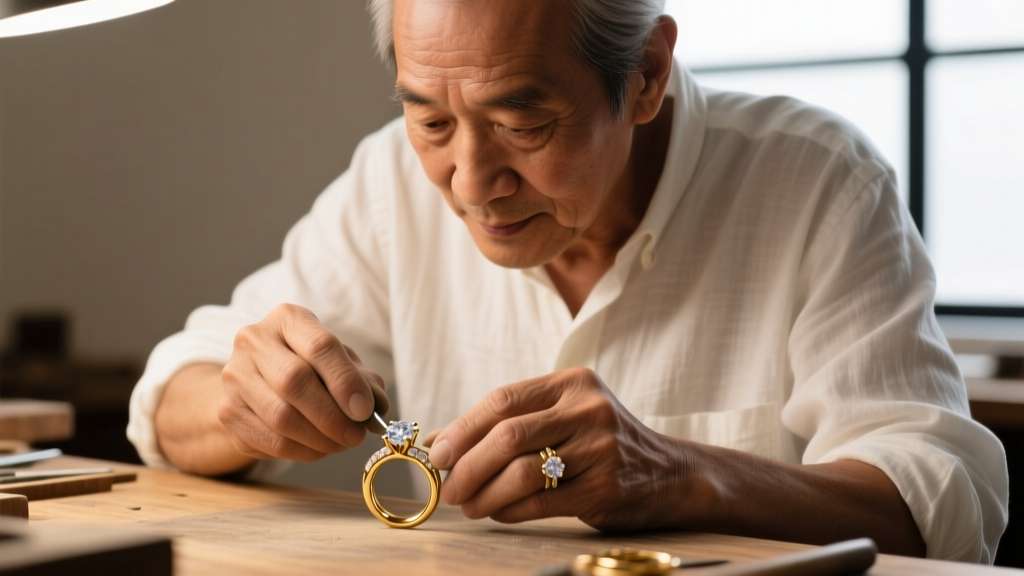
In a premium red rosary necklace, every single bead is individually wire-wrapped. This technique uses a spool of dead-soft or half-hard wire (typically 22-gauge / 0.64mm for 6-8mm beads, and 20-gauge / 0.81mm for 10mm Our Father beads). The craftsman creates a 'wrapped loop' at both ends of the bead, wrapping the tail of the wire 2 to 3 times around the 'neck' of the loop before trimming it flush.
"A properly executed wrapped loop will endure over 10,000 articulation cycles without metal fatigue, whereas a simple 'eye-pin' loop will pull open under the lateral tension of a dropped rosary." — Master Liturgical Jeweler
For red garnet or heavy carnelian beads, half-hard sterling silver or 14k gold-filled wire is mandatory. Dead-soft wire lacks the tensile memory to hold the loops closed under the weight of heavy gemstones.
2. Cable Stringing (Tiger Tail / Beadalon)
Mass-produced rosaries often use multi-strand stainless steel cables coated in nylon (e.g., 49-strand Beadalon). While the cable itself has immense tensile strength (often exceeding 30 lbs), the crimp beads used to secure the loops are structural weak points. Furthermore, cable-strung rosaries lack the fluid drape of wire-wrapped links, behaving more like a stiff hoop than a flexible chain.
Hardware and Findings: The Crucifix and Centerpiece
The centerpiece (the junction where the tail meets the loop) and the crucifix endure the highest mechanical stress. Cheap rosaries use stamped sheet metal or hollow-cast zinc alloys (Zamak) that will pit, tarnish, and eventually snap at the bail.
A high-quality red rosary necklace features a solid cast centerpiece, often utilizing an 'interlocking' design where the loop and tail pass through integrated jump rings rather than relying on a single soldered joint. The crucifix should feature a cast 'corpus' (the figure) that is either integral to the cross or securely laser-welded. For silver rosaries, look for a '.925' stamp and a rhodium plating to prevent the silver sulfide tarnish that can transfer onto porous carnelian beads.
Sizing Guide: Loop Drop and Tail Lengths
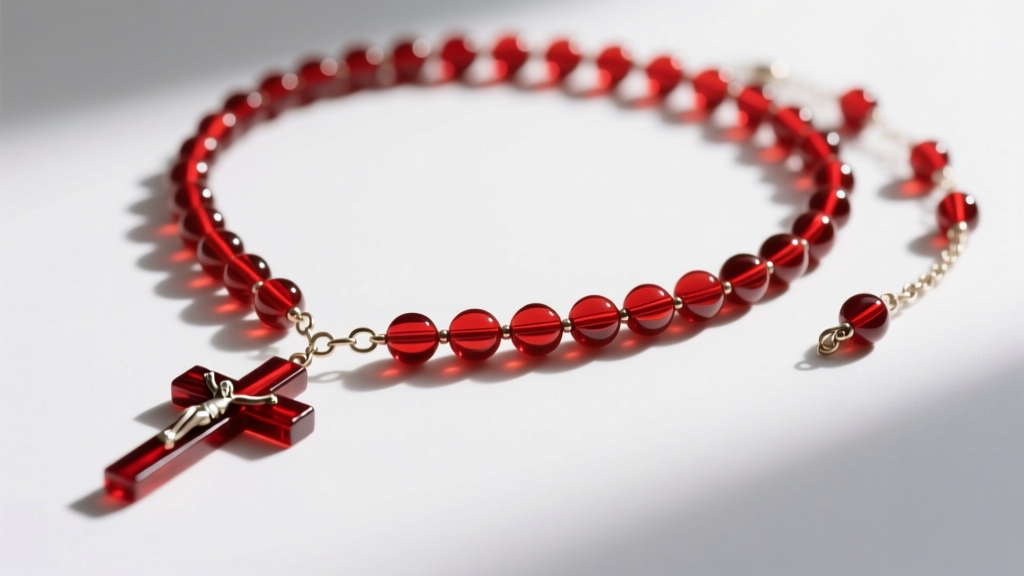
Unlike standard fashion necklaces, a rosary must be sized for both neck comfort and hand manipulation. The standard dimensions for an adult rosary are:
- Loop Circumference: 32 to 36 inches (yielding a drop of 16 to 18 inches from the back of the neck to the centerpiece).
- Tail Length: 4.5 to 5.5 inches from the centerpiece to the top of the crucifix.
If the loop is smaller than 30 inches, the rosary will act as a choker, causing the wire links to bind and kink when the user pulls it over their head. If the tail exceeds 6 inches, the crucifix will swing excessively, increasing the risk of the wire links bending out of shape.
Long-Term Maintenance and Structural Care
Maintaining a red rosary necklace requires specific protocols based on the bead material. Never use ultrasonic cleaners on carnelian or Czech glass, as the high-frequency vibrations can exploit microscopic inclusions and cause the beads to fracture internally.
For wire-wrapped sterling silver rosaries, tarnish is inevitable. Use a treated silver polishing cloth to clean the wire links, avoiding harsh liquid silver dips. Liquid dips strip the natural patina and can leave chemical residues that degrade the polish of garnet and glass beads. Inspect the wrapped loops bi-annually; if the neck of the wire shows signs of thinning or if the loop has pulled into an oval shape, the link must be replaced by a jeweler before catastrophic failure occurs.
By understanding the precise material grades, wire gauges, and structural geometry detailed above, you can confidently evaluate, commission, or maintain a red rosary necklace that will endure as both a functional devotional tool and a masterpiece of micro-engineering.


