Lightning Bolt Necklace Gold: Troubleshooting & Repair Guide
Is your lightning bolt necklace gold pendant bent or snapping? Learn expert troubleshooting tips to fix sharp points, repair jump rings, and prevent damage.

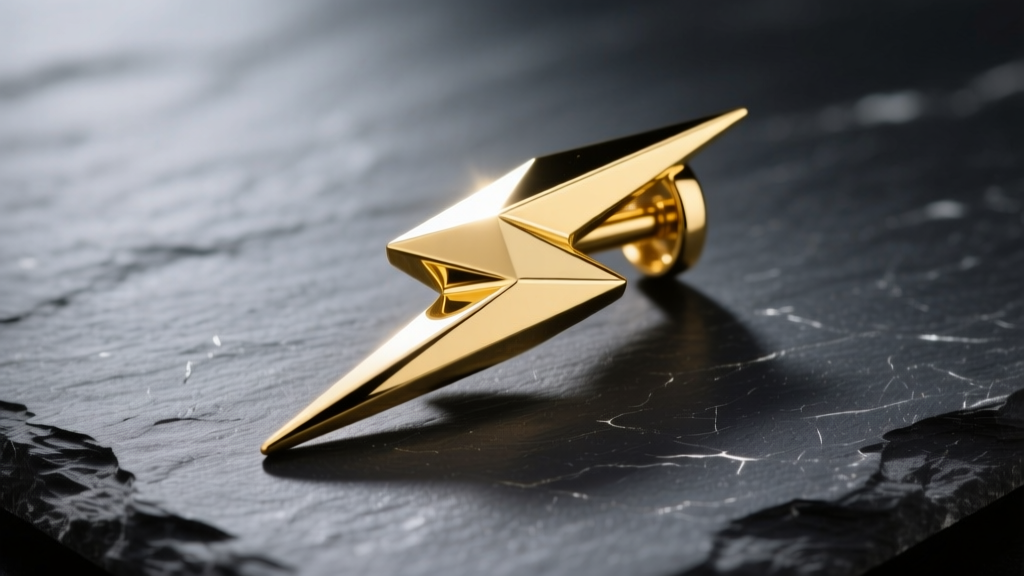
The lightning bolt pendant is an undisputed icon in jewelry design. From vintage rock-and-roll memorabilia to modern minimalist layering stacks, a lightning bolt necklace gold piece offers an edgy, dynamic silhouette that catches the light beautifully. However, from a structural engineering perspective, the lightning bolt shape is a jeweler's nightmare. The extreme acute angles and elongated points create inherent stress concentrators, making these pendants highly susceptible to bending, snapping, and chain-tangling.
If your favorite gold lightning bolt has warped, lost a point, or constantly flips upside down, you are not alone. This comprehensive troubleshooting guide dives deep into the metallurgy and mechanics of lightning bolt pendants, providing actionable, professional-grade solutions to restore and maintain your jewelry.
The Geometry Problem: Why Lightning Bolts Bend and Break
To understand why your pendant fails, you must understand the physics of its shape. A lightning bolt features multiple sharp inner vertices (the 'zig-zag' cuts). In metallurgy, these acute angles act as stress concentrators. When the pendant catches on a sweater or gets pulled, the kinetic energy does not distribute evenly across the metal; it focuses entirely on the sharpest inner corner, causing the gold to yield or snap.
The karat weight of your gold dictates its resistance to this yielding. According to the Gemological Institute of America (GIA), the Vickers Hardness (HV) scale reveals significant differences in alloy durability:
- 24k Gold (99.9% pure): ~25 HV. Extremely soft. A 24k lightning bolt will bend under its own weight if dropped. Avoid for this shape.
- 18k Yellow Gold (75% pure): ~125 HV. Beautiful rich color, but the high gold content makes the sharp points prone to warping if bumped against hard surfaces.
- 14k Yellow Gold (58.3% pure): ~150 HV. The optimal sweet spot. The alloy metals (copper, silver, zinc) provide enough tensile strength to hold sharp geometric edges without becoming overly brittle.
- 10k Gold (41.7% pure): ~180 HV. Very hard, but can be brittle. Instead of bending at the stress point, a thin 10k bolt might cleanly snap.
Troubleshooting a Bent or Warped Gold Pendant
If your 14k or 18k gold lightning bolt has bent out of its flat plane, do not attempt to bend it back with your bare hands. Human fingers apply uneven torque, which will cause the metal to 'work-harden' and eventually crack at the inner vertex.
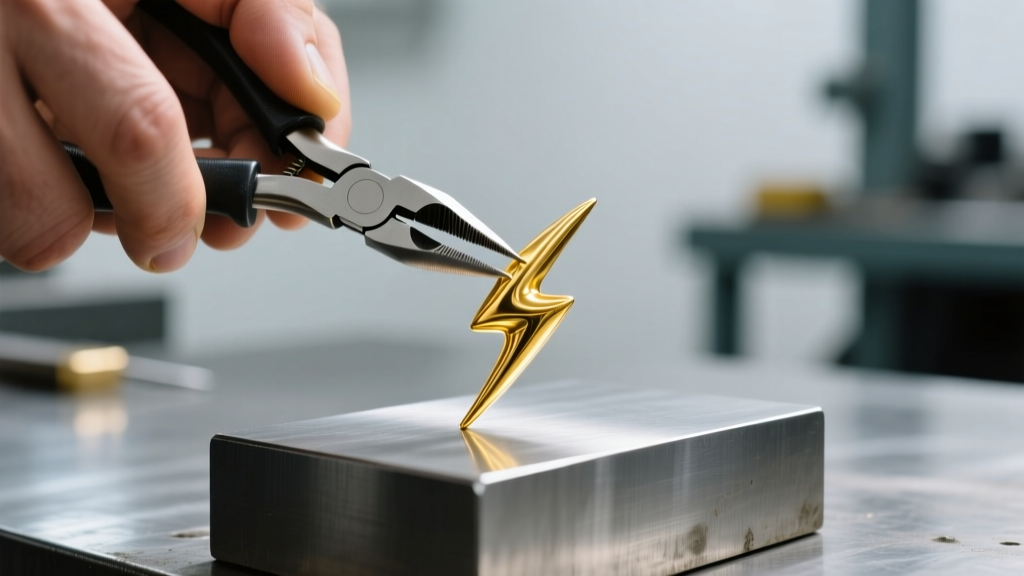
The Safe Reshaping Protocol
- Secure the Base: Place the pendant on a clean, polished steel bench block. Ensure the block is free of debris to avoid stamping new scratches into the gold.
- Use Non-Marring Tools: Never use standard steel-jaw pliers. You must use nylon jaw pliers or wrap the jaws of your pliers in thick masking tape to prevent gouging the gold.
- Apply Gradual Pressure: Grip the pendant on either side of the bend. Apply slow, steady pressure to coax the metal back into alignment. Do not snap it back quickly.
- Annealing (For Severe Warps): If the gold resists bending and feels 'springy,' it has work-hardened. A professional jeweler will use a micro-torch to anneal (heat) the specific bent area to a dull red, quenching it to relax the crystalline structure before reshaping. Warning: Do not attempt this at home if your bolt has soldered components or enamel, as they will melt.
Jump Ring and Bail Failures: The Lever Effect
The most common failure point on a lightning bolt necklace gold design is the jump ring at the top. Because the bolt is elongated and top-heavy, the top point acts as a lever. Every time the pendant swings, it applies lateral shear force to the jump ring.
If your pendant frequently detaches from the chain, the issue is likely your jump ring gauge and closure type. Standard mass-produced necklaces use 22-gauge or 20-gauge split rings (like tiny keyrings). Under the lever effect of a heavy gold bolt, these split rings will slowly pull apart.
The Upgrade Solution
Take your necklace to a local bench jeweler and request a soldered jump ring upgrade. Ask for an 18-gauge or 16-gauge solid ring that has been laser or torch soldered completely shut. According to Rio Grande Jewelry Supply, moving from a 20-gauge split ring to an 18-gauge soldered ring increases the shear strength of the connection by over 300%. This minor $15–$25 repair will permanently solve the detachment issue.
Cleaning Crevices Without Dulling the Edges
Lightning bolts often feature a mix of high-polish surfaces and matte or textured recesses. Furthermore, the crisp outer points are what give the bolt its visual impact. Improper cleaning routines will slowly round off these sharp points, turning a fierce lightning strike into a dull, melted-looking blob.
| Cleaning Method | Effect on Sharp Points | Best Used For |
|---|---|---|
| Silver/Gold Polishing Cloths | Destructive. The friction and mild abrasives will round off the acute outer points over time. | Flat, smooth chains only. Avoid using directly on the bolt's edges. |
| Ultrasonic Cleaner | Safe. Uses high-frequency sound waves in liquid; zero physical friction on the metal edges. | Removing trapped lotion and dead skin from the inner zig-zag crevices. |
| Steam Cleaning | Safe. Blasts hot vapor; excellent for final rinse and drying without touching the metal. | Restoring high-polish shine after an ultrasonic bath. |
| Soft Toothbrush & Dish Soap | Safe. Gentle mechanical action that won't alter the geometry of the gold. | Weekly at-home maintenance and degreasing. |
Pro-Tip: If your lightning bolt has a matte or sandblasted finish in the recesses, never put it in an ultrasonic cleaner. The high-frequency vibrations can cause the matte texture to polish out, leaving you with a patchy, uneven pendant.
Solving the 'Pendant Flip' on Box and Cable Chains
A notorious quirk of the lightning bolt shape is its asymmetrical center of gravity. Because the top half is usually wider or heavier than the bottom strike point, the pendant constantly flips upside down or shows its flat back against the chest, especially when worn on standard cable chains.
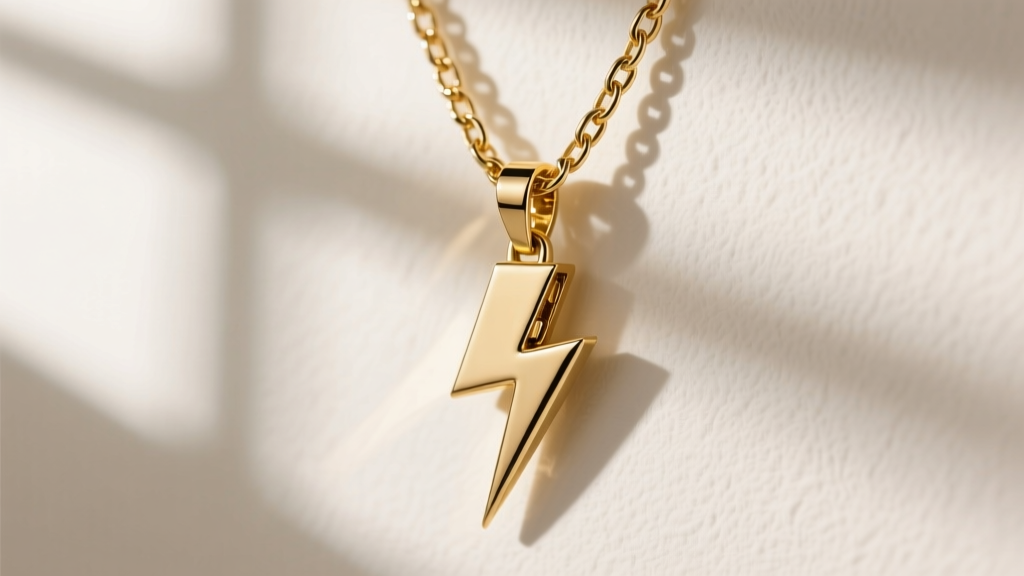
Counterweighting and Bail Selection
To solve the pendant flip, you must address how the chain feeds through the top. If your bolt uses a standard loop bail (a ring soldered perpendicular to the back), the chain will twist. The ultimate troubleshooting fix is to have a jeweler install a hidden slide bail. A slide bail allows a box chain or a flat snake chain to glide smoothly through the top of the bolt, keeping the pendant anchored flat against the sternum. Alternatively, if you prefer a delicate cable chain, adding a tiny 2mm gold bead directly to the chain just above the jump ring acts as a micro-counterweight, forcing the bolt to hang perfectly vertical.
When to Seek Professional Laser Welding
If one of the sharp outer points of your lightning bolt has completely snapped off, traditional torch soldering is rarely the best fix. A jeweler using a torch must apply significant heat, which can warp the thin gold and leave a visible, oxidized seam line that requires heavy filing—ultimately altering the original shape of the bolt.
Instead, seek out a jeweler equipped with a laser welder. Laser welding uses concentrated pulses of light to melt the gold at a microscopic level, fusing the broken point back together without heating the rest of the pendant. The result is a seamless repair that retains the exact millimeter precision of the original sharp point. Expect to pay between $45 and $85 for a single-point laser weld, a worthwhile investment to save an iconic piece of jewelry.


