What Does a Ring on a Necklace Mean? Symbolism & Metal Pairing Guide
Discover what a ring on a necklace means symbolically, plus a material science guide to pairing ring and chain metals to prevent galvanic corrosion.

The Symbolism vs. The Physics of Rings on Chains
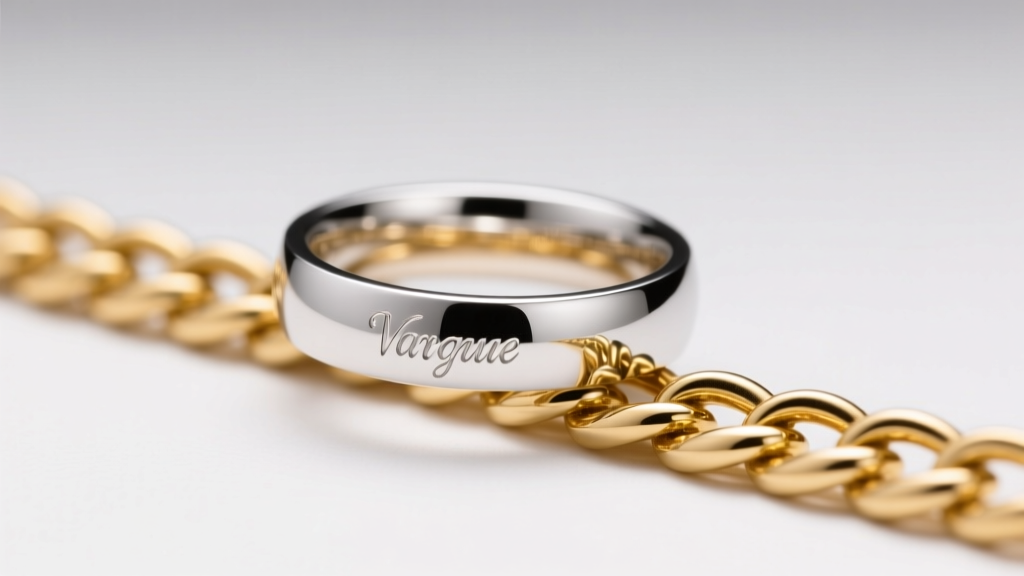
When people search for what does a ring on a necklace mean, they are usually seeking emotional context. Symbolically, wearing a ring on a chain represents safekeeping, pregnancy (when fingers swell), occupational hazard avoidance (like nurses or mechanics preventing degloving injuries), or mourning a late spouse. However, from a metallurgical and material science perspective, threading a ring onto a necklace transforms the jewelry into a localized friction engine. The physical interaction between the ring's inner band and the chain's links dictates the lifespan of both pieces. Understanding the material properties of your specific ring-and-chain pairing is critical to preserving sentimental jewelry.
The Pendulum Effect and Tensile Failure
A ring worn on a necklace acts as a pendulum. With every step, the kinetic energy of the swinging ring concentrates sheer stress on a single 2mm to 4mm section of the chain—usually the link resting inside the ring's bail or the ring itself if no bail is used. According to structural analyses published by the JCK jewelry industry journal, standard 1.2mm rope chains are highly susceptible to tensile failure under this pendulum effect, especially when holding a 6-gram or heavier wedding band.
Gauge and Weave Recommendations by Ring Weight
- Lightweight Promise Rings (2g - 4g): A 1.5mm to 1.8mm Box chain is ideal. The square links distribute the pendulum's kinetic force evenly across flat surfaces, reducing point-stress.
- Standard Wedding Bands (5g - 8g): A 2.0mm to 2.2mm Wheat (Spiga) chain. The woven, directional links offer high tensile strength and resist the kinking that destroys other weaves.
- Heavy Statement or Tungsten Rings (9g+): A 2.5mm+ Stainless Steel or Titanium curb chain. You must prioritize sheer breaking strength over flexibility.
Galvanic Corrosion: When Metals Attack Each Other
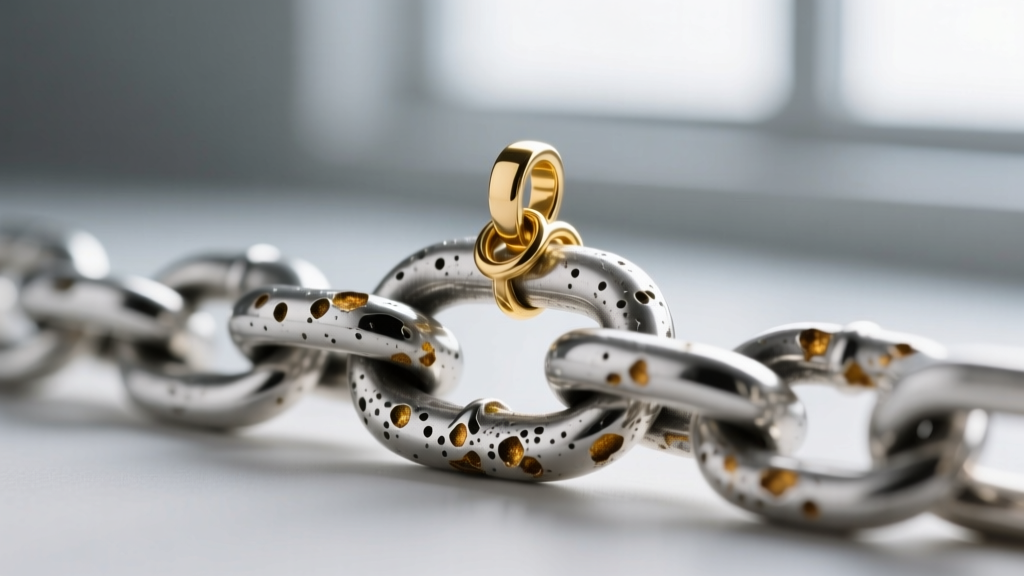
One of the most overlooked dangers in pairing a ring and a chain is galvanic corrosion. Human sweat acts as an electrolyte (containing sodium chloride and lactic acid). When two dissimilar metals touch in the presence of this electrolyte, an electrochemical cell is created. The more anodic (less noble) metal will corrode and dissolve to protect the cathodic (more noble) metal.
For example, if you thread a platinum wedding band (highly cathodic) onto a sterling silver chain (highly anodic), the silver links resting inside the platinum ring will rapidly pit, tarnish, and eventually snap. The Gemological Institute of America (GIA) frequently warns about mixed-metal jewelry degradation when exposed to daily wear and environmental moisture.
Galvanic Compatibility Chart for Jewelry Metals
| Ring Metal (Cathode/Anode) | Chain Metal | Corrosion Risk (With Sweat) | Expert Recommendation |
|---|---|---|---|
| Platinum (Cathodic) | Sterling Silver (Anodic) | SEVERE | Avoid. Silver will degrade rapidly. |
| Platinum (Cathodic) | Platinum (Neutral) | NONE | Ideal pairing for heirloom safety. |
| 14k/18k Gold (Cathodic) | Sterling Silver (Anodic) | HIGH | Avoid daily wear; silver will pit. |
| 14k/18k Gold (Cathodic) | 14k/18k Gold (Neutral) | NONE | Safe, but match karat weights. |
| Titanium (Anodic) | Sterling Silver (Cathodic) | MODERATE | Use a protective silicone bail. |
Friction and Micro-Abrasion: The Mohs Scale Factor
Beyond chemical corrosion, physical micro-abrasion destroys chains. The Mohs scale of mineral hardness applies directly to jewelry metals. Tungsten carbide ranks around 8.5 to 9 on the Mohs scale, making it nearly as hard as a sapphire. Conversely, 18k yellow gold ranks at a mere 2.5 to 3. If you slide a tungsten ring onto an 18k gold chain, the ring acts as a metallic file. Over six months of daily pendulum friction, the tungsten will physically shave away the gold links, creating gold dust inside the ring and leading to catastrophic chain failure.
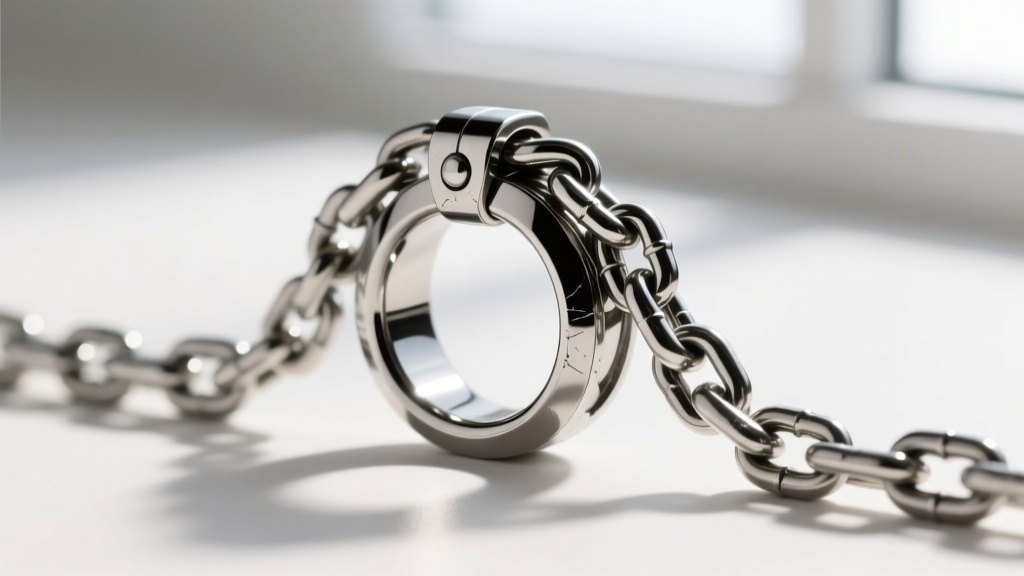
To mitigate this, jewelers recommend using a silicone or Teflon-coated ring guard/bail when pairing ultra-hard alternative metals (Tungsten, Ceramic, Cobalt Chrome) with precious metal chains. This creates a sacrificial polymer buffer that absorbs the kinetic friction, preserving the structural integrity of the gold or platinum links.
Chain Architecture: Why Snake and Rope Chains Fail
The physical architecture of the chain weave dictates its survival rate when holding a ring. Snake chains, while beautiful and smooth, are comprised of tightly wavy, interlocking rings that form a continuous tube. When a heavy ring swings on a snake chain, the localized bending causes the internal links to buckle and kink. Once a snake chain kinks, it cannot be repaired and must be melted down. Similarly, rope chains trap the ring's edge inside their twisted grooves, causing severe micro-abrasion. Box, Wheat, and Curb chains remain the gold standard for ring suspension because their geometric link structures resist localized folding and distribute the ring's weight across multiple axes.
Final Thoughts on Preserving Sentimental Jewelry
Ultimately, understanding what does a ring on a necklace mean goes beyond the emotional sentiment of safekeeping or mourning; it requires a commitment to the physical preservation of the piece. By matching the galvanic properties, respecting the Mohs hardness scale, and selecting a chain weave engineered for pendulum stress, you ensure that the ring—and the chain holding it—survives to carry its meaning for generations.


