The Ultimate Riviera Necklace Gift Guide & Styling Tips 2026
Discover the perfect riviera necklace for every milestone. Our 2026 gift guide covers diamond grades, carat weights, and occasion-matching tips.


Gifting fine jewelry is an exercise in emotional translation. You are attempting to capture a milestone, a memory, or a promise in a physical object. When it comes to high-stakes gifting—be it a landmark anniversary, a major career triumph, or a generational coming-of-age—few pieces command the room quite like a riviera necklace. Often confused with the ubiquitous tennis necklace, the true riviera is a masterclass in lapidary artistry, demanding a higher level of craftsmanship and offering a far more dramatic visual impact.
In this comprehensive 2026 gift guide, we move beyond generic jewelry advice. We will dissect the exact specifications, grading nuances, and structural mechanics you need to know to select, commission, or purchase a riviera necklace that perfectly aligns with your recipient's lifestyle and the gravity of the occasion.
What Defines a True Riviera Necklace?
To gift a riviera, you must first understand what separates it from a standard diamond line necklace. The term rivière (French for 'river') was coined in the late 18th century to describe a continuous stream of gemstones flowing around the neck. According to the historical archives at the Victoria and Albert Museum, early rivieras were set in closed-back silver and gold mounts, but the modern iteration relies on open-back settings to maximize light return.
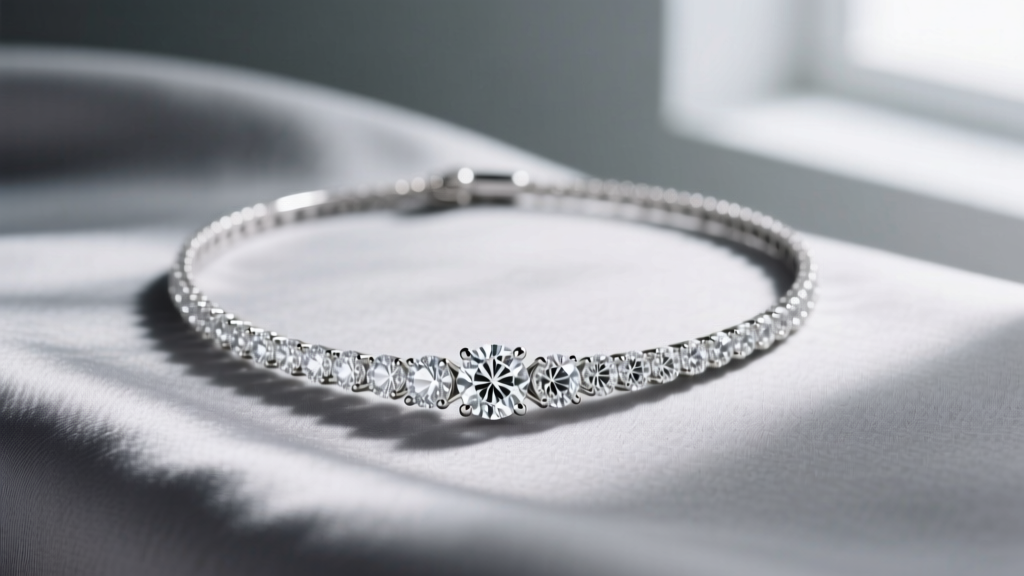
The defining characteristic of a true riviera necklace is graduation. Unlike a tennis necklace, where every stone is identical in carat weight and millimeter size, a riviera features a central focal stone (or cluster of three to five large stones) that gradually tapers down in size as it wraps around to the nape of the neck. This graduation mimics the natural anatomy of the décolletage, allowing the necklace to lay flush against the collarbone without buckling or flipping.
The 2026 Riviera Necklace Gift Matrix
Matching the necklace to the occasion requires balancing carat weight, metal choice, and budget. Use this matrix as your baseline when consulting with a jeweler.
| Occasion | Ideal TCW | Center Stone Size | Recommended Metal | Budget Range (USD) |
|---|---|---|---|---|
| 10th Anniversary | 7 - 10 ct | 5.0 - 6.0 mm | 18k White Gold | $6,500 - $14,000 |
| 20th / 25th Anniversary | 12 - 16 ct | 6.5 - 7.5 mm | Platinum (950) | $18,000 - $35,000 |
| Black-Tie Gala / Red Carpet | 18 - 25+ ct | 8.0 - 10.0 mm | Platinum (950) | $45,000 - $120,000+ |
| Milestone Birthday (Lab) | 5 - 8 ct | 4.5 - 5.5 mm | 14k / 18k Gold | $2,500 - $6,000 |
Decoding Diamond & Gemstone Grades for Gifting
When purchasing a riviera, you are not buying a single diamond; you are buying a matched set. The Gemological Institute of America (GIA) emphasizes that color matching across dozens of individual stones is vastly more complex than grading a single solitaire.
The 4Cs That Actually Matter for Rivieras
- Cut: This is non-negotiable. Because the stones are relatively small (ranging from 1.5mm at the clasp to 8mm at the center), poor cut quality will result in a dull, lifeless 'ribbon' effect. Insist on Excellent or Ideal cut grades. The facets must align perfectly from stone to stone to create a continuous 'scintillation ribbon'.
- Color: You do not need D-color diamonds across the entire piece. The secret to a smart purchase is requesting 'G-H' color for the tapering side stones, but insisting on 'D-F' for the center 3 to 5 stones. If the center stones are warmer than the sides, the eye will immediately detect a yellowish 'dead zone' at the base of the throat.
- Clarity: VS2 is the sweet spot. Because the stones are under 1.00 carat each, SI1 inclusions are often visible to the naked eye when grouped together in a line. Avoid I1 clarity entirely, as structural weaknesses in a continuous line necklace can lead to stone loss.
Alternative Stones: Sapphires and Emeralds
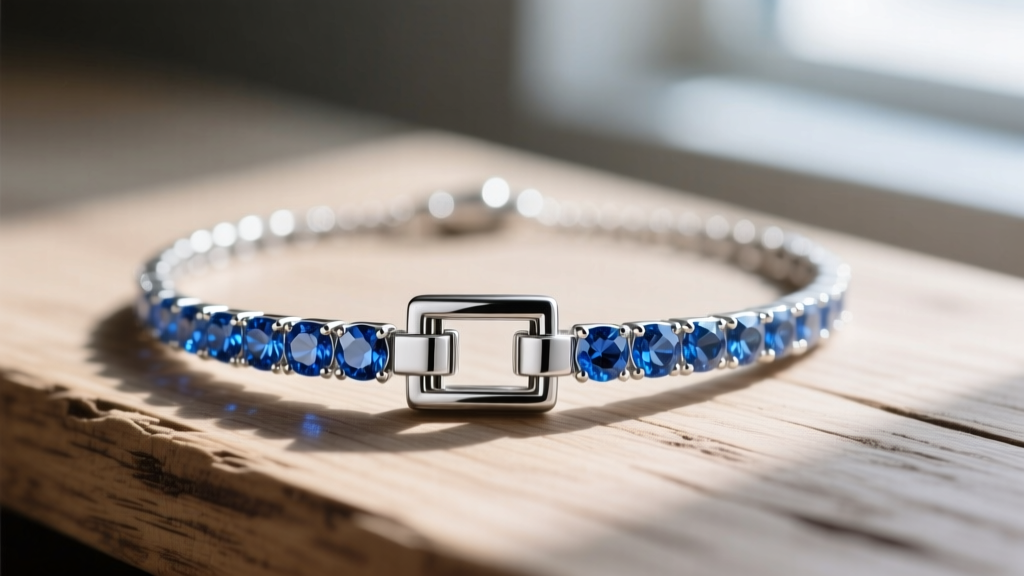
For the recipient who favors color, a sapphire riviera is a breathtaking alternative. Look for unheated Ceylon (Sri Lankan) sapphires in the 1.50 to 3.00 carat range for the center stones. The cornflower blue hue reads incredibly well under both natural sunlight and warm indoor gala lighting. Emeralds are generally discouraged for rivieras due to their inherent brittleness and the high risk of chipping during the rigorous setting process required for a flexible, articulated necklace.
Occasion Matching: From Anniversaries to Red Carpets
Milestone Anniversaries (10th, 20th)
For major anniversaries, the goal is everyday elegance that can transition from a high-end dinner to a sophisticated daytime event. A 16-inch riviera with a 6.5mm center stone (roughly 1.00 carat) and a total carat weight (TCW) of 12 carats sits perfectly in the suprasternal notch. It is substantial enough to be noticed, but not so heavy that it feels like 'costume' jewelry.
High-Society Galas & Black-Tie Events
If the gift is intended for red-carpet wear or ultra-formal galas, scale is paramount. You will want a TCW of 20 carats or more, with a center stone exceeding 8.5mm (approx. 2.50 carats). At this level, the necklace should be set in 950 Platinum. Platinum's natural white luster does not require rhodium plating (unlike white gold), ensuring the metalwork remains invisible against the diamonds under harsh camera flashes.
A true riviera should feel like liquid light. If the necklace feels stiff or stands away from the collarbone when the wearer sits down, the articulation joints in the setting are too rigid. Walk away from the piece.
Sizing, Settings, and Security
The mechanics of a riviera necklace are just as important as the gemstones. A poorly engineered setting will result in a stiff, uncomfortable garment that flips outward.
Three-Prong vs. Four-Prong Settings
While four-prong settings are standard for solitaire rings, three-prong settings are the industry gold standard for high-end rivieras. By removing one prong per stone, the jeweler exposes more surface area of the diamond to ambient light, increasing brilliance. Furthermore, three-prong settings allow for tighter articulation, giving the necklace the necessary drape to hug the neck seamlessly.
Clasp Mechanics: The Hidden Box
Never accept a lobster clasp on a piece of this caliber. A proper riviera must feature a hidden box clasp with a tongue-and-groove mechanism, integrated seamlessly into the tapering design so it is invisible when worn. Crucially, it must be equipped with double figure-eight safety catches on the exterior. If the primary tongue mechanism fails or is accidentally depressed, the figure-eight safeties will catch on the opposite post, preventing a catastrophic loss.
Lab-Grown vs. Natural: The 2026 Perspective
As of 2026, the lab-grown diamond market has matured significantly, offering exceptional gifting opportunities for buyers who want maximum visual impact without the six-figure price tag. A 15-TCW natural diamond riviera with F-color, VS-clarity stones will easily command $40,000 to $60,000. That exact same visual specification in a certified lab-grown diamond (such as those graded by IGI or GIA) will cost between $4,500 and $8,000.
The Gifting Verdict: If the recipient values sustainability, sheer size, and brilliance above all else, a lab-grown riviera is an outstanding, guilt-free gift. However, if the occasion is a generational wealth transfer, a 25th silver anniversary, or if the recipient is a serious jewelry collector who views pieces as heirloom assets, natural, earth-mined diamonds remain the only appropriate choice to retain long-term emotional and financial value.
Final Thoughts on Commissioning
Gifting a riviera necklace is not an off-the-rack endeavor. While some high-end jewelers stock pre-made graduated lines, the most thoughtful gifts are often semi-custom. Work with a trusted bench jeweler to select the exact center stone, and have them source the perfectly matched tapering stones. By focusing on the cut quality, the fluidity of the articulation, and the security of the hidden clasp, you will present a gift that is not just a piece of jewelry, but a masterwork of engineering and light.


