Rubber Necklace Buying Guide: Materials, Fit & Styles
Discover how to choose the perfect rubber necklace. Our buying guide covers silicone vs. latex, durometer ratings, clasp types, and pendant pairing.

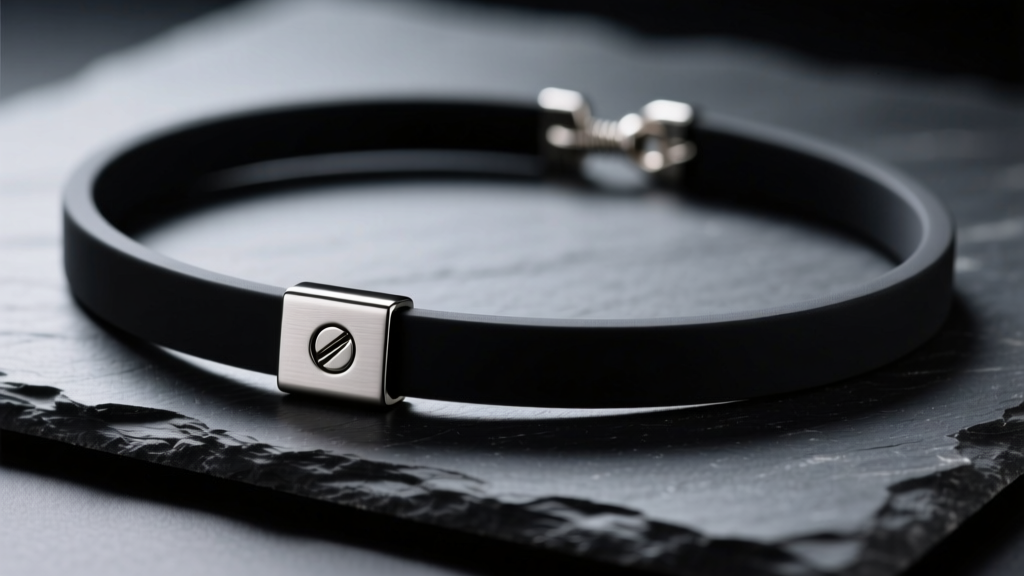
The "Rubber" Misnomer: Silicone vs. Latex vs. Neoprene
When shopping for a rubber necklace, the first thing to understand is that true natural rubber (latex) is rarely used in high-quality modern jewelry. As of 2026, the term "rubber" in the jewelry industry is largely a colloquial catch-all for various elastomers, primarily medical-grade silicone, neoprene, and thermoplastic polyurethane (TPU). Understanding the exact material composition is critical for longevity, skin safety, and aesthetic drape.
Natural latex is highly porous, degrades rapidly when exposed to UV light and skin oils, and is a known allergen. According to clinical studies on jewelry-induced contact dermatitis, latex and cheap PVC blends are frequent culprits behind allergic reactions and skin maceration. Instead, premium brands utilize platinum-cured silicone. Unlike peroxide-cured silicones, platinum-cured variants leave no chemical byproducts, resulting in a completely inert, hypoallergenic cord that meets FDA guidelines for medical-grade silicone biocompatibility.
| Material | Composition | Skin Safety | Water Resistance | Lifespan |
|---|---|---|---|---|
| Platinum Silicone | Siloxane polymers | Excellent (Hypoallergenic) | 100% Waterproof | 5-10+ Years |
| Neoprene | Polychloroprene | Good (Rare allergies) | Highly Resistant | 3-5 Years |
| TPU | Thermoplastic Polyurethane | Very Good | Waterproof | 2-4 Years |
| Natural Latex | Isoprene polymers | Poor (High allergy risk) | Degrades in water | 6-12 Months |
Understanding Thickness and Durometer (Shore A)
The physical behavior of a rubber necklace is dictated by two metrics: cord diameter (thickness) and durometer (hardness). Durometer is measured on the Shore A scale, which quantifies the material's resistance to indentation. A lower Shore A number indicates a softer, more pliable cord, while a higher number indicates a stiffer, more rigid one.
For jewelry applications, a Shore A rating between 40 and 60 is the sweet spot. A 40A silicone cord will drape fluidly like a heavy chain, conforming perfectly to the collarbone. A 60A cord will hold its shape better, making it ideal for heavier pendants that might otherwise cause a softer cord to kink or stretch permanently.
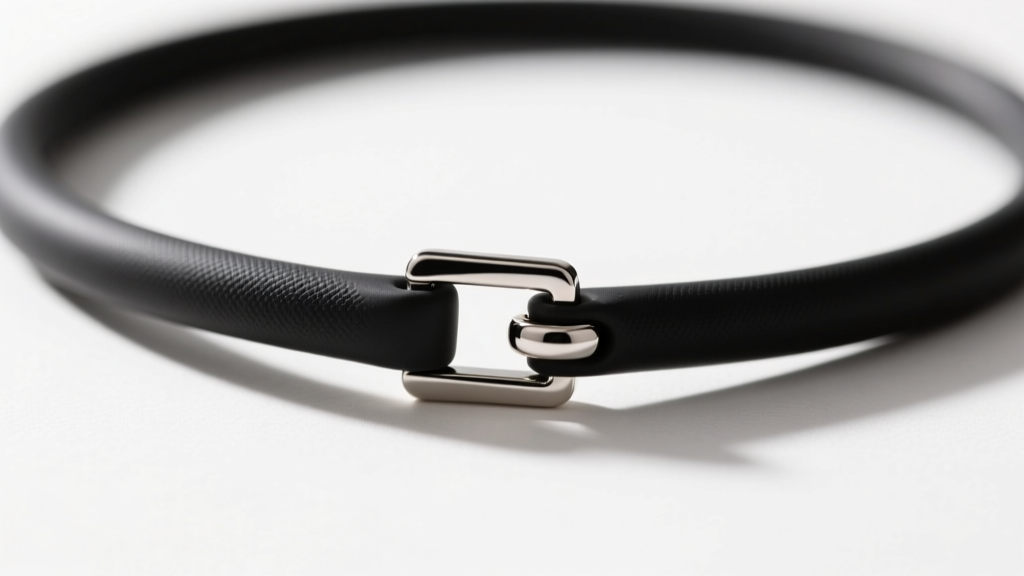
Diameter Sizing Guide
- 1.5mm - 2.0mm: Delicate and lightweight. Best for small, minimalist pendants (under 10 grams) or wearing bare as a subtle choker. Requires specialized micro-crimps or adhesive-lined end caps.
- 3.0mm - 4.0mm: The industry standard. Offers the perfect balance of tensile strength and flexibility. Accommodates most standard pendant bails and supports moderate weight (up to 30 grams) without structural fatigue.
- 5.0mm - 8.0mm: Statement thickness. Highly visible, rigid, and capable of supporting heavy, oversized pendants. Often worn alone as a bold, sporty architectural piece.
Clasp Mechanics: The Weakest Link
The most common point of failure in any rubber necklace is not the cord itself, but the junction where the cord meets the clasp. Elastomers cannot be soldered or welded, meaning the connection relies entirely on mechanical friction, industrial adhesives, or compression.
Screw Barrel Clasps
The gold standard for premium silicone necklaces. A metal tube (usually 316L stainless steel or Grade 5 titanium) features an internal threaded screw that caps the end. The silicone cord is inserted into the barrel, and a specialized two-part epoxy or mechanical crimp secures it inside. The screw mechanism ensures that lateral pulling forces are distributed across the metal threads rather than stressing the adhesive bond.
Magnetic Clasps
While convenient for easy on-and-off, magnetic clasps are a liability for heavy pendants. Neodymium magnets provide strong direct-pull resistance but are highly susceptible to shear forces. A sudden sideways tug can cause the magnets to slide apart, dropping your pendant. If you opt for a magnetic clasp, ensure it features a secondary locking sleeve or a bayonet twist-lock mechanism.
Bayonet and Twist-Locks
These utilize a pin-and-groove system. You push the two ends together and twist a quarter-turn to lock them. They offer excellent security against both direct and shear forces and are entirely independent of adhesive degradation over time.
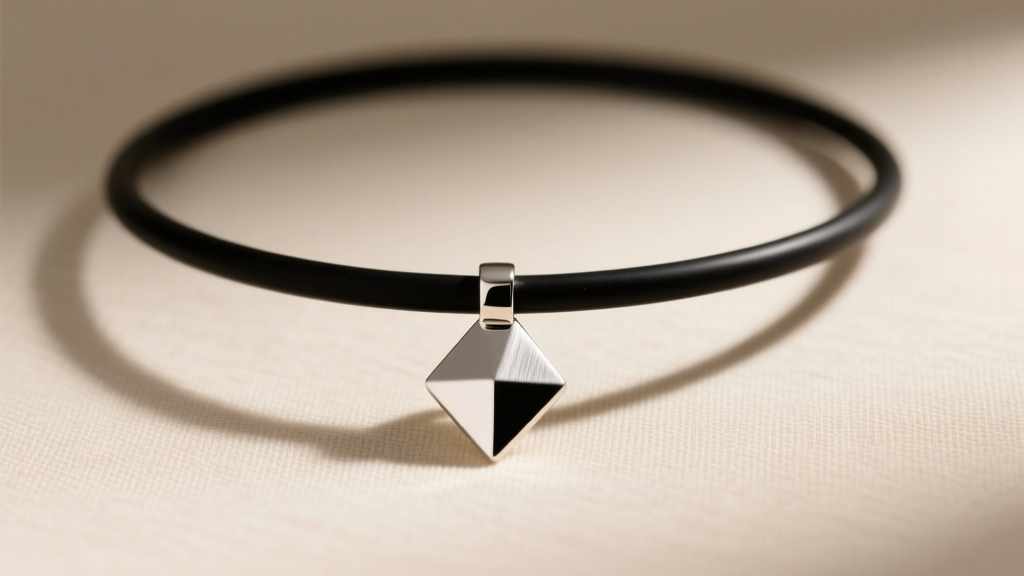
Pendant Pairing and Bail Sizing
Pairing a pendant with a rubber necklace requires precise attention to the bail (the loop that connects the pendant to the chain). Unlike metal chains, which can flex and compress to squeeze through tight openings, a rubber cord has a fixed, non-compressible circular cross-section.
The 1.5x Rule: The inner diameter of the pendant bail must be at least 1.5 times the diameter of the rubber cord. For example, if you are using a 4mm silicone cord, the bail opening must be no smaller than 6mm. If the fit is too tight, the friction of sliding the pendant on and off will cause micro-tears in the silicone surface, eventually leading to catastrophic snapping.
Additionally, consider the weight distribution. Heavy pendants on thin rubber cords will cause the cord to stretch and permanently deform (a phenomenon known as "creep" in material science). Always match the cord's tensile rating to the pendant's mass.
Care, Cleaning, and Degradation
While platinum-cured silicone is incredibly resilient, it is not invincible. The primary enemy of silicone rubber is not water or sweat, but other silicones and certain solvents.
- Avoid Silicone Oils: Do not clean your necklace with polish or conditioners containing dimethicone or silicone oils. These can cause the solid silicone cord to absorb the oil, swell, and become gummy or structurally compromised.
- Cleaning Protocol: Wash the necklace with warm water, a mild dish soap (free of harsh degreasers), and a soft microfiber cloth. Rinse thoroughly and air dry.
- UV and Heat: While medical-grade silicone is UV stable, prolonged exposure to extreme heat (like leaving it on a car dashboard in direct summer sunlight) can accelerate the breakdown of the metal-to-rubber adhesive in the clasp.
Final Purchasing Checklist
Before adding a rubber necklace to your cart, verify these critical specifications:
- Material Verification: Confirm the listing specifies "platinum-cured silicone" or "medical-grade silicone," not just generic "rubber."
- Clasp Quality: Look for 316L surgical steel or titanium screw-barrel clasps. Avoid cheap alloy crimps.
- Durometer Rating: Check if the seller lists the Shore A hardness (aim for 40A-60A for optimal drape).
- Bail Compatibility: Measure your favorite pendants to ensure their bails will accommodate the cord thickness.
By prioritizing material science and mechanical integrity over superficial aesthetics, you can secure a rubber necklace that serves as a durable, waterproof, and endlessly versatile foundation for your jewelry collection.


