The Scarab Beetle Necklace: 2026 Trend & Style Guide
Discover how to style the scarab beetle necklace in 2026. Explore materials, historical symbolism, layering techniques, and top designer picks.

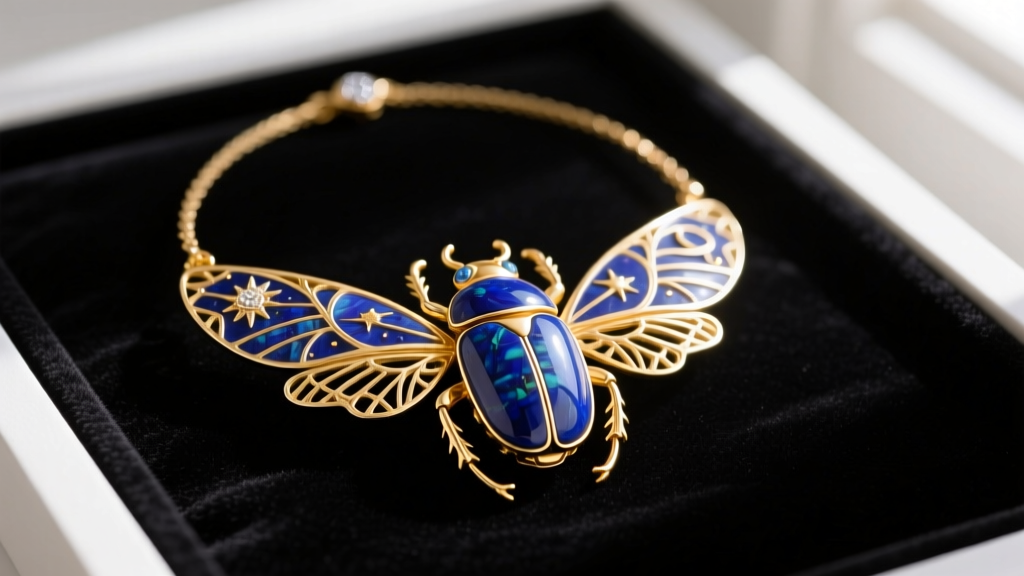
The Resurgence of Curated Historicism
As we navigate the jewelry landscape of 2026, the industry has decisively pivoted from the stark minimalism of the early 2020s toward 'Curated Historicism.' At the forefront of this movement is the scarab beetle necklace. No longer relegated to costume jewelry or souvenir shops, the scarab has been reclaimed by fine jewelers and independent artisans who are treating this ancient Egyptian motif with serious metallurgical and gemological respect. The scarab, representing Khepri—the god of the rising sun and rebirth—offers a profound narrative weight that modern consumers crave. But how do you integrate a piece with such heavy historical baggage into a contemporary wardrobe without looking like you are wearing a museum replica? The answer lies in precise material selection, proportional chain pairings, and strategic layering.
Decoding the Carapace: Material Grades and Gemology
The authenticity and visual impact of a scarab beetle necklace rely entirely on the materials used for the carapace (the beetle's wing case) and the setting. Mass-market versions often rely on dyed howlite or resin, but true 2026 trendsetters are demanding natural, untreated stones. According to the Gemological Institute of America (GIA), the porosity and hardness of these stones dictate both their longevity and their care requirements.
| Material | Grade / Quality Marker | Mohs Hardness | Best Chain Pairing | Price Range (Fine) |
|---|---|---|---|---|
| Lapis Lazuli | AAA Afghan (Deep blue, visible pyrite, no calcite) | 5.5 - 6.0 | 18k Yellow Gold Rope (2.0mm) | $450 - $1,200 |
| Carnelian | Translucent orange-red, heat-treated for stability | 6.5 - 7.0 | 14k Rose Gold Box (1.2mm) | $300 - $800 |
| Malachite | High-contrast concentric green banding | 3.5 - 4.0 | Sterling Silver Wheat (1.5mm) | $250 - $600 |
| Guilloché Enamel | Vitreous enamel over engine-turned 18k gold base | N/A (Glass-like) | 18k Gold Cable (1.0mm) | $800 - $2,500 |
When shopping for lapis lazuli scarabs, avoid stones with large white calcite veins, as these indicate lower grades that are prone to chipping at the bezel edge. For malachite, be acutely aware of its low Mohs hardness; it should never be cleaned in an ultrasonic bath, and the bezel setting must have a slightly rolled edge to protect the stone from impact.
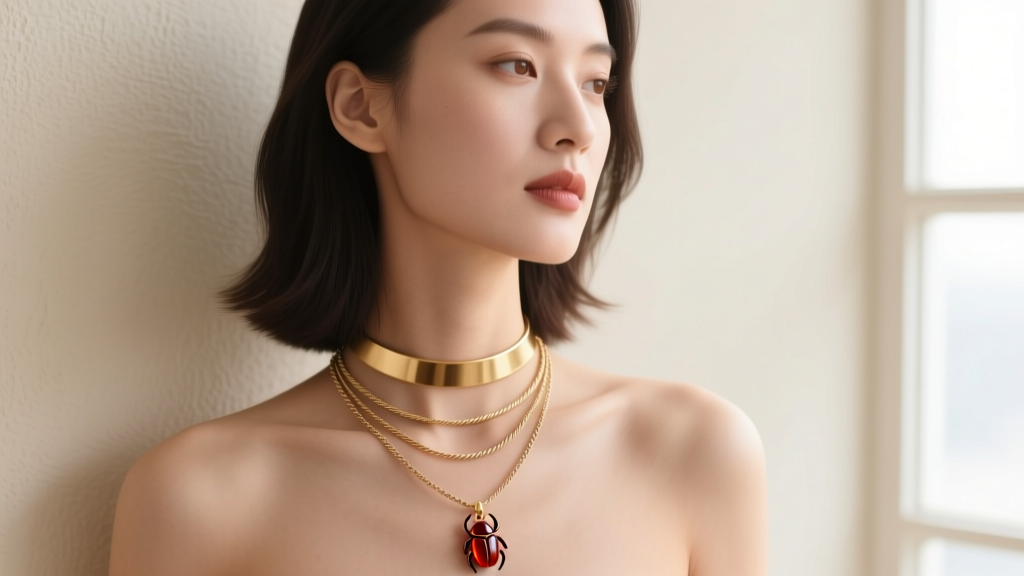
Proportions, Bails, and Chain Architecture
A common failure point in styling the scarab beetle necklace is a mismatch between the pendant's visual weight and the chain's gauge. The scarab is an inherently dense, grounded motif. Suspending a 25mm solid gold and lapis scarab on a fragile 0.8mm thread chain creates a jarring visual dissonance and risks structural failure.
The Gauge-to-Pendant Ratio
- Micro Scarabs (10mm - 14mm): Best suited for 1.0mm to 1.2mm cable or box chains. These are ideal for the 16-inch collarbone length and serve as excellent anchor pieces in a layered stack.
- Standard Scarabs (18mm - 24mm): Require a 1.5mm to 2.0mm wheat or rope chain. The twisted texture of a rope chain complements the organic, articulated legs often carved into the gold underside of the beetle.
- Statement Scarabs (30mm+): Demand heavy 2.5mm+ chains or even multi-strand bead necklaces. These should be worn solo at a 20-inch or 24-inch drop to allow the piece to rest on the sternum.
Pay close attention to the bail (the loop connecting the pendant to the chain). High-end scarab pendants utilize a hidden 'tube bail' that runs horizontally through the top of the beetle, allowing the chain to pass directly through the stone or metal. This eliminates the awkward dangling loop of a standard soldered bail and keeps the scarab lying perfectly flat against the chest.
The 2026 Layering Protocol: Integrating the Scarab
Layering is no longer about simply piling on chains; it is about creating a structured hierarchy of motifs. The scarab beetle necklace acts as a 'narrative anchor' in a stack. Here is the definitive three-piece layering framework for the current year:
- The Base (14-15 inches): A simple, unadorned 1.5mm herringbone or snake chain. This provides a liquid-gold reflection near the neck without competing for attention.
- The Anchor (16-17 inches): Your scarab beetle necklace. Opt for a 15mm carnelian or enamel scarab on a textured rope chain. The warm tones of carnelian bridge the gap between the skin and the lower layers.
- The Counterweight (19-20 inches): A geometric or abstract pendant, such as a plain gold signet disc or a raw diamond slice. This contrasts the ancient, figurative nature of the scarab with modern abstraction.
'The key to wearing historical motifs like the scarab in 2026 is juxtaposition. You must pair the ancient symbolism with modern, architectural chain links or contemporary gemstone cuts to prevent the look from becoming theatrical.' — Dr. Elena Rostova, Jewelry Historian and Curator.
Authenticity and Metallurgical Standards
As the demand for the scarab beetle necklace has surged, so has the market saturation of poorly constructed pieces. If you are investing in gold vermeil rather than solid gold, you must understand the legal and practical standards of plating. According to the Federal Trade Commission (FTC), for a piece to be legally marketed as 'vermeil' in the United States, it must have a base of 925 sterling silver and be plated with gold of at least 10k fineness, with a minimum thickness of 2.5 microns.
Many fast-fashion retailers sell 'gold-plated' scarabs with a mere 0.5-micron flash plating over brass. These will oxidize and turn your skin green within weeks, especially given the acidity of human sweat reacting with the brass base. Always use a jeweler's loupe to inspect the bail of the scarab pendant. You should see a '925' stamp. If the piece is vermeil, reputable makers will often stamp the micron thickness or use a heavy 3-micron plating to ensure the intricate crevices of the beetle's legs do not rub bare over time.
Historical Context: From the 1920s to Now
To truly appreciate the modern iteration of this trend, one must look back at the Egyptian Revival period. The discovery of Tutankhamun's tomb in 1922 sent shockwaves through the Art Deco jewelry world, resulting in highly geometric, enamel-heavy scarab pieces by houses like Cartier and Van Cleef & Arpels. As noted by the Metropolitan Museum of Art, these revival periods often occur during times of societal shift, where the public seeks the permanence and mysticism of antiquity.
In 2026, the revival is less about the rigid geometry of Art Deco and more about organic, tactile realism. Modern jewelers are using 3D wax printing and lost-wax casting to capture the microscopic pitting and natural asymmetry of real scarab beetles, resulting in pieces that feel unearthed rather than manufactured. The legs are often articulated with microscopic jump rings, allowing them to move and catch the light independently of the carapace.
Final Styling Verdict
The scarab beetle necklace has successfully transcended its status as a niche historical artifact to become a cornerstone of the 2026 fine jewelry wardrobe. By prioritizing AAA-grade natural stones, insisting on proper chain gauges, and adhering to strict vermeil thickness standards, you can invest in a piece that offers both profound symbolic resonance and impeccable modern style. Whether worn as a solitary talisman on a heavy rope chain or integrated into a curated, multi-layered stack, the scarab remains an ultimate testament to the enduring power of ancient design.


