Shark Tooth Necklace Calamity: Avoiding Resin Fakes
Uncover the shark tooth necklace calamity of resin fakes and unethical sourcing. Learn expert material tests, CITES rules, and saltwater-safe hardware.

The Anatomy of the Shark Tooth Necklace Calamity
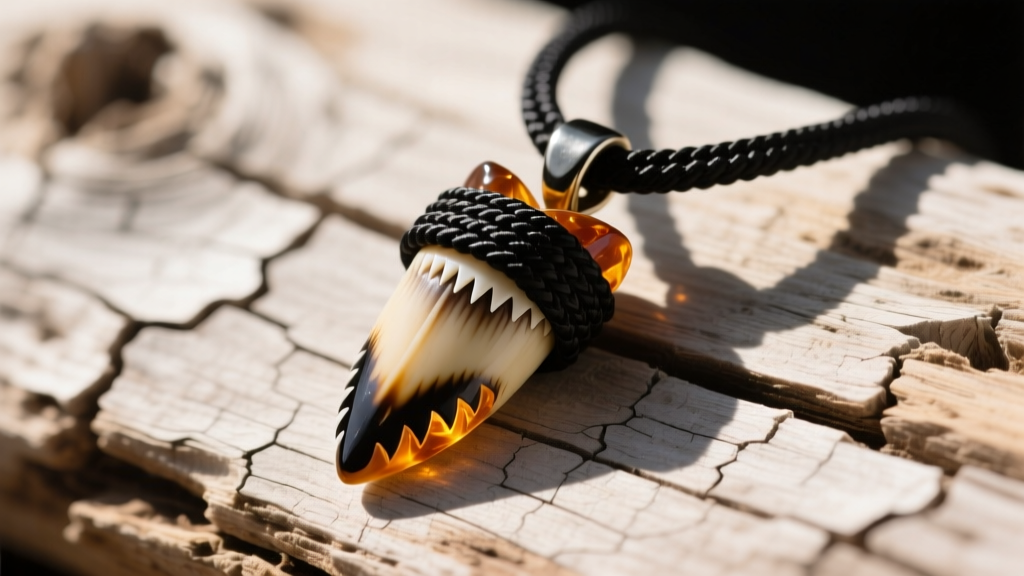
In 2026, the coastal and surf-inspired jewelry sector is grappling with a widespread issue that gemologists and marine conservationists have dubbed the shark tooth necklace calamity. As the demand for organic, oceanic aesthetics has surged, the market has been flooded with counterfeit polyurethane resin casts and unethically sourced modern teeth. For the discerning collector or the everyday wearer seeking an authentic connection to the ocean, navigating this saturated market requires a deep understanding of material science, ethical sourcing frameworks, and marine-grade metallurgy. This expert guide dismantles the calamity, providing you with the technical forensics needed to authenticate real shark teeth and construct a pendant that survives harsh saltwater environments.
Material Forensics: Real Enameloid vs. Polyurethane Resin
Authentic shark teeth are biological marvels composed primarily of fluorapatite (a highly mineralized enameloid) and a dentin core. Counterfeit teeth are typically cast from polyurethane resins or 3D-printed using SLA (stereolithography) photopolymers. While modern molds can capture macro-details, they consistently fail at the microscopic and structural levels.
The Thermal Conductivity Test
The most reliable non-destructive test for authentication relies on thermal conductivity. Fluorapatite is a dense, mineralized tissue that feels distinctly cool to the touch and takes several seconds to absorb body heat. Polyurethane resin, conversely, is a thermal insulator. When you press a genuine tooth to your cheek or the inside of your wrist, it will register a sharp, immediate coolness. A resin fake will feel room-temperature or warm almost instantly.
Root Morphology and Micro-Striations
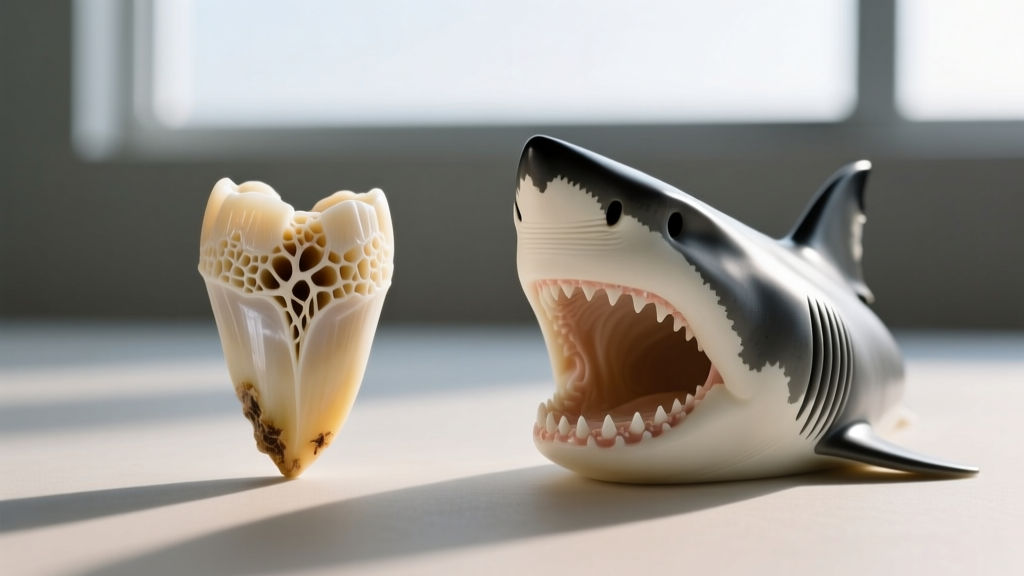
Examine the root (the base of the tooth) under a 10x jeweler's loupe. Genuine shark teeth feature a complex root structure with distinct lobes, vascular channels, and a central nutrient foramen (a small hole or groove where blood vessels once entered the pulp cavity). Resin casts often exhibit a flattened, featureless root or display faint, linear mold seams along the edges where the silicone mold halves met. Furthermore, the cutting edges of real teeth feature micro-striations—tiny, natural serrations that are often smoothed over or exaggerated unnaturally in resin casts.
UV Fluorescence and Mineral Replacement
If you are evaluating fossilized teeth (such as those from the extinct Otodus megalodon), ultraviolet light is an invaluable tool. Fossilization involves permineralization, where organic material is replaced by minerals like agate, quartz, or iron oxides over millions of years. Under a 365nm UV flashlight, natural fossilized dentin often exhibits a dull, mottled fluorescence or absorbs the light entirely, depending on the mineral matrix. Modern resin replicas, however, frequently contain optical brighteners that cause them to glow with a stark, uniform blue or bright white hue under UV light.
The Ethical Quagmire: CITES and Bycatch Realities
The shark tooth necklace calamity is not merely a problem of counterfeit goods; it is deeply tied to marine conservation. The global shark population is under severe threat from overfishing and the fin trade. When purchasing modern (non-fossilized) shark teeth, provenance is critical.
Many apex predators, including the Great White Shark (Carcharodon carcharias) and the Basking Shark, are strictly regulated under CITES (Convention on International Trade in Endangered Species) Appendix II. Buying or selling teeth from these protected species without rigorous, verifiable documentation is illegal in most jurisdictions and fuels the black market. Organizations like The Shark Trust emphasize that the only truly ethical modern teeth are those recovered from verified, regulated bycatch or naturally shed teeth collected by divers—though naturally shed teeth from large species are exceptionally rare. For the eco-conscious consumer, fossilized teeth represent the gold standard: they offer the authentic beauty and mineral density of real shark teeth with zero ecological footprint.
Sourcing and Material Comparison Matrix
| Material Type | Origin & Composition | Ethical Status | Durability & Hardness |
|---|---|---|---|
| Fossilized (e.g., Megalodon) | Marine sediment; Agatized fluorapatite | Excellent (Zero ecological harm) | Mohs 6.5-7 (Highly durable) |
| Modern Ethical Bycatch | Regulated fisheries; Organic fluorapatite | Moderate (Requires strict documentation) | Mohs 5 (Prone to chipping) |
| Polyurethane Resin Cast | Synthetic polymers; Molded | Excellent (No animal products) | Mohs 2-3 (Scratches easily, UV degrades) |
| 3D Printed (SLA/PLA) | Photopolymers; Layered printing | Excellent (No animal products) | Mohs 1-2 (Brittle, visible layer lines) |
Hardware Metallurgy: Surviving Saltwater Exposure
A genuine shark tooth is only as good as the hardware securing it. The 'calamity' of coastal jewelry often culminates in the catastrophic failure of cheap base metals. Saltwater is a highly corrosive electrolyte that accelerates galvanic corrosion and dezincification in inferior alloys.
Bail and Chain Alloys Breakdown
Never use brass, copper, or standard sterling silver (925) for a necklace intended for ocean wear. Sterling silver contains 7.5% copper, which oxidizes rapidly in saltwater, leading to black, irreversible tarnishing and structural weakening. Brass suffers from dezincification, where the zinc is leached out by saltwater, leaving behind a porous, brittle copper sponge that will inevitably snap under the weight of a heavy tooth.
For expert-tier hardware, restrict your choices to the following:
- Grade 2 or Grade 4 Titanium: The undisputed king of marine jewelry. Titanium forms a passive oxide layer that makes it entirely immune to saltwater corrosion. It is also hypoallergenic and incredibly lightweight.
- 316L Marine-Grade Stainless Steel: Contains molybdenum, which drastically increases resistance to chloride pitting. It is a highly durable, cost-effective alternative to titanium, though it can still develop superficial surface rust if not rinsed with freshwater after prolonged ocean exposure.
- Solid 14k or 18k Gold: While highly resistant to corrosion, gold is soft and expensive. Ensure the bail is cast thick enough to support the pendant's weight without bending.
Cordage and Wrapping Techniques for Ocean Wear
If you opt for a macrame or knotted pendant wrap instead of a metal chain, the choice of cordage is paramount. Traditional leather cords are a catastrophic choice for surfers and swimmers; leather undergoes rapid hydrolysis and bacterial degradation when exposed to saltwater, leading to sudden snapping. Similarly, natural hemp and cotton fibers absorb moisture, swell, and rot from the inside out.
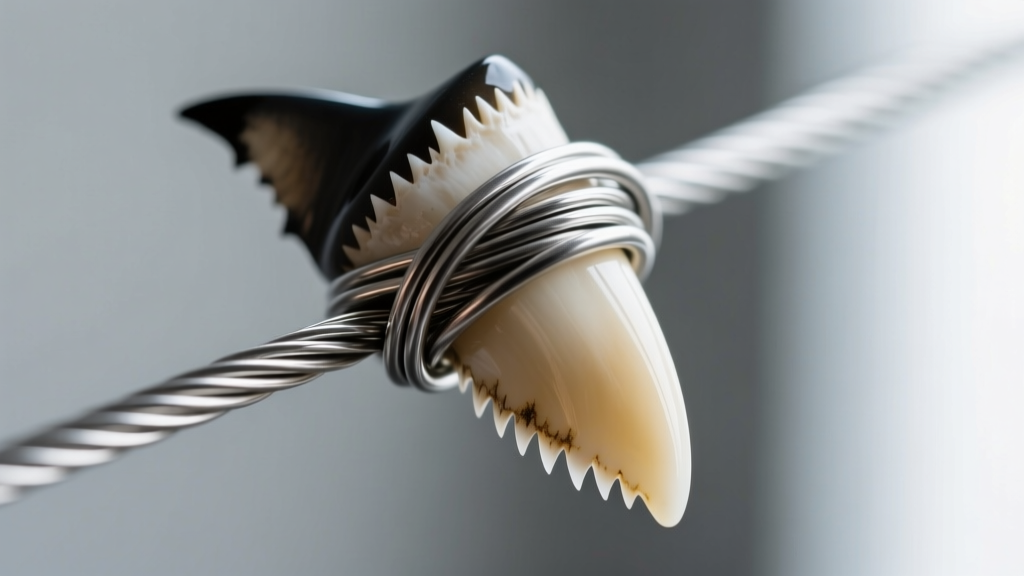
The industry standard for high-end, saltwater-safe wrapping is 0.8mm to 1.0mm waxed polyester cord (often sold under brand names like Linhasita). Polyester is inherently hydrophobic, meaning it does not absorb water, and the wax coating provides an additional barrier against UV degradation and salt crystallization. When wrapping a tooth, utilize a non-abrasive technique. Shark enameloid, while hard, can be scratched by harsh wire bindings. Expert wire-wrappers use 20-gauge dead-soft titanium wire, applying a small dab of clear, marine-grade epoxy (such as 3M DP8010) at the stress points to secure the wrap without relying solely on the tension of the wire, which can slip when wet.
Expert Verdict: Navigating the Market in 2026
The shark tooth necklace calamity serves as a stark reminder that organic jewelry requires rigorous consumer due diligence. By prioritizing fossilized specimens, employing thermal and UV forensic tests to weed out polyurethane fakes, and insisting on 316L stainless steel or titanium hardware paired with waxed polyester cordage, you can acquire a piece of oceanic history that is both ethically sound and structurally immortal. Demand transparency from jewelers, ask for CITES documentation on modern teeth, and refuse to settle for resin replicas masquerading as the real thing.


