Sideways Cross on Necklace: Expert Guide to Fit, Bail & Metals
Master the engineering of a sideways cross on necklace. Explore bail mechanics, metal hardness, chain pairing, and structural durability.


The horizontal cross pendant has evolved from a fleeting celebrity trend into a permanent staple of modern jewelry design. However, rotating a traditional symbol 90 degrees introduces unique structural and mechanical challenges that many mass-market jewelers ignore. When you wear a sideways cross on necklace chains, the physics of gravity, torque, and friction change entirely. A standard vertical cross hangs from a top loop, utilizing a natural pendulum effect to stay centered. A horizontal cross, conversely, relies on precise center-of-mass engineering to maintain its alignment. In this expert deep dive, we deconstruct the metallurgy, bail mechanics, and chain-pairing dynamics required to execute this design flawlessly.
The Physics of the Horizontal Bail
The most critical point of failure on any horizontal pendant is the bail—the loop that connects the metal cross to the chain. For a sideways cross to lay perfectly flat against the sternum, the bail must be positioned at the exact horizontal and vertical center of gravity. If the bail is off by even 0.5 millimeters, the heavier arm of the cross will drag downward, resulting in a perpetually tilted pendant.
Integrated vs. Soldered Bails
There are two primary manufacturing methods for these bails. An integrated bail is cast or struck as a single continuous piece with the cross itself, usually featuring a horizontal tube that the chain threads directly through. This offers the lowest profile and prevents flipping. A soldered jump ring, on the other hand, is attached to the back or top edge post-manufacturing. While cheaper to produce, soldered rings on horizontal pendants are highly susceptible to shear stress. According to manufacturing standards outlined by the Gemological Institute of America (GIA), the solder joint on a jump ring is often the weakest point of the assembly, particularly when subjected to the lateral pulling forces unique to horizontal designs.
Material Science: Casting vs. Die-Striking
The durability of the thin, elongated arms of a horizontal cross depends heavily on how the metal is formed. Most commercial jewelry is cast using the lost-wax method, which can leave microscopic porosity within the gold or silver. When the arms of a sideways cross are cast too thin (under 1.2mm), this porosity creates structural weak points that can snap if the pendant catches on clothing.
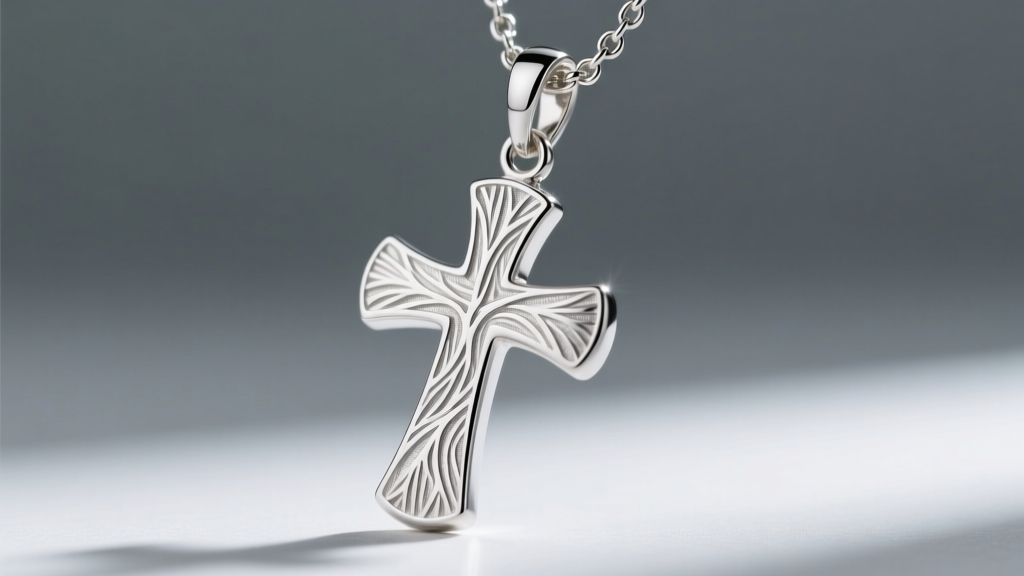
For superior durability, experts recommend seeking out die-struck pendants. Die-striking involves subjecting a sheet of metal to immense pressure (often tens of thousands of pounds per square inch) between two hardened steel dies. This process compresses the metal's grain structure, resulting in a work-hardened piece that is significantly denser and more resistant to bending. A 14k yellow gold die-struck cross will exhibit a Vickers hardness (HV) of approximately 130-150, whereas a cast equivalent might only reach 110-120 HV. This density is crucial for maintaining the rigid, straight lines required for the horizontal aesthetic.
Chain Pairing and Torque Resistance
Pairing the wrong chain with a sideways cross on necklace configurations is the leading cause of pendant 'flipping' and bail wear. The chain must glide freely through the bail without creating friction locks. If the chain is too thick, it acts as a rigid lever, forcing the cross to tilt whenever the wearer turns their head. Below is a technical breakdown of chain compatibility for horizontal pendants.
| Chain Type | Optimal Thickness | Torque Resistance | Expert Verdict |
|---|---|---|---|
| Cable Chain | 0.9mm - 1.2mm | High | Ideal. Uniform round links allow 360-degree rotation within the bail. |
| Box Chain | 1.0mm - 1.5mm | Low | Avoid. Square links create friction and can kink under horizontal torque. |
| Rope Chain | 1.5mm - 2.0mm | Medium | Good for heavier crosses, but the twisted texture can wear down soft gold bails. |
| Wheat Chain | 1.0mm - 1.2mm | High | Excellent. The woven, directional links provide fluid movement and high tensile strength. |
When selecting a chain, always measure the inner diameter of the pendant's bail. The chain's width should be no more than 70% of the bail's inner diameter to ensure a frictionless glide. For example, a bail with a 1.5mm inner diameter requires a chain no thicker than 1.05mm.
Sizing and Proportion Framework
The visual impact of a horizontal cross relies on strict proportional rules. Because the human eye reads horizontal lines as wider and heavier than vertical lines, a sideways cross must be scaled down compared to its traditional counterpart to achieve the same visual weight.
- The Subtle Everyday (10mm - 14mm width): Best suited for 14k or 18k solid gold with a high-polish finish. At this scale, the cross acts as a minimalist geometric shape rather than an overt religious symbol, perfect for layering with 16-inch chokers or 18-inch princess chains.
- The Statement Proportion (18mm - 25mm width): Requires a thicker metal profile (at least 1.5mm depth) to prevent the piece from looking like stamped tin. Matte or sandblasted finishes work exceptionally well here to reduce light glare and emphasize the architectural lines.
- The Oversized Streetwear (30mm+ width): Must be hollowed out or crafted from lightweight materials like titanium or aerospace-grade aluminum to prevent the chain from bowing under the weight, which causes the clasp to slide to the front of the neck.

Troubleshooting Common Failure Modes
Even high-end jewelry can suffer from mechanical failures if the design parameters are ignored. Here is how to diagnose and prevent the most common issues associated with horizontal pendants.
The 'Flipping' Phenomenon
If your pendant continuously flips upside down or tilts at a 45-degree angle, the issue is almost always chain-to-bail friction. The chain is binding inside the bail, locking the pendant in place while the chain twists. The Fix: Switch to a smaller, smoother cable chain, or take the piece to a jeweler to have the bail reamed out and polished with a high-grit rouge to reduce internal friction.
Premature Tarnishing on Sterling Silver
Sterling silver sideways crosses are highly popular, but the horizontal orientation means the back of the pendant rests flush against the skin, trapping sweat and sebum. This accelerates the oxidation of the copper alloy in 925 silver. To combat this, ensure the piece features a thick rhodium plating (ideally 0.2 to 0.3 microns). The Federal Trade Commission (FTC) Jewelry Guides mandate accurate disclosure of metal platings, so always verify the rhodium thickness with the manufacturer to ensure long-term tarnish resistance.
Bail Shearing
If the bail snaps off the back of the cross, it is usually due to a combination of casting porosity and lateral stress. When a horizontal cross is yanked, the force is distributed unevenly across the solder joint. The Fix: Avoid pieces where the bail is merely glued or laser-welded with low penetration. Insist on pieces where the bail is either fully integrated into the CAD design prior to casting, or soldered using high-temperature hard solder that flows deeply into the joint.
Conclusion
Choosing the perfect sideways cross on necklace configurations requires looking past the aesthetic and understanding the underlying engineering. By prioritizing die-struck metals, calculating precise bail-to-chain ratios, and respecting the physics of horizontal center-of-mass alignment, you can secure a piece that not only makes a modern stylistic statement but withstands the mechanical rigors of daily wear. True luxury in jewelry is defined by the invisible details—the polished interior of a bail, the density of the gold grain, and the flawless horizontal drape against the collarbone.


